
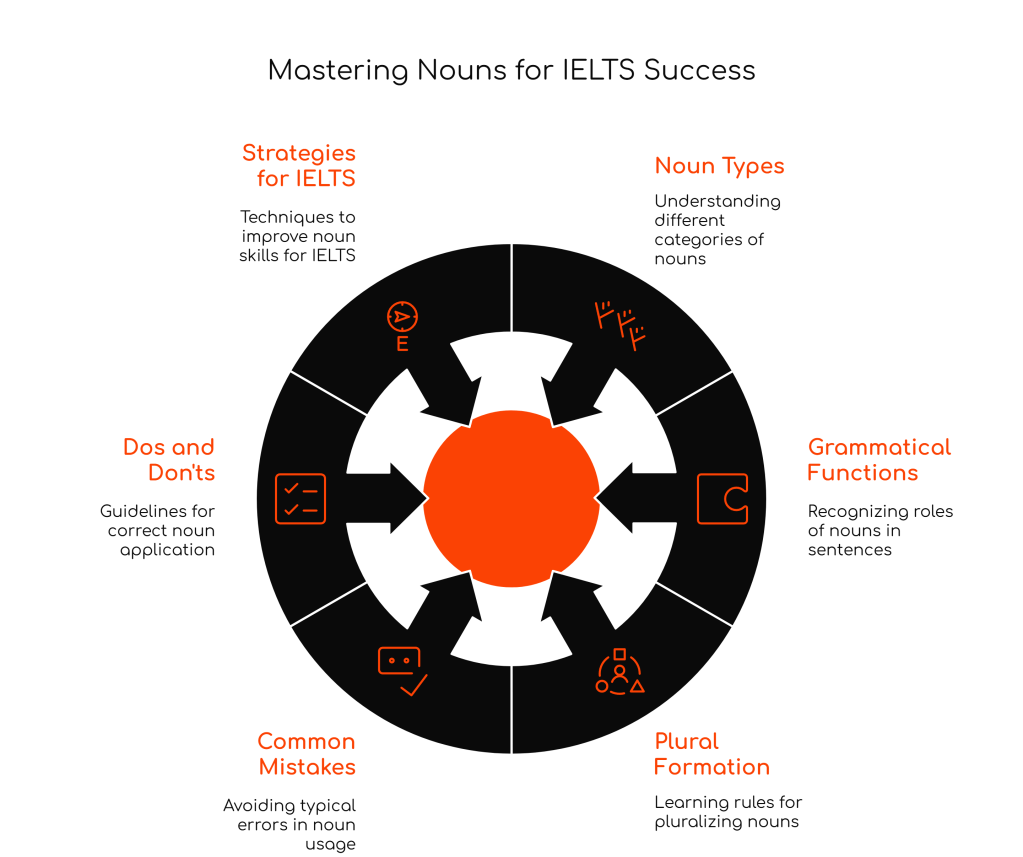
Nouns are the foundation of the English language. Without them, we couldn’t name people, places, objects, ideas, or actions. Whether you’re writing an IELTS essay, preparing a formal letter, or speaking in an interview, using nouns accurately and effectively will strengthen your communication. You can watch this YouTube video explainer by IELTS Guide Phil.
What Is a Noun?
A noun is a word used to name a person, place, thing, idea, quality, or activity.
Examples:
- People: teacher, doctor, Maria
- Places: London, school, library
- Things: book, table, phone
- Ideas/Concepts: freedom, success, honesty
Types of Nouns
1. Common Nouns
Definition: General names of people, places, or things.
Examples: city, boy, dog, country
2. Proper Nouns
Definition: Specific names of people, places, or things. Always capitalized.
Examples: Paris, IELTS, Microsoft, Dr. Smith
3. Concrete Nouns
Definition: Things you can see, touch, smell, hear, or taste.
Examples: flower, music, chocolate, dog
4. Abstract Nouns
Definition: Intangible ideas or qualities.
Examples: happiness, courage, education, love
5. Countable Nouns
Definition: Nouns that can be counted and made plural.
Examples: book/books, apple/apples
Use: many, few, a number of
6. Uncountable Nouns
Definition: Nouns that cannot be counted.
Examples: information, water, advice, luggage
Use: much, little, a piece of
7. Collective Nouns
Definition: Words that refer to groups.
Examples: team, family, jury, audience
Example Sentence: The team is winning. (treated as singular in American English)
How Nouns Function in Sentences
Nouns can serve different grammatical functions:
| Function | Example |
|---|---|
| Subject | The teacher explained the lesson. |
| Object | She loves chocolate. |
| Complement | He is a doctor. |
| Object of preposition | He sat on the chair. |
Forming Plurals
Most nouns: add -s
- dog → dogs
- pen → pens
Nouns ending in -s, -sh, -ch, -x, or -z: add -es
- box → boxes
- bus → buses
Nouns ending in -y after a consonant: change y to i + es
- baby → babies
- city → cities
Irregular plurals:
- man → men
- child → children
- tooth → teeth
- mouse → mice
Common Mistakes with Nouns
| Mistake | Why It’s Wrong | Correct Version |
|---|---|---|
| He gave me an advice. | “Advice” is uncountable | He gave me some advice. |
| Informations are important. | “Information” is uncountable | Information is important. |
| She has many luggages. | “Luggage” is uncountable | She has a lot of luggage. |
| The childs are playing. | Irregular plural | The children are playing. |
Dos and Don’ts for Using Nouns
Dos
- Do use articles (a, an, the) correctly with singular countable nouns.
- Do memorize irregular plural forms.
- Do distinguish between countable and uncountable nouns.
- Do capitalize proper nouns.
Don’ts
- Don’t pluralize uncountable nouns (e.g., advices, furnitures).
- Don’t forget articles (e.g., She is teacher → She is a teacher).
- Don’t use “a/an” with plural nouns.
Nouns in IELTS Writing and Speaking
- Use abstract nouns to express opinions: equality, freedom, technology, pollution
- Use specific proper nouns where appropriate: the United Nations, Google, the UK
- Use uncountable nouns with correct quantifiers:
✅ a piece of advice, a bit of information, a bottle of water
Top Strategies for Mastering Nouns for IELTS
- Keep a vocabulary notebook organized by noun type and theme.
- Read academic articles to see abstract and collective nouns in context.
- Practice rewriting sentences to change countable nouns to uncountable forms or vice versa.
- Use sample IELTS questions to practice noun accuracy in writing tasks.
Frequently Asked Questions
Q: Can a word be more than one type of noun?
A: Yes! For example, “school” is a place (concrete noun), but in “Education is important,” it’s part of the abstract noun “education.”
Q: Should I use ‘a’ or ‘an’ before abstract nouns?
A: Only if they’re countable in that context:
✅ a happiness (uncommon) ❌ → happiness (more natural)
Q: How do I make uncountable nouns plural in meaning?
A: Use partitive expressions:
- a piece of furniture
- a glass of water
- a piece of information
Quick Quiz: Test Your Knowledge
Choose the correct noun usage:
- I need (some / many / a) information. → ✅ some
- The (childs / children / childs’) are playing. → ✅ children
- She has (many / much / a lot of) luggage. → ✅ a lot of
Final Thoughts
Understanding how nouns work is crucial not only for acing the IELTS but also for mastering the English language in everyday life. Nouns help you name the world around you, convey abstract thoughts, and build grammatically sound sentences. Master them, and you’ll build a strong foundation for writing and speaking success.
Learn More with IELTS Guide Phil
- Listen on Spotify: IELTS Guide Phil Podcast
- Blog: ieltsguidephil.com
- Facebook: IELTS Guide Phil
- X/Twitter: @ieltsguidephil
- BlueSky: IELTS Guide Phil on BlueSky
#EnglishNouns #GrammarForIELTS #IELTSWriting #IELTSSpeaking #EnglishGrammar #CountableNouns #UncountableNouns #AbstractNouns #GrammarTips #IELTSGuidePhil #IELTS
 IELTS Guide Phil
Leave a comment