
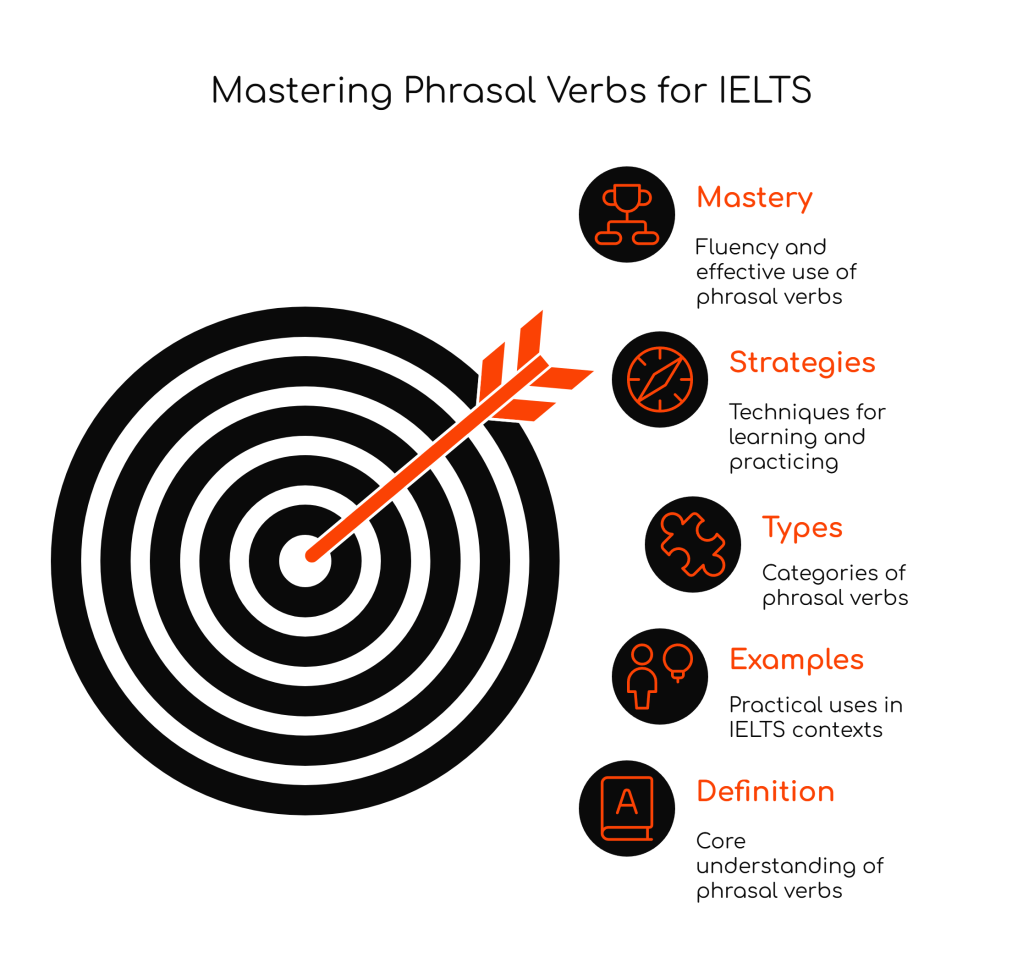
Whether you’re aiming for a Band 7+ in IELTS Speaking or trying to make your Writing more dynamic, phrasal verbs are indispensable tools. These multi-word expressions can enrich your language, but they can also be confusing. This in-depth guide helps you understand, use, and master phrasal verbs effectively.
What Are Phrasal Verbs?
A phrasal verb is made up of a main verb and one or more particles (prepositions or adverbs) that, when combined, change the original meaning of the verb.
Example:
- Break = to separate into pieces
- Break down = to stop functioning (mechanical failure)
“The bus broke down on the way to the IELTS center.”
Phrasal verbs are idiomatic, meaning the meaning is not literal—which makes them difficult for learners.
Types of Phrasal Verbs Explained
1. Transitive Phrasal Verbs (Require a direct object)
- “I put off the meeting.” (put off = postpone)
- These can sometimes be separated:
“I put the meeting off.”
2. Intransitive Phrasal Verbs (No direct object)
- “She woke up at 6 AM.”
3. Separable Phrasal Verbs
- The object can come between the verb and the particle.
- “Turn off the alarm.” or “Turn the alarm off.”
4. Inseparable Phrasal Verbs
- The verb and particle must stay together.
- “He ran into his professor.” (NOT “ran his professor into”)
5. Three-Word Phrasal Verbs
- Verb + two particles.
- “I look up to my father.” (respect)
- “She came down with the flu.”
Common Phrasal Verbs for IELTS Success
Grouped by IELTS-relevant topics:
Education
- Drop out – leave school before completing
- Hand in – submit (an assignment)
- Catch up – reach the level of others
Work
- Take on – accept responsibilities
- Lay off – dismiss due to downsizing
- Move up – get promoted
Health
- Come down with – become ill
- Pass out – faint
- Fight off – resist an illness
Travel
- Check in – register at a hotel or airport
- Set off – begin a journey
- Get away – go on vacation
Common Mistakes to Avoid
MistakeWhy It’s WrongCorrect Version
“He passed away his dog.““Pass away” is intransitive. | “His dog passed away.”
“I ran him into at the mall.”Incorrect word order. | “I ran into him at the mall.”
“I broke out the argument.“Wrong usage of phrasal verb. | “An argument broke out.”
“She called up to him.”“Call up” means to phone someone. | “She called out to him.”
Dos and Don’ts for IELTS
DO:
- Use phrasal verbs naturally in Speaking.
- Understand meaning + context before using.
- Include in Writing only when appropriate (especially in letters or informal essays).
DON’T:
- Use slangy phrasal verbs in Task 2 essays.
- Translate directly from your native language.
- Memorize lists without practicing in sentences.
Frequently Asked Questions (FAQs)
Are phrasal verbs formal or informal?
Most are informal, but some are neutral or even formal:
- Informal: “Give up,” “hang out”
- Neutral/Formal: “Carry out,” “go through,” “follow up”
Should I use phrasal verbs in IELTS Writing?
Use sparingly and appropriately:
- Good for General Training Letters
- Caution for Academic Writing Task 1 and 2: use formal alternatives when possible.
Are idioms and phrasal verbs the same?
No. Idioms are fixed expressions with figurative meanings (e.g., “kick the bucket”).
Phrasal verbs are verb-based expressions with their own grammatical rules.
Top Strategies for Mastery
Strategy 1: Learn Phrasal Verbs by Topic
This helps you recall relevant expressions when discussing IELTS themes.
Strategy 2: Practice in Full Sentences
Use them in mock Speaking and Writing exercises.
Strategy 3: Use Spaced Repetition Tools
Apps like Anki, Quizlet, or Memrise are great for review.
Strategy 4: Watch Native Content
TV shows, YouTube, and the IELTS Guide Phil Podcast feature tons of natural phrasal verbs.
Strategy 5: Make a Phrasal Verb Diary
Write down new ones daily with definitions and original example sentences.
Bonus: Formal Alternatives for IELTS Writing Task 2
Phrasal VerbFormal Equivalent
Give up | Surrender / Relinquish
Come up with | Propose / Develop
Go through | Experience / Undergo
Put off | Postpone / Delay
Find out | Discover / Determine
Final Thoughts
Mastering phrasal verbs is a game-changer for achieving fluency and impressing IELTS examiners. While they’re tricky at first, regular exposure, practice, and strategic usage will make them second nature.
Explore More with IELTS Guide Phil
- Read more grammar tips at: ieltsguidephil.com
- Listen to the IELTS Guide Phil Podcast on Spotify
- Follow IELTS Guide Phil on Facebook, X (Twitter), and BlueSky for daily lessons, quizzes, and motivation!
#IELTSGuidePhil #PhrasalVerbsForIELTS #IELTSGrammarTips #EnglishPhrasalVerbs #IELTSSpeakingVocabulary #GrammarForIELTS #FluentEnglish #LearnEnglishOnline #IELTSTopTips #IELTS
 IELTS Guide Phil
Leave a comment