
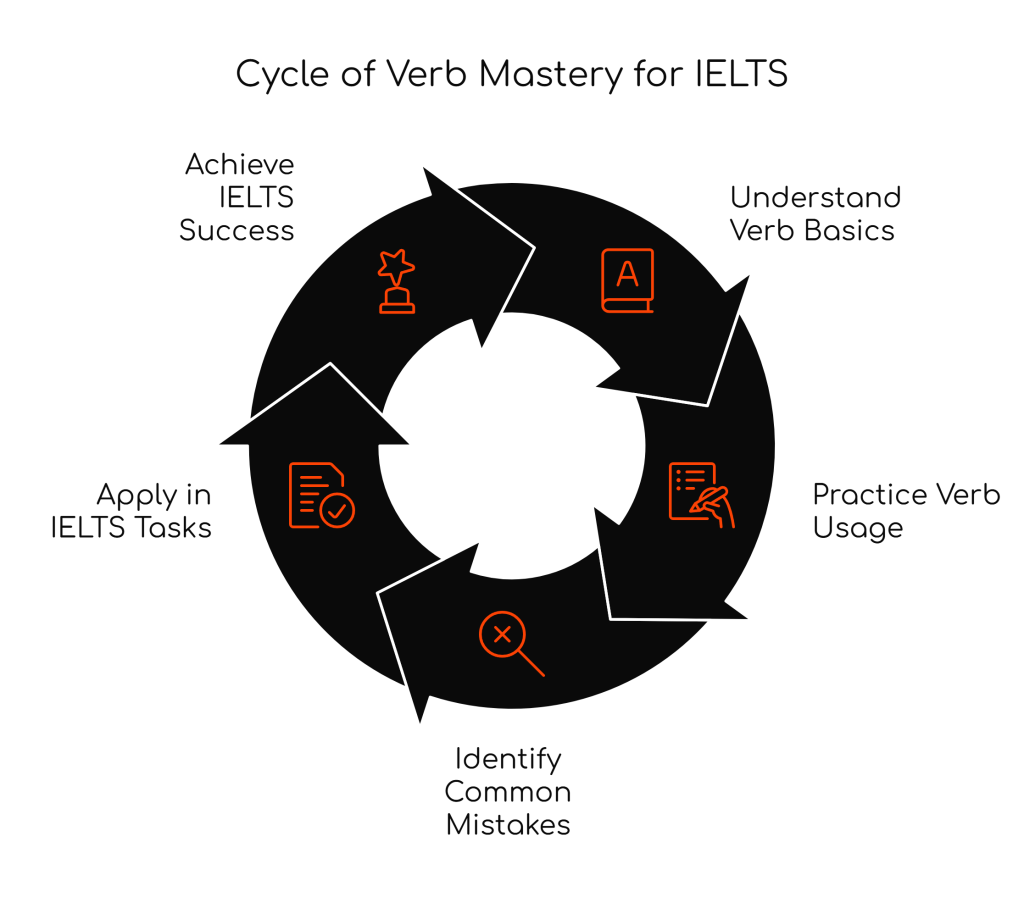
Verbs are the heart of English sentences. They describe actions, states, and occurrences—making them essential in both written and spoken English. A strong command of verbs can dramatically boost your IELTS Writing and Speaking scores, helping you express ideas clearly and accurately. You can watch this YouTube video explainer by IELTS Guide Phil.
What Is a Verb?
A verb is a word that expresses an action, state, or occurrence. Every complete sentence must have at least one verb.
Examples:
- She writes every day.
- They are tired.
- It rained last night.
Types of Verbs in English
1. Action Verbs (Dynamic Verbs)
Describe physical or mental actions.
Examples:
- He runs every morning.
- I think about the future often.
2. Stative Verbs
Express a state or condition rather than an action.
Examples:
- I know the answer.
- She believes in hard work.
- It seems strange.
Note: Stative verbs are rarely used in continuous (–ing) forms.
3. Transitive and Intransitive Verbs
- Transitive verbs need a direct object.
She reads a book. - Intransitive verbs do not need an object.
He sleeps peacefully.
Some verbs can be both:
- She runs (intransitive).
- She runs a business (transitive).
4. Linking Verbs
Connect the subject with additional information (not action).
Common linking verbs: be, seem, appear, become, feel, grow, look, sound, taste
Examples:
- She is a doctor.
- He seems tired.
5. Auxiliary (Helping) Verbs
Used with main verbs to show tense, voice, mood.
Primary auxiliaries: be, have, do
Modal auxiliaries: can, could, may, might, must, shall, should, will, would
Examples:
- They have finished.
- She is studying.
- You should call him.
6. Modal Verbs
Express ability, possibility, necessity, or advice.
| Modal | Usage | Example |
|---|---|---|
| can | ability/permission | I can swim. |
| should | advice | You should rest. |
| must | obligation | You must wear a seatbelt. |
| might | possibility | It might rain. |
7. Phrasal Verbs
Verb + preposition/adverb = new meaning
Examples:
- Give up = quit
- Take off = remove (clothing) or depart (airplane)
- Look after = care for
📝 Common in IELTS Speaking but should be used wisely in Writing.
Verb Tenses Overview
Understanding verb tenses is crucial for accuracy and cohesion in IELTS Writing and Speaking.
| Tense | Example | Usage |
|---|---|---|
| Present Simple | I work at a bank. | Habits, facts |
| Present Continuous | I am studying now. | Current actions |
| Past Simple | She visited Rome. | Finished actions in the past |
| Present Perfect | They have lived here. | Past action with present relevance |
| Future Simple | He will come tomorrow. | Predictions, future decisions |
There are 12 major tenses in English. Mastering their forms and usage helps ensure grammatical range and accuracy in IELTS.
Common Verb Mistakes
| Mistake | Why It’s Wrong | Correct Version |
|---|---|---|
| He go to school every day. | Incorrect verb form (subject-verb agreement) | He goes to school every day. |
| I have saw the movie. | Wrong past participle | I have seen the movie. |
| She can sings well. | Modal verb + base form rule broken | She can sing well. |
| He is know the answer. | Misuse of continuous with stative verb | He knows the answer. |
Dos and Don’ts of Verb Usage
Dos
- Use the correct verb tense for time references.
- Use auxiliary verbs properly in questions and negatives.
- Match subject and verb (He does, not He do).
- Vary your verbs in writing to avoid repetition.
Don’ts
- Don’t mix tenses without reason.
- Don’t overuse phrasal verbs in formal writing.
- Don’t use base forms after modals incorrectly.
- Don’t ignore irregular past forms (go → went, not goed).
Top Strategies for IELTS Success
IELTS Writing Task 2
- Use a variety of tenses to show cause-effect (present perfect, past simple, future).
- Employ modals for making suggestions or expressing certainty.
- Avoid repetition—use synonyms and paraphrasing with varied verbs.
IELTS Speaking
- Use phrasal verbs naturally in informal parts (Part 1 and 2).
“I look forward to the weekend.” - Show tense control when telling stories or describing routines.
- Use modals for speculating in Part 3.
“It might improve in the future.”
Frequently Asked Questions
Q: How do I know when to use “have” or “has”?
A: Use “has” with he, she, it and “have” with I, you, we, they.
- She has a car.
- They have two pets.
Q: What’s the difference between “do,” “does,” and “did”?
A:
- Do/does = present tense auxiliaries
- Did = past tense
- Does is used with he, she, it
- Do with I, you, we, they
Example: Does she play piano? / Did they go yesterday?
Q: Can I use “will” with “if” in conditionals?
A: Avoid using “will” in the if-clause of first conditionals.
- ❌ If he will come, we’ll start.
- ✅ If he comes, we’ll start.
Mini Quiz: Test Your Verb Knowledge
- She ______ (go) to the gym every morning.
→ goes - They ______ (be) to Japan twice.
→ have been - I ______ (study) when you called.
→ was studying - He ______ (not do) his homework yet.
→ has not done - You ______ (must / go) to the doctor.
→ must go
Final Thoughts
Verbs are the core of expression in English. From complex tense structures to everyday action words, mastering verbs gives you the grammatical confidence needed to perform well in all parts of the IELTS test. Keep practicing, pay attention to form and meaning, and you’ll see noticeable improvement in both fluency and accuracy.
Keep Learning with IELTS Guide Phil
- Spotify: IELTS Guide Phil Podcast
- Blog: ieltsguidephil.com
- Facebook: IELTS Guide Phil
- X (Twitter): @ieltsguidephil
- BlueSky: IELTS Guide Phil on BlueSky
#EnglishVerbs #GrammarForIELTS #VerbTenses #IELTSWriting #IELTSSpeaking #AuxiliaryVerbs #PhrasalVerbs #IELTSGrammarTips #IELTSGuidePhil #IELTS
 IELTS Guide Phil
Leave a comment