
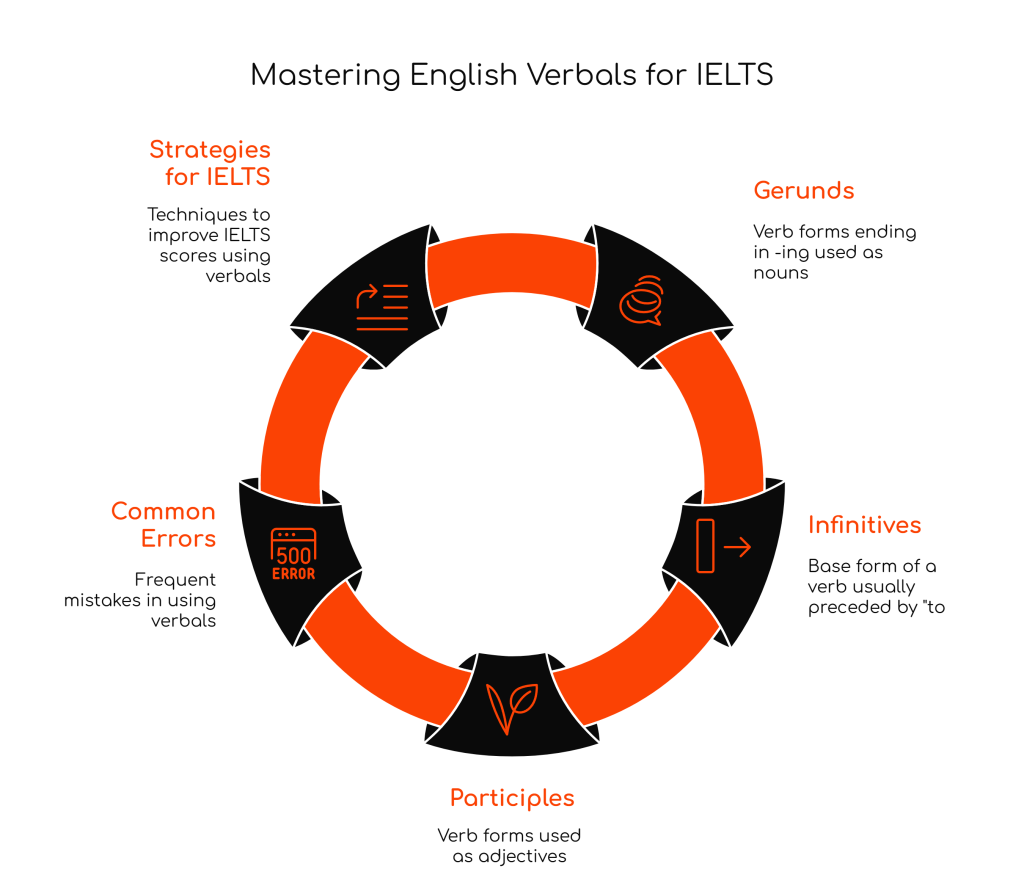
Understanding English verbals is crucial for achieving high scores in the IELTS Writing and Speaking sections. Verbals are verb forms that function as other parts of speech—nouns, adjectives, or adverbs. Though they look like verbs, they don’t act as the main verb in a sentence. Mastering them allows for more precise and varied expression, a must for high-band IELTS responses.
What Are Verbals?
Verbals are verb forms that do not function as the main verb in a clause. Instead, they function as nouns, adjectives, or adverbs. The three types of verbals are:
- Gerunds
- Infinitives
- Participles
Each plays a unique role in sentence structure and meaning.
1. Gerunds
Definition: A gerund is the –ing form of a verb used as a noun.
Examples:
- Swimming is good for your health.
- She enjoys reading historical fiction.
Common Uses:
- As a subject: Reading helps improve vocabulary.
- After certain verbs: She enjoys dancing.
- After prepositions: He is good at drawing.
Common Mistakes:
❌ I avoid to eat junk food.
✅ I avoid eating junk food.
Dos and Don’ts:
Do use gerunds after prepositions.
Don’t confuse gerunds with present participles.
2. Infinitives
Definition: An infinitive is the base form of a verb, usually preceded by “to.”
Examples:
- I want to study in Canada.
- It’s important to speak clearly.
Common Uses:
- As a subject: To learn another language is rewarding.
- After certain verbs: She decided to leave early.
- To express purpose: He studies hard to pass the exam.
Common Mistakes:
❌ She suggested to meet later.
✅ She suggested meeting later.
Dos and Don’ts:
Do use infinitives after adjectives (e.g., It’s hard to understand.)
Don’t use infinitives when the verb requires a gerund (e.g., avoid eating, not avoid to eat).
3. Participles
Definition: A participle is a verb form used as an adjective. There are present (–ing) and past (–ed, –en, etc.) participles.
Present Participles
Examples:
- The crying baby kept everyone awake.
- We saw a burning building.
Past Participles
Examples:
- The broken window needs repair.
- Frightened, she called the police.
Common Uses:
- As adjectives: The fascinating book kept me up all night.
- In participial phrases: Walking through the park, I saw squirrels.
Common Mistakes:
❌ He was interesting in the project.
✅ He was interested in the project.
Dos and Don’ts:
Do use participles for variety in sentence structure.
Don’t confuse -ing adjectives (exciting, boring) with -ed ones (excited, bored).
Common Errors with Verbals
| Mistake | Correction |
|---|---|
| I enjoy to read. | I enjoy reading. |
| She suggested to go. | She suggested going. |
| The movie was boring. I am boring. | I am bored. The movie was boring. |
Top Strategies for IELTS Success
- Use Verbals for Sentence Variety
- Avoid repetitive sentence structures by integrating verbals into your writing.
- Practice Transforming Sentences
- Convert simple sentences into complex ones using participles and infinitives.
- Master Verb Patterns
- Know which verbs are followed by gerunds vs. infinitives (e.g., enjoy doing vs. hope to do).
- Listen for Verbals in IELTS Listening
- Practice identifying verbals to understand relationships between ideas.
- Use in IELTS Speaking for Fluency and Range
- “I’m trying to improve my pronunciation.”
- “Learning a language takes time.”
Frequently Asked Questions (FAQs)
Q1: Can a sentence have more than one verbal?
Yes! Example: Learning to speak well requires practicing often.
Q2: How do I know if a verb takes a gerund or infinitive?
Memorize patterns or consult a verb list. For example:
- Gerunds: enjoy, avoid, suggest
- Infinitives: want, need, decide
Q3: Is a verbal the same as a verb?
No. A verb shows action or state of being. A verbal looks like a verb but acts as a noun, adjective, or adverb.
Final Thoughts
Verbals add depth, precision, and fluency to your English. Whether you’re writing an academic essay or speaking in a high-stakes IELTS interview, using gerunds, infinitives, and participles effectively will help you stand out. Don’t just memorize forms—practice them in real context.
Explore More with IELTS Guide Phil
For grammar deep dives, tips, and real IELTS practice:
- Visit the blog: ieltsguidephil.com
- Follow on Facebook, X, and BlueSky
- Subscribe to the IELTS Guide Phil Podcast on Spotify for grammar lessons and IELTS strategies on the go!
#IELTSGrammar #VerbalsExplained #EnglishForIELTS #IELTSSuccess #StudySmart #IELTSGuidePhil #GrammarTips #IELTSPrep #AcademicEnglish #LearnEnglishOnline #IELTS
 IELTS Guide Phil
Leave a comment