
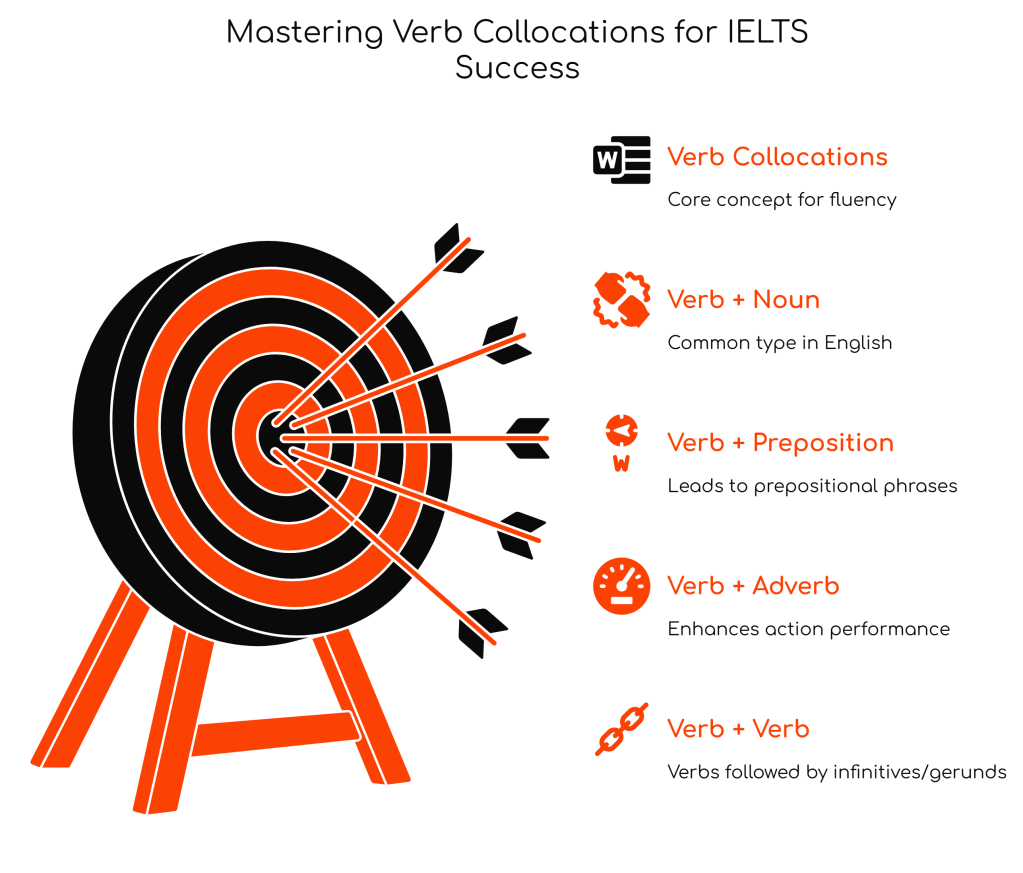
When preparing for the IELTS exam, mastering vocabulary is important—but using the right verb collocations is what elevates your fluency and coherence to a higher band score. Verb collocations are natural combinations of verbs with nouns, adjectives, or prepositions that native speakers use instinctively. Understanding and applying these will significantly enhance your writing and speaking skills. You can watch this YouTube video explainer by IELTS Guide Phil.
What Are Verb Collocations?
A verb collocation is a pair or group of words that are often used together in English, especially in the form of a verb + noun, verb + preposition, or verb + adverb. These word combinations sound “right” to native speakers.
Examples:
- Make a decision (not “do a decision”)
- Take responsibility (not “make responsibility”)
- Pay attention (not “give attention”)
Types of Verb Collocations
1. Verb + Noun
This is the most common type in both formal and informal English.
- Make a mistake
- Have a shower
- Take a break
- Give a speech
2. Verb + Preposition
These collocations often lead into prepositional phrases.
- Rely on someone
- Apologize for something
- Believe in yourself
- Succeed at something
3. Verb + Adverb
These enhance how an action is performed.
- Speak fluently
- Drive carefully
- Whisper softly
- Work hard
4. Verb + Verb
Certain verbs are followed by infinitive or gerund forms of another verb.
- Want to go
- Enjoy reading
- Avoid talking
- Decide to move
Common Examples for IELTS
| Verb Collocation | Example Sentence |
|---|---|
| Make progress | She made remarkable progress in her IELTS preparation. |
| Take notes | Always take notes during the Listening test. |
| Do research | I did extensive research before writing my Task 2 essay. |
| Give feedback | The examiner gave me constructive feedback on my speaking. |
| Break the ice | I tried to break the ice by smiling during Part 1. |
Common Mistakes
| Incorrect Collocation | Correct Collocation |
|---|---|
| Do a decision | Make a decision |
| Give a bath | Have a bath / Take a bath |
| Make an exam | Take an exam |
| Do progress | Make progress |
Dos and Don’ts
Do:
- Learn collocations in context (through reading/listening).
- Use collocations in both Speaking and Writing for natural expression.
- Practice using IELTS-related topics: environment, education, technology, etc.
Don’t:
- Translate directly from your native language.
- Rely only on individual vocabulary—focus on word partnerships.
- Overuse basic collocations like “do” or “make”; learn specific ones instead.
Frequently Asked Questions (FAQs)
Q1: Are collocations important for IELTS?
Yes. Collocations improve your lexical resource score by showing natural and appropriate language use.
Q2: How can I learn verb collocations?
Read IELTS essays and listen to podcasts, noting down common collocations. Use apps like Quizlet or Anki for spaced repetition.
Q3: Should I memorize lists?
Yes and no. Memorize with contextual examples, not isolated lists.
Q4: Are some collocations more formal?
Absolutely. For example:
- Give a speech (neutral/formal)
- Have a chat (informal)
Choose collocations appropriate for IELTS Writing (formal) and Speaking (semi-formal to informal).
Top Strategies for IELTS Success with Collocations
- Read IELTS model essays and highlight collocations.
- Keep a vocabulary notebook of useful collocations by theme (e.g., Health, Environment).
- Practice using 3–5 collocations per day in speaking or writing exercises.
- Record yourself using collocations and analyze your fluency.
- Join online IELTS groups to exchange practice responses and spot collocations.
Final Thoughts
Mastering verb collocations isn’t just about sounding more natural—it’s about scoring higher in Lexical Resource, Grammatical Range and Accuracy, and Fluency and Coherence. Whether you’re aiming for Band 7.0 or beyond, integrating natural word combinations into your English will give you a decisive edge.
Ready to take your IELTS preparation further? Explore more lessons and strategies on:
- IELTSGuidePhil.com
- IELTS Guide Phil on Spotify
- IELTS Guide Phil on Facebook
- IELTS Guide Phil on BlueSky
- IELTS Guide Phil on X (Twitter)
#IELTSVocabulary #VerbCollocations #IELTSWritingTips #IELTSSpeakingSkills #AcademicEnglish #LearnCollocations #FluencyBooster #GrammarMatters #IELTSPreparation #IELTSGuidePhil
 IELTS Guide Phil
Leave a comment