
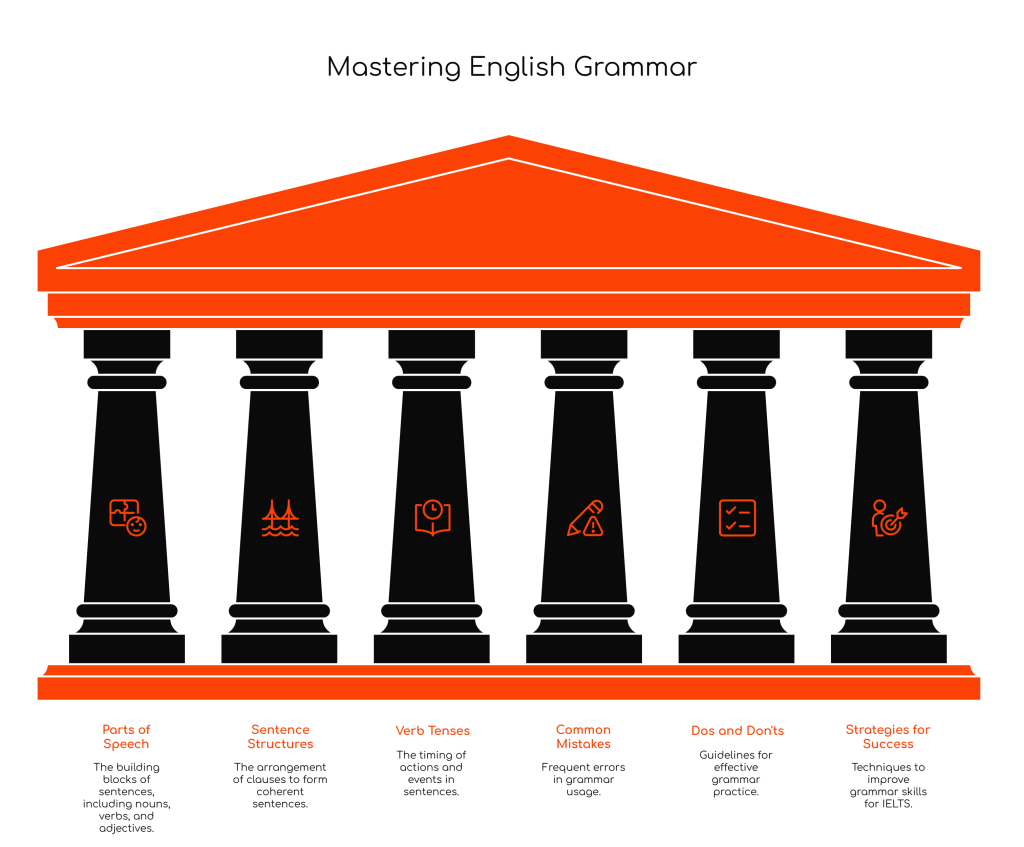
English grammar is more than a set of rules—it’s a powerful tool for expressing thoughts with clarity, precision, and impact. Whether you’re preparing for the IELTS exam or aiming to enhance your academic and professional English, mastering grammar will transform your communication skills. You can watch this YouTube video explainer by IELTS Guide Phil.
What Is English Grammar?
English grammar is the system of rules and structures that govern how words are used to form sentences. It helps you:
- Communicate ideas logically
- Avoid misunderstandings
- Convey tone and intent
- Achieve higher scores in tests like IELTS
The 8 Parts of Speech (Expanded with Extra Examples)
1. Nouns
Definition: Words that name people, places, things, or ideas.
Examples:
- Common nouns: cat, school, happiness
- Proper nouns: London, IELTS, Microsoft
- Abstract nouns: freedom, knowledge, love
2. Pronouns
Definition: Words that take the place of nouns to avoid repetition.
Types:
- Subject pronouns: I, you, he, she
- Object pronouns: me, him, her
- Possessive pronouns: mine, yours, theirs
Example: Maria is a teacher. She teaches English.
3. Verbs
Definition: Words that express action or state.
Types:
- Action verbs: run, write, explain
- Linking verbs: be, seem, become
- Helping verbs: has, will, can
Example: She has written three essays.
4. Adjectives
Definition: Words that describe nouns.
Types:
- Descriptive: intelligent, red, fast
- Quantitative: many, few, several
Example: The large, red apple was delicious.
5. Adverbs
Definition: Words that modify verbs, adjectives, or other adverbs.
Types:
- Manner: quickly, carefully
- Frequency: always, never
- Time: now, soon
Example: He speaks very fluently.
6. Prepositions
Definition: Words that show relationships between other words in a sentence.
Examples: in, on, under, between, during
Example: The book is on the table.
7. Conjunctions
Definition: Words that connect words, phrases, or clauses.
Types:
- Coordinating: and, but, or
- Subordinating: although, because, while
Example: I stayed home because it was raining.
8. Interjections
Definition: Words that express emotions or sudden exclamations.
Examples: wow, ouch, hey, oh
Example: Wow! That essay was outstanding!
Sentence Structures
- Simple Sentence – One independent clause
Example: I studied for the IELTS. - Compound Sentence – Two independent clauses joined by a conjunction
Example: I studied hard, and I passed the test. - Complex Sentence – One independent clause and at least one dependent clause
Example: Because I studied, I passed the exam. - Compound-Complex Sentence – Two independent clauses and at least one dependent clause
Example: I studied hard because I wanted to succeed, and I passed the test.
Tenses: A Quick Breakdown
Understanding verb tenses is crucial in IELTS Writing and Speaking. Here’s a summary:
| Tense | Usage | Example |
|---|---|---|
| Present Simple | General facts | She writes essays every day. |
| Present Continuous | Actions happening now | She is writing now. |
| Present Perfect | Past actions with relevance to present | She has written many essays. |
| Past Simple | Completed actions in the past | She wrote an essay yesterday. |
| Future Simple | Actions that will happen | She will write an essay tomorrow. |
| Future Perfect | Actions that will be completed in the future | She will have written ten essays by Friday. |
Common Grammar Mistakes (Expanded)
- Using “a” vs. “an” incorrectly:
❌ an university → ✅ a university - Confusing verb tenses:
❌ I have saw the movie. → ✅ I have seen the movie. - Misplacing modifiers:
❌ She almost ate all the cake. → ✅ She ate almost all the cake. - Run-on sentences:
❌ I studied I passed. → ✅ I studied, and I passed. - Comma splices:
❌ It was raining, I stayed inside. → ✅ It was raining, so I stayed inside.
Grammar Dos and Don’ts (Expanded)
Dos
- Do review basic grammar rules regularly.
- Do use grammar checkers (e.g., Grammarly) as a learning tool.
- Do speak and write daily to apply grammar in context.
- Do read quality texts (articles, books) to learn by example.
Don’ts
- Don’t memorize rules without context.
- Don’t avoid new grammar structures out of fear.
- Don’t translate directly from your native language.
- Don’t rely on shortcuts or cheat sheets alone.
Top Strategies for IELTS Grammar Success
- Practice paraphrasing to vary grammar and sentence structure.
- Use linking words for coherence: however, moreover, in contrast, etc.
- Record yourself speaking and listen for grammar errors.
- Join English groups to engage in grammar-rich conversation.
- Review feedback from teachers or writing apps carefully.
Frequently Asked Questions
Q: How much grammar should I focus on for IELTS?
A: Grammar is 25% of your Writing and Speaking score. Aim for a balance of accuracy and variety.
Q: Should I use passive voice in IELTS?
A: Yes, when appropriate—especially in Academic Writing Task 1.
Q: What grammar books do you recommend?
A:
- English Grammar in Use by Raymond Murphy
- Oxford Practice Grammar
- Collins Grammar for IELTS
IELTS Grammar Sample Correction
Original: There is many problems in the system.
Corrected: There are many problems in the system.
Original: If I will go there, I will see her.
Corrected: If I go there, I will see her. (Zero or First Conditional)
Final Thoughts
Grammar is your ally—not your enemy—in IELTS preparation. With regular practice, feedback, and exposure to real-world examples, you can significantly enhance your grammatical accuracy and flexibility. Remember, a good command of grammar helps you not just pass IELTS, but also thrive in academic and professional settings.
Learn More with IELTS Guide Phil
- Listen on Spotify: IELTS Guide Phil Podcast
- Read in-depth posts: ieltsguidephil.com
- Join us on Facebook: IELTS Guide Phil
- Follow on X: @ieltsguidephil
- Connect on BlueSky: IELTS Guide Phil on BlueSky
All content written, created, and produced by IELTS Guide Phil – your trusted partner in IELTS preparation.
#EnglishGrammar #IELTSGrammar #GrammarTips #GrammarMistakes #GrammarForIELTS #IELTSPreparation #StudyEnglish #AcademicEnglish #IELTSGuidePhil #GrammarSuccess #IELTS
 IELTS Guide Phil
Leave a comment