
Everything You Need to Know: Types, Examples, Common Mistakes, and Expert Tips
Understanding and using conditionals correctly is essential for achieving a high score on the IELTS exam. Whether you’re writing essays, answering speaking questions, or interpreting written texts, conditionals help you express cause, effect, possibility, and hypothetical scenarios—key functions in both Academic and General Training IELTS.
What Are English Conditionals?
Conditionals are sentence structures used to discuss possible or hypothetical situations and their consequences. They often contain an “if clause” (condition) and a “main clause” (result).
Example:
If you study hard, you will pass the IELTS exam.
Types of Conditionals (With Expanded Examples)
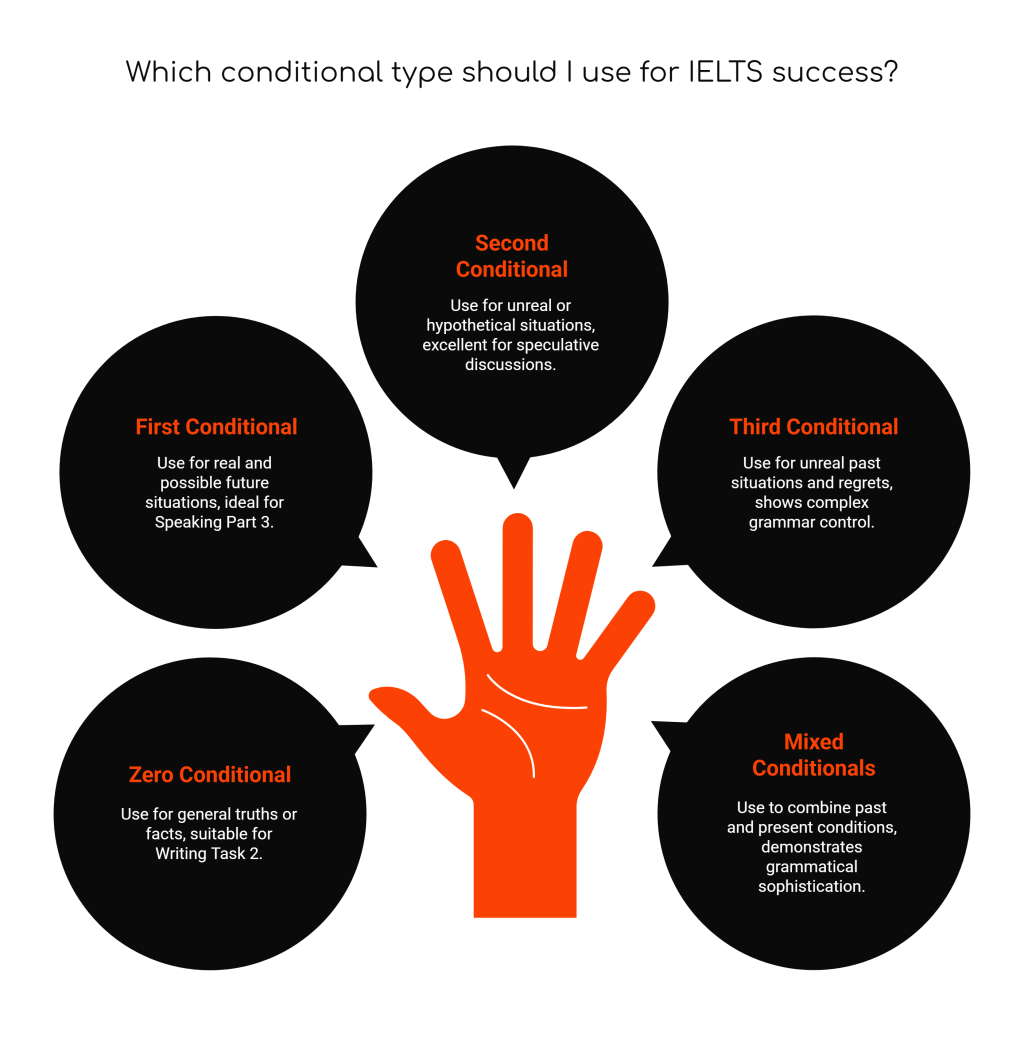
1. Zero Conditional (General Truths or Facts)
Structure: If + present simple, present simple
Usage: To talk about facts, habits, or universal truths.
Example:
If water reaches 100°C, it boils.
If you don’t eat, you get hungry.
IELTS Tip: Useful in Writing Task 2 when presenting facts or scientific truths.
2. First Conditional (Real and Possible Future Situations)
Structure: If + present simple, will + base verb
Usage: To express future possibilities that are likely to happen.
Example:
If I get a Band 7, I will apply to a university abroad.
If it rains tomorrow, the exam may be postponed.
IELTS Tip: Great for Speaking Part 3 when discussing future plans or consequences.
3. Second Conditional (Unreal or Hypothetical Present/Future Situations)
Structure: If + past simple, would/could/might + base verb
Usage: To discuss imaginary or unlikely situations.
Example:
If I were the examiner, I would focus more on fluency.
If I had more time, I would practice writing every day.
IELTS Tip: Excellent for speculative discussions in Writing Task 2 or Speaking Part 3.
4. Third Conditional (Unreal Past Situations and Regrets)
Structure: If + past perfect, would/could/might have + past participle
Usage: To describe hypothetical past outcomes.
Example:
If I had practiced more, I would have scored higher.
If she had known the format, she could have prepared better.
IELTS Tip: Shows complex grammar control, ideal for high scores in writing and speaking.
5. Mixed Conditionals
Structure: Combine elements of second and third conditionals.
Usage: To describe past conditions with present results, or vice versa.
Examples:
- If I had taken the IELTS course, I would be more confident now. (Past condition → Present result)
- If I were more confident, I would have spoken better during the test. (Present condition → Past result)
IELTS Tip: Demonstrates grammatical sophistication and coherence.
Common Mistakes with Conditionals
- Incorrect verb tenses:
Wrong: If I will see her, I will tell her.
Right: If I see her, I will tell her. - Mixing conditional types randomly:
Wrong: If I study hard, I would pass.
Right: If I studied hard, I would pass. - Using ‘was’ instead of ‘were’ in the 2nd conditional:
Wrong: If I was rich, I would travel.
Right: If I were rich, I would travel. - Missing ‘if’ clause altogether:
Wrong: Would travel more, had more time.
Right: If I had more time, I would travel more.
Do’s and Don’ts
Do:
- Practice all types of conditionals with IELTS-specific topics.
- Use mixed conditionals to show complexity in writing/speaking.
- Familiarize yourself with both formal and informal uses.
Don’t:
- Overuse conditionals in one paragraph or answer.
- Confuse the second and third conditionals.
- Forget subject-verb agreement and correct punctuation.
? Frequently Asked Questions (FAQs)
Q1: Are conditionals required in IELTS Writing and Speaking?
Yes, especially for higher band scores. They demonstrate grammatical range and accuracy.
Q2: Can I use contractions in conditionals during the Speaking test?
Yes, contractions (e.g., I’d, he’d) are natural in spoken English and perfectly acceptable.
Q3: Which conditional is best for expressing opinions?
The second conditional is ideal for expressing imagined solutions or alternative ideas in Task 2 or Speaking Part 3.
Top Strategies for IELTS Success Using Conditionals
- Use second conditionals to hypothesize or give opinions:
If governments invested more in education, society would benefit greatly. - Use third conditionals to discuss past errors or missed opportunities:
If more people had followed health guidelines, the pandemic could have been shorter. - Mix conditional structures in your writing and speaking to show variety.
- Practice writing essays or letters that include at least one conditional sentence.
- Record yourself using different conditional types in your IELTS Speaking mock tests.
Final Thoughts
Conditionals are powerful tools that showcase not only your grammatical range, but also your ability to express complex ideas clearly and logically. Mastering them can significantly boost your IELTS Writing and Speaking scores.
For more grammar lessons, vocabulary tips, and IELTS preparation resources, visit IELTSGuidePhil.com and follow IELTS Guide Phil on Facebook, X, BlueSky, and Spotify.
#IELTSGrammar #EnglishConditionals #IELTSWritingTips #IELTSSpeakingPractice #GrammarForIELTS #IELTSGuidePhil #Band7Plus #IELTSPreparation #LearnEnglishOnline #IELTSSuccess #IELTS
 IELTS Guide Phil
Leave a comment