
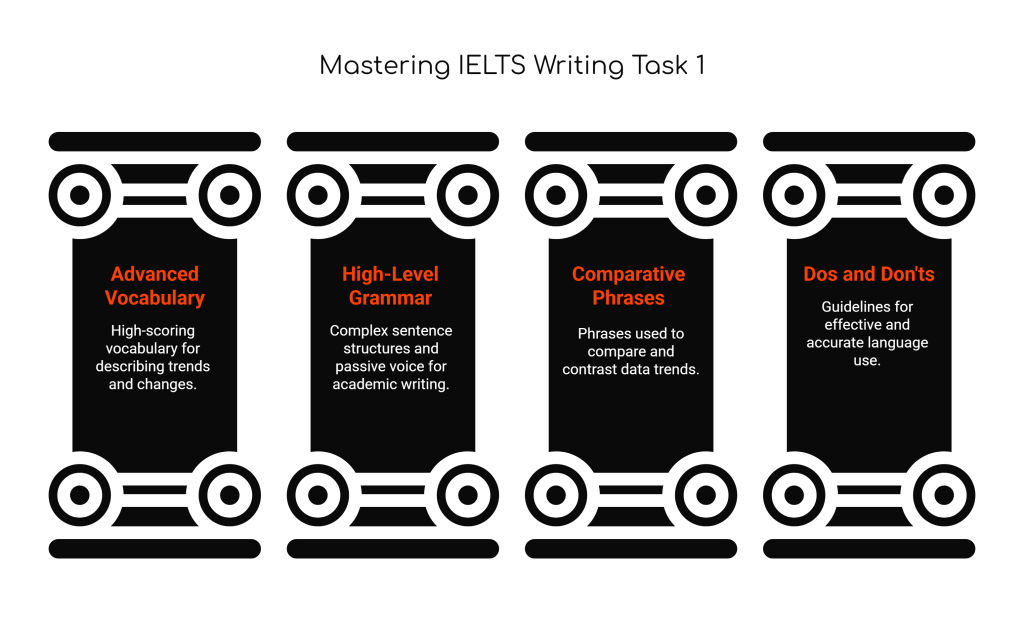
Describing line graphs in IELTS Writing Task 1 requires more than just identifying trends. To achieve a Band 7.0 or higher, candidates must demonstrate a range of grammatical structures and precise, academic vocabulary. This post explores how to integrate sophisticated grammar and advanced lexis in your responses.
Sample IELTS Writing Task 1 – Academic
You should spend about 20 minutes on this task.
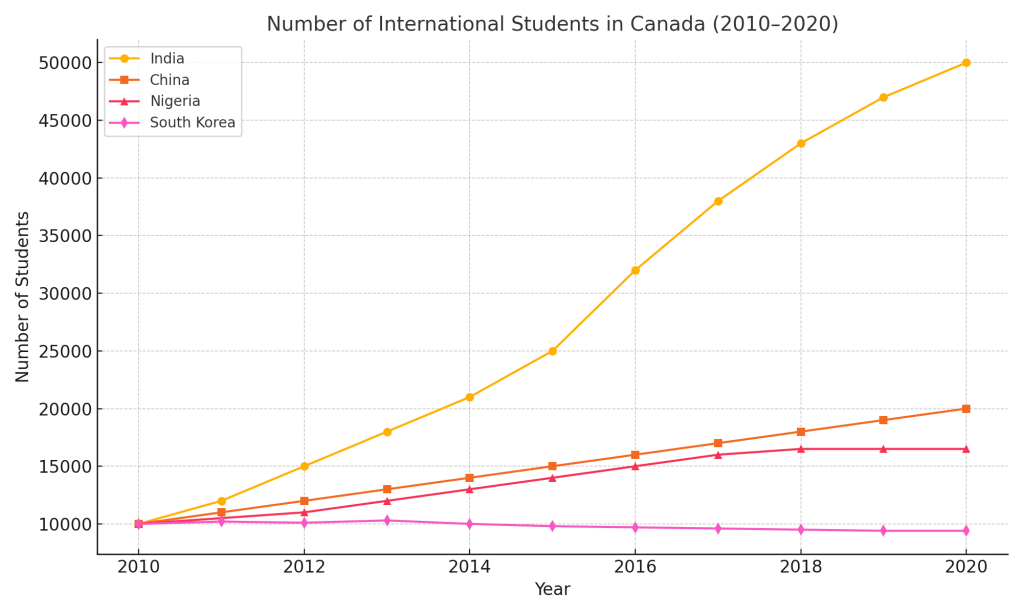
The graph below shows the number of international students from India, China, Nigeria, and South Korea who studied in Canada from 2010 to 2020.
Summarize the information by selecting and reporting the main features, and make comparisons where relevant.
Write at least 150 words.
Advanced Vocabulary for Describing Line Graphs
Here is a curated list of high-scoring vocabulary you can use to describe trends, changes, and comparisons:
Vocabulary for Increase and Growth
- Soar: The number of Indian students soared between 2015 and 2020.
- Climb steadily: The figure for Nigerian students climbed steadily from 2010 to 2018.
- Experience an upward trend: Chinese enrollments experienced a moderate upward trend.
Vocabulary for Decrease and Decline
- Dip slightly: There was a slight dip in South Korean students after 2014.
- Decline gradually: Numbers declined gradually in the latter half of the period.
- Plummet (more dramatic): Use only when there’s a very sharp decrease.
Describing Stability and Plateaus
- Level off: Enrollment figures for Nigerian students levelled off from 2018 to 2020.
- Remain constant: The number remained constant at around 10,000 students.
- Show little variation: Data for South Korea showed little variation across the decade.
Comparative Phrases
- Outpace: Indian students outpaced all other groups by 2020.
- Double/Triple: The number of Indian students tripled within five years.
- Lag behind: South Korea lagged behind in student numbers throughout.
High-Level Grammar Structures
1. Complex Sentences
Use a mix of subordinating conjunctions to present relationships between trends:
Although the number of Chinese students rose steadily, it never surpassed that of India.
2. Passive Voice
Ideal for highlighting data-focused trends:
A significant increase was observed in Indian student enrollment from 2016 onwards.
3. Relative Clauses
Add specificity and fluency:
Indian students, who started with lower figures in 2010, saw exponential growth.
4. Noun Phrases
Use compound and expanded noun phrases to sound more academic:
A substantial upward trend in the number of Indian students was recorded.
5. Causative Verbs (When Appropriate)
Though rare in Task 1, can be useful when reasons are inferred:
Government scholarships may have caused the surge in Nigerian enrollment.
Sample Band 8–9 Response (High-Level Language Focus)
The line graph illustrates how the number of international students from four countries—India, China, Nigeria, and South Korea—changed in Canada over a ten-year period.
Overall, Indian student numbers experienced the most significant growth, particularly after 2015, ultimately surpassing the other nationalities by a wide margin. In contrast, South Korean figures remained relatively stable and the lowest throughout.
In 2010, all countries except South Korea had similar enrollment numbers, hovering around 10,000. Indian figures began a gradual ascent until 2015, after which they soared, reaching nearly 50,000 by 2020. Chinese students showed a steady climb, doubling to approximately 20,000 during the period.
Nigerian enrollments increased moderately between 2010 and 2018 but plateaued thereafter. South Korea, on the other hand, maintained a consistent level, with only minor fluctuations, indicating a lack of substantial change.
Dos and Don’ts for High-Level Language
Do:
- Vary your sentence structures (simple, compound, complex).
- Use academic collocations (e.g., “exponential growth,” “moderate decline”).
- Focus on accuracy over complexity—use advanced grammar only if you can do so correctly.
Don’t:
- Use informal or conversational phrases (e.g., “went up a lot”).
- Repeat basic words like “increase” or “number” too frequently.
- Overuse memorized phrases without adapting them to the data.
Frequently Asked Questions
Q: Is it okay to use synonyms for “increase” multiple times?
A: Yes, as long as the synonyms are contextually appropriate. Use “climb,” “rise,” “soar,” or “surge” for variety.
Q: Do I need to explain reasons for trends?
A: Not unless the cause is implied or obvious. Focus on describing the data objectively.
Q: Will using complex grammar improve my score?
A: Only if used accurately and appropriately. Forced complexity can reduce clarity.
Final Tips
- Review academic verbs and nouns related to trends and comparisons.
- Practice paraphrasing with data sets to strengthen lexical resource.
- Keep sentences clear, cohesive, and data-driven.
#IELTSGuidePhil #IELTS #IELTSWritingTask1 #IELTSBand7 #AcademicWriting #IELTSGrammar #IELTSVocabulary #IELTSTips #LineGraphIELTS #HighBandScore #IELTSWritingStrategy
 IELTS Guide Phil
Leave a comment