
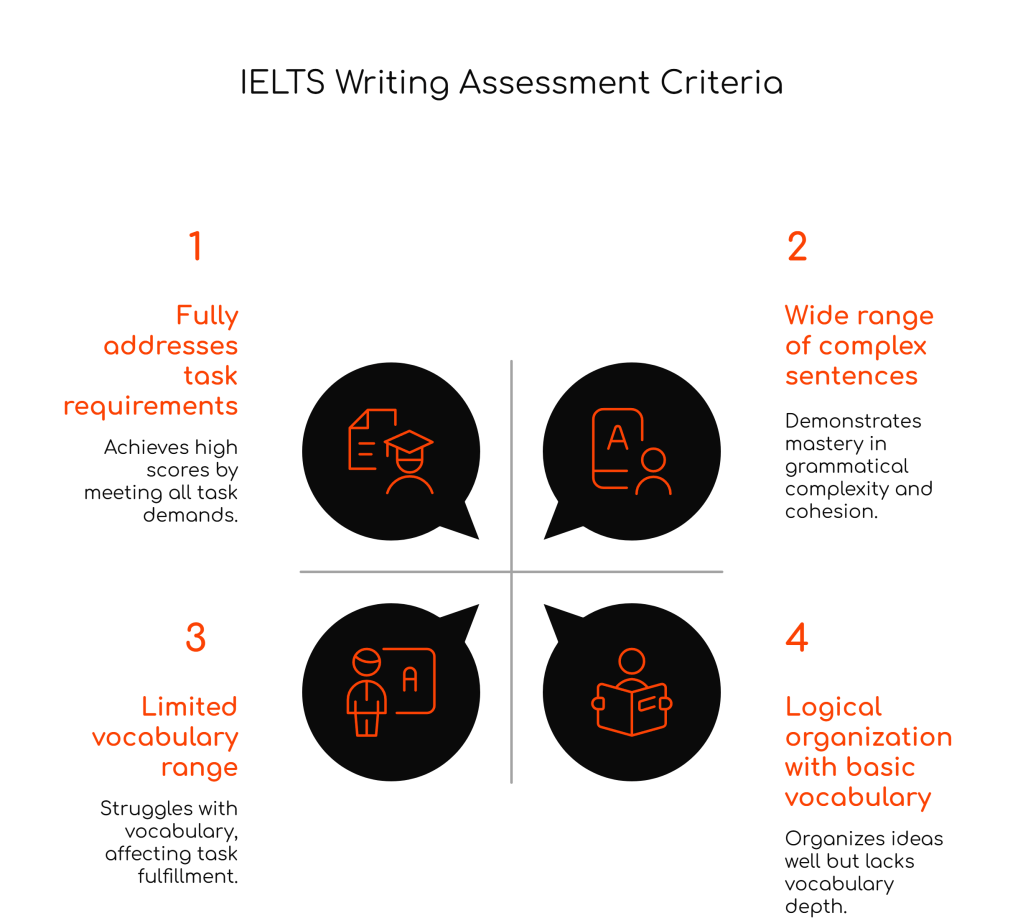
Success in the IELTS Writing test requires more than just strong ideas—it demands mastery over four essential assessment areas. Whether you are preparing for Academic or General Training IELTS, understanding exactly how examiners evaluate your writing will give you a powerful advantage.
This blog post explains the IELTS Writing band descriptors, the key criteria for scoring, and provides actionable advice to help you improve in every category. You can watch this YouTube video explainer by IELTS Guide Phil.
Overview of IELTS Writing Test Structure
Both the Academic (AC) and General Training (GT) Writing modules consist of two tasks:
- Task 1:
- AC: Summarize or describe visual data (graphs, charts, maps, processes, etc.).
- GT: Write a letter (formal, semi-formal, or informal) based on a given situation.
- Task 2:
- Write an essay responding to a point of view, argument, or problem.
Important:
Task 2 carries more weight in scoring than Task 1, meaning it has a stronger influence on your final Writing band score.
The Four Key Assessment Criteria
For both Task 1 and Task 2, IELTS examiners assess your writing based on four equally important criteria:
| Assessment Criteria | Key Focus |
|---|---|
| Task Achievement / Task Response | How well you answer the task requirements. |
| Coherence and Cohesion | How logically ideas are organized and connected. |
| Lexical Resource | Your range and accuracy of vocabulary. |
| Grammatical Range and Accuracy | Your range and control of grammar and punctuation. |
1. Task Achievement (Task 1) / Task Response (Task 2)
Task Achievement (for Task 1) and Task Response (for Task 2) assess whether you fully, appropriately, and accurately address the task prompt.
Academic Task 1 Requirements:
- Summarize key features.
- Provide accurate comparisons.
- Avoid personal opinions.
- Select relevant details from the data.
General Training Task 1 Requirements:
- Explain the purpose of the letter.
- Cover all bullet points in the prompt.
- Use an appropriate tone and format.
Task 2 Requirements (Essay):
- Present a clear position throughout.
- Fully respond to the prompt.
- Support main ideas with evidence or examples.
- Avoid irrelevant or repetitive ideas.
2. Coherence and Cohesion (CC)
Coherence relates to the logical organization of ideas.
Cohesion concerns the use of linking words and structures to connect ideas smoothly.
Key Points:
- Organize ideas into clear paragraphs (one main idea per paragraph).
- Use a range of cohesive devices correctly (e.g., “however,” “in contrast,” “as a result”).
- Maintain logical progression throughout your essay.
- Avoid mechanical or excessive linking words.
3. Lexical Resource (LR)
This refers to your vocabulary range and how effectively you use it.
Key Points:
- Use a range of vocabulary appropriate for the task.
- Avoid unnecessary repetition by using synonyms and paraphrases.
- Use topic-specific vocabulary accurately.
- Show control over word collocations (e.g., “heavy traffic,” not “strong traffic”).
- Avoid memorized phrases from textbooks or practice materials.
4. Grammatical Range and Accuracy (GRA)
This criterion evaluates the complexity and accuracy of your grammar.
Key Points:
- Use a mix of simple, compound, and complex sentence structures.
- Maintain control over tenses, articles, subject-verb agreement, etc.
- Avoid frequent grammar errors.
- Use punctuation correctly to support clarity.
IELTS Writing Band Descriptors: What They Mean
Here’s a simplified overview of the Band Descriptors:
| Band Score | Task Achievement / Response | Coherence and Cohesion | Lexical Resource | Grammar Range and Accuracy |
|---|---|---|---|---|
| Band 9 | Fully addresses all parts; ideas fully developed. | Logical, effortless flow. | Wide and precise vocabulary use. | Wide range, highly accurate structures. |
| Band 8 | Sufficient coverage and development. | Logical flow; minor lapses. | Wide vocabulary with occasional inaccuracies. | Wide range; minor errors. |
| Band 7 | Covers all requirements; minor lapses. | Clear progression; occasional linking errors. | Good range; some inappropriate word choices. | Frequent error-free sentences. |
| Band 6 | Mostly addresses task; some underdeveloped points. | Some mechanical cohesion. | Adequate vocabulary; some repetition. | Mix of simple and complex structures; some errors. |
| Band 5 | Addresses parts of the task; unclear development. | Limited cohesion; frequent repetition. | Limited vocabulary range. | Errors frequent, though meaning is often clear. |
| Band 4 or lower | Minimal or irrelevant response. | Poor cohesion and organization. | Very limited vocabulary. | Frequent errors that impede meaning. |
Common Mistakes That Lower Your Writing Score
- Misunderstanding the task prompt.
- Lack of a clear thesis or purpose.
- Overusing basic linking words (“and,” “but,” “because”).
- Excessive repetition of words or phrases.
- Using incorrect word combinations (wrong collocations).
- Frequent grammar and spelling errors.
- Poor paragraphing (one long block of text or missing main ideas).
Tips for Scoring Higher in IELTS Writing
Analyze the task carefully before planning your answer.
Plan your ideas logically before you start writing.
Develop your main points with explanations and examples.
Use a range of academic vocabulary and grammar.
Practice linking ideas smoothly within and between paragraphs.
Proofread your work to catch mistakes.
Aim for natural, precise English—avoid memorized templates.
Final Thoughts
Understanding the IELTS Writing band descriptors and key assessment criteria is critical for anyone aiming for a Band 7 or higher. Clear organization, precise language, effective grammar, and full task fulfillment are non-negotiables. By aligning your preparation with these expectations, you can confidently target and achieve your desired writing band score.
Continuous practice, regular feedback, and attention to the official criteria will ensure steady improvement—and success on test day.
#IELTSGuidePhil #IELTS #IELTSWriting #IELTSBandDescriptors #IELTSPreparation #IELTSTips #IELTSBlog #IELTSAcademic #IELTSGeneralTraining #IELTSWritingTask1 #IELTSWritingTask2 #StudyIELTS #IELTSSuccess
 IELTS Guide Phil
Leave a comment