
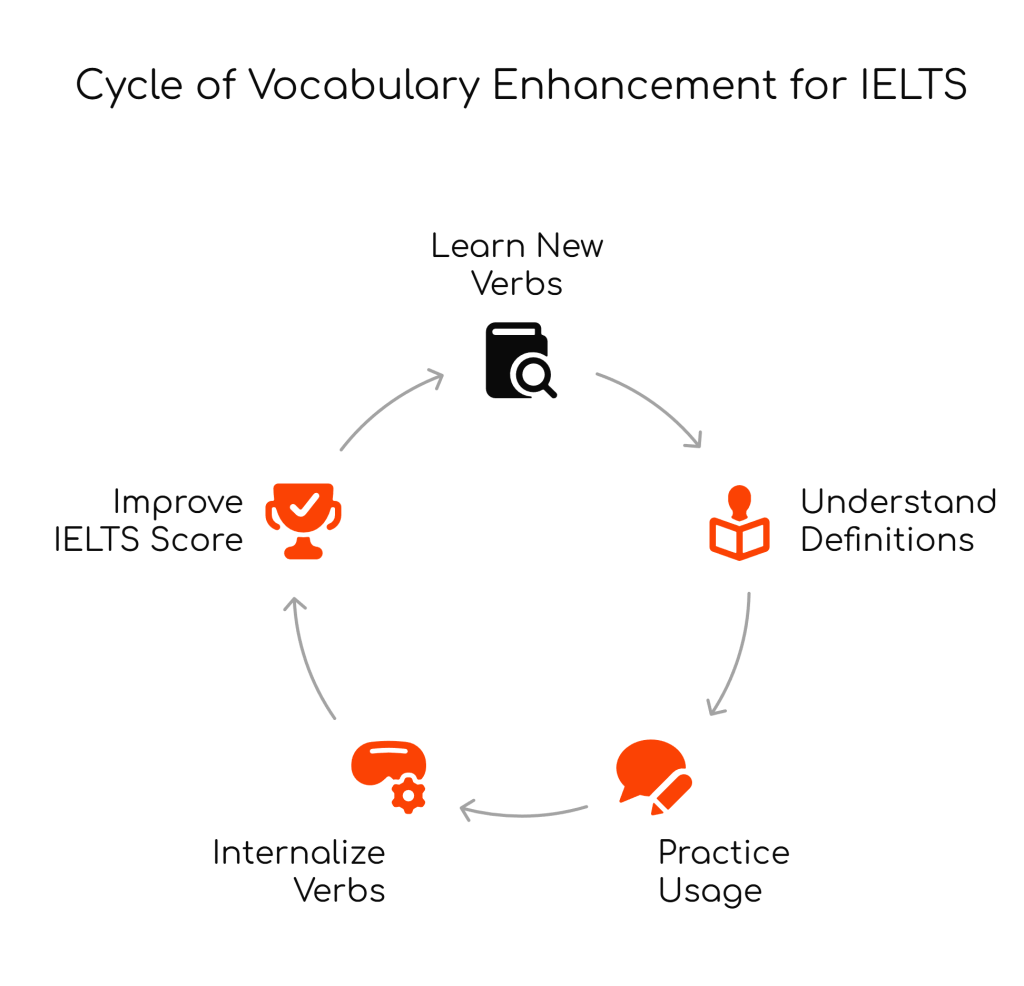
Mastering a varied and sophisticated set of verbs can greatly improve your performance in the IELTS Speaking and Writing sections. Using less common verbs not only showcases your range of vocabulary but also makes your communication more precise, natural, and academic.
Here’s a complete list of 100 less common verbs — each with a definition and an example sentence — to help you sound like a high-band IELTS candidate.
100 Less Common Verbs for a Higher IELTS Band Score
- Abate — to become less intense
“The storm finally abated after several hours.” - Absolve — to free from guilt or blame
“The court absolved him of all charges.” - Acquiesce — to accept reluctantly without protest
“She acquiesced to her manager’s request.” - Admonish — to warn or reprimand
“The teacher admonished the student for being late.” - Allude — to refer to indirectly
“He alluded to the difficulties without mentioning them directly.” - Amass — to collect or gather
“She amassed a fortune through real estate investments.” - Annex — to add or attach
“The country annexed the neighboring territory.” - Arrogate — to claim without justification
“The dictator arrogated absolute power to himself.” - Ascertain — to find out for certain
“The detective ascertained the cause of the fire.” - Assuage — to relieve or ease
“He tried to assuage her fears with kind words.”
- Avert — to prevent or turn away
“He averted his gaze from the accident scene.” - Banish — to send away or exile
“The king banished the traitors from the kingdom.” - Beckon — to signal or summon
“She beckoned him to come closer.” - Belittle — to make someone seem less important
“He belittled her achievements in front of others.” - Berate — to scold harshly
“The coach berated the team after their loss.” - Bestow — to give as a gift or honor
“The university bestowed an honorary degree upon her.” - Bolster — to support or strengthen
“The new evidence bolstered his argument.” - Cajole — to persuade through flattery
“She cajoled him into attending the event.” - Capitulate — to surrender
“The enemy eventually capitulated after months of fighting.” - Castigate — to criticize severely
“The editor castigated the writer for factual errors.”
- Chastise — to punish or reprimand
“The parent chastised the child for misbehaving.” - Coerce — to force someone by threats
“They coerced him into signing the agreement.” - Commiserate — to express sympathy
“They commiserated with their friend after his loss.” - Concede — to admit defeat or yield
“She conceded the election after the final results.” - Confer — to grant or bestow
“The committee conferred the award upon the scientist.” - Consolidate — to combine or strengthen
“They consolidated their resources to start the business.” - Constrain — to restrict or limit
“Budget cuts constrained the project’s scope.” - Contend — to argue or struggle
“They contended that the policy was unfair.” - Debilitate — to weaken
“The disease debilitated the patient rapidly.” - Debunk — to expose false claims
“The documentary debunked several myths about nutrition.”
- Decry — to publicly denounce
“They decried the unfair labor practices.” - Defame — to damage someone’s reputation
“The article defamed the politician unjustly.” - Delineate — to describe precisely
“The report delineated the proposed changes in detail.” - Demolish — to destroy completely
“They demolished the old building to make way for a new park.” - Denounce — to condemn openly
“She denounced the corruption during the press conference.” - Deride — to mock or ridicule
“They derided the idea as impractical.” - Desist — to stop doing something
“The company was ordered to desist from illegal practices.” - Deter — to discourage
“The threat of punishment deterred them from cheating.” - Deviate — to depart from a course
“He deviated from the original plan.” - Diminish — to reduce in size or importance
“His influence diminished after the scandal.”
- Disclose — to reveal information
“She disclosed her plans to her friends.” - Dispel — to drive away doubts or fears
“His explanation dispelled their concerns.” - Disseminate — to spread widely
“The organization disseminated information about the disease.” - Dissuade — to persuade against
“She dissuaded him from investing all his money.” - Elicit — to draw out a response
“The joke elicited laughter from the audience.” - Embellish — to decorate or exaggerate
“He embellished the story to make it more interesting.” - Emulate — to imitate
“Young athletes emulate their sporting heroes.” - Encompass — to include comprehensively
“The curriculum encompasses science, arts, and humanities.” - Endeavor — to try hard to achieve
“She endeavored to finish the project on time.” - Enervate — to weaken or drain energy
“The heat enervated the runners.”
- Engender — to cause or give rise to
“The new policy engendered widespread debate.” - Entail — to involve or require
“The job entails frequent travel.” - Entice — to attract or lure
“The ad enticed customers with huge discounts.” - Enumerate — to list one by one
“He enumerated the reasons for his decision.” - Eradicate — to destroy completely
“Efforts to eradicate the disease have intensified.” - Espouse — to support a belief or cause
“She espoused the philosophy of minimalism.” - Exacerbate — to make worse
“The heavy rainfall exacerbated the flooding.” - Exemplify — to illustrate by example
“His dedication exemplifies true professionalism.” - Exonerate — to clear of blame
“The DNA evidence exonerated the suspect.” - Expedite — to speed up the process
“The manager expedited the shipping of the product.”
- Extol — to praise highly
“The teacher extolled the student’s efforts.” - Fabricate — to invent falsely
“He fabricated the story to cover up his mistake.” - Facilitate — to make easier
“The translator facilitated communication between the two parties.” - Fathom — to understand deeply
“He couldn’t fathom the complexity of the situation.” - Fetter — to restrain or chain
“Fear fettered his ambitions.” - Fluctuate — to vary irregularly
“Prices fluctuated throughout the year.” - Forsake — to abandon
“He forsook his old ways after moving abroad.” - Foster — to encourage growth
“The school fosters creativity among its students.” - Frustrate — to prevent from achieving
“The heavy rain frustrated their travel plans.” - Galvanize — to stimulate into action
“The speech galvanized the crowd into action.”
- Garner — to gather or collect
“He garnered praise for his innovation.” - Hamper — to hinder or obstruct
“Bad weather hampered the rescue efforts.” - Harbor — to keep in mind (usually negative)
“She harbored resentment for years.” - Heed — to pay attention to
“You must heed the warnings.” - Impart — to communicate information
“The teacher imparted valuable knowledge.” - Impel — to drive or force
“His conscience impelled him to confess.” - Implore — to beg earnestly
“She implored him to reconsider.” - Inhibit — to restrain or prevent
“Fear inhibited his speech.” - Instigate — to provoke or initiate
“They instigated a rebellion against the authorities.” - Intervene — to come between
“The UN intervened to stop the conflict.”
- Invalidate — to render invalid
“The new evidence invalidated the old theory.” - Jeopardize — to put at risk
“His actions jeopardized the entire mission.” - Lament — to mourn or grieve
“They lamented the loss of their leader.” - Magnify — to make larger
“The microscope magnified the tiny organisms.” - Mitigate — to lessen the severity
“The government took measures to mitigate the crisis.” - Muster — to gather together
“He mustered all his courage.” - Obfuscate — to confuse or make unclear
“The politician obfuscated the facts during the debate.” - Oblige — to require
“The law obliges companies to provide safety measures.” - Pacify — to calm down
“The police tried to pacify the angry crowd.” - Perceive — to become aware of
“He perceived a slight change in her attitude.”
- Persevere — to persist
“Despite difficulties, she persevered with her studies.” - Plummet — to fall rapidly
“Stock prices plummeted after the announcement.” - Proclaim — to announce formally
“He proclaimed his innocence publicly.” - Rebuke — to criticize sharply
“The boss rebuked him for being late.” - Refute — to disprove
“He refuted the accusations with evidence.” - Renounce — to give up voluntarily
“He renounced his claim to the throne.” - Reprimand — to scold formally
“The teacher reprimanded the students for cheating.” - Repudiate — to reject
“She repudiated the unfair allegations.” - Substantiate — to provide evidence
“He substantiated his argument with statistics.” - Undermine — to weaken gradually
“The scandal undermined public confidence in the government.”
Final Thoughts
Incorporating less common verbs into your IELTS Writing and Speaking will make your language more dynamic, precise, and sophisticated, giving you a significant edge for Band 7, 8, or even 9. Remember, it’s not about using “big words” randomly — it’s about using them accurately and appropriately!
Practice writing essays, describing graphs, or answering speaking questions using these verbs to internalize them naturally.
#IELTSGuidePhil #IELTS #IELTSVocabulary #IELTSWriting #IELTSSpeaking #Band9Vocabulary #AcademicEnglish #LearnEnglish #EnglishVerbs #VocabularyBoost #IELTSPreparation
 IELTS Guide Phil
Leave a comment