
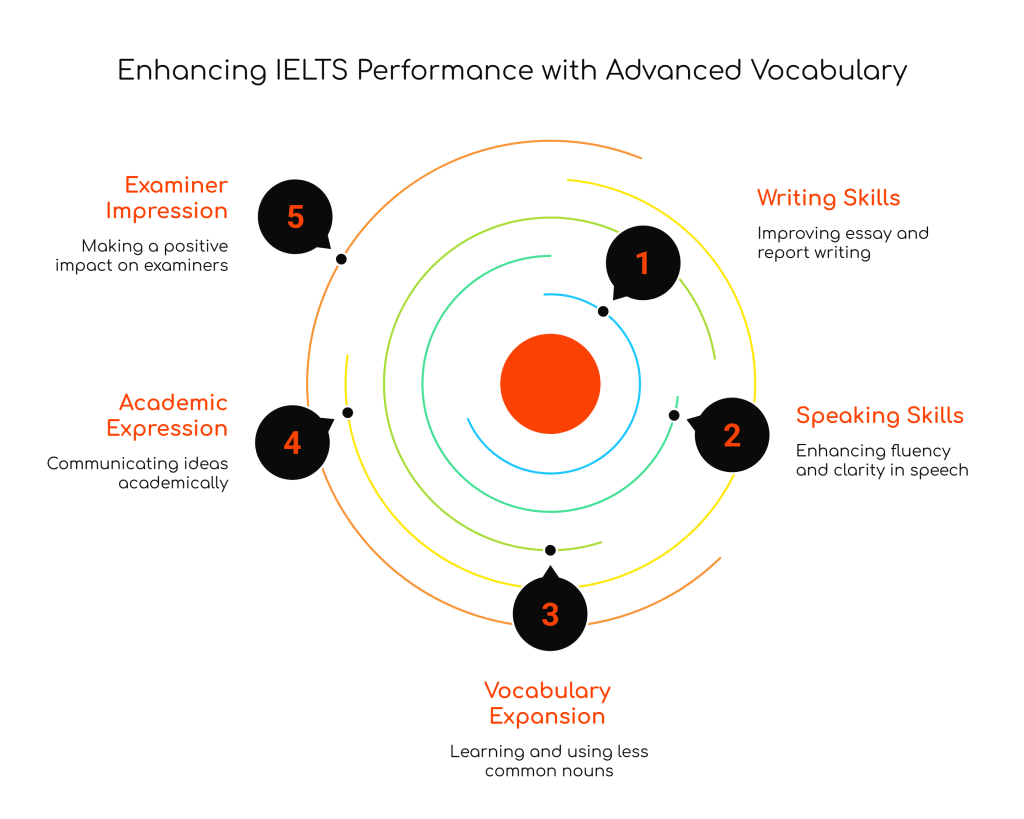
A rich vocabulary of precise and sophisticated nouns can dramatically boost your performance in both IELTS Writing and IELTS Speaking. Using less common nouns not only impresses examiners but also helps you express your ideas more clearly, accurately, and academically.
Below is a complete list of 100 less common nouns — each with a definition and example sentence — to help you expand your vocabulary and sound like a high-band IELTS candidate.
100 Less Common Nouns for a Higher IELTS Band Score
- Aberration — a departure from what is normal or expected
“His sudden anger was an aberration from his usual calm demeanor.” - Acumen — keen insight or sharpness
“Her business acumen impressed the investors.” - Adversity — hardship or misfortune
“He showed resilience in the face of adversity.” - Allegiance — loyalty or commitment
“The soldiers swore allegiance to their country.” - Ambiguity — uncertainty or inexactness
“The ambiguity in his answer confused everyone.” - Animosity — strong hostility
“There was deep animosity between the rival groups.” - Apathy — lack of interest or concern
“Voter apathy led to low turnout at the election.” - Aspirant — a person who aspires to achieve something
“Several aspirants competed for the leadership role.” - Atrocity — an extremely cruel act
“The atrocities of war were documented in the report.” - Auspice — protection or support
“The charity operated under the auspices of the local government.”
- Benevolence — kindness and generosity
“The benevolence of the donors helped fund the project.” - Berth — a place to sleep on a ship or train
“He secured a lower berth for the overnight journey.” - Blunder — a careless mistake
“His blunder cost the company millions.” - Boondoggle — a pointless or wasteful project
“Critics called the new stadium a boondoggle.” - Bravado — a bold manner intended to impress
“His bravado masked his insecurity.” - Breach — a violation or gap
“There was a breach of contract between the two parties.” - Brevity — concise and exact use of words
“She was praised for the brevity of her speech.” - Broach — an act of raising a sensitive topic
“He broached the subject of moving abroad carefully.” - Burden — a heavy load or responsibility
“She bore the burden of caring for her family.” - Byproduct — something produced unintentionally
“Pollution is a byproduct of industrialization.”
- Cacophony — a harsh mixture of sounds
“The cacophony from the construction site was unbearable.” - Candor — honesty or frankness
“Her candor during the interview was refreshing.” - Caprice — a sudden change of mood or behavior
“The project was abandoned on a whim of caprice.” - Catalyst — something that speeds up change
“The new policy acted as a catalyst for reform.” - Cauldron — a situation characterized by instability
“The city became a cauldron of unrest.” - Cessation — a stopping or ending
“The cessation of hostilities was a relief.” - Chasm — a deep division between people or views
“A chasm developed between the two political factions.” - Chronicle — a factual written account
“The book is a chronicle of her travels.” - Circumference — the distance around something circular
“The circumference of the stadium was enormous.” - Clout — strong influence or power
“The company has considerable clout in the market.”
- Conjecture — a guess based on incomplete information
“His explanation was pure conjecture.” - Consensus — general agreement
“There was a consensus to proceed with the merger.” - Contingency — a possible event or outcome
“They prepared for every contingency.” - Conundrum — a confusing and difficult problem
“Deciding where to live was a real conundrum.” - Credence — belief or acceptance as true
“The witness’s story gave credence to the rumors.” - Culmination — the highest point of something
“Winning the award was the culmination of years of effort.” - Curiosity — a strong desire to learn
“Her curiosity led her to explore new cultures.” - Deference — respectful submission
“Out of deference, he remained silent.” - Deluge — a severe flood
“The deluge caused widespread damage.” - Demise — a person’s death or the end of something
“The demise of the newspaper shocked its readers.”
- Dichotomy — a division between two opposing ideas
“There is a clear dichotomy between science and religion.” - Diligence — careful and persistent effort
“Her diligence paid off when she passed the exam.” - Disarray — a state of disorder
“The sudden resignation left the team in disarray.” - Disclosure — the action of revealing information
“Full disclosure is required by law.” - Discrepancy — a difference or inconsistency
“There was a discrepancy between the two reports.” - Disposition — a person’s inherent qualities of mind
“She has a cheerful disposition.” - Dissent — disagreement
“There was growing dissent within the party.” - Doctrine — a set of beliefs held by a group
“The doctrine emphasized equality for all.” - Drought — a prolonged period of dryness
“The drought devastated the crops.” - Duplicity — deceitfulness or double-dealing
“She was accused of duplicity in her dealings.”
- Eccentricity — strange behavior
“His eccentricity made him memorable.” - Effigy — a sculpture or model of a person
“The protesters burned an effigy of the leader.” - Elation — great happiness
“She was filled with elation after receiving the news.” - Endeavor — an attempt to achieve something
“Starting a business is a risky endeavor.” - Enmity — hatred
“There was longstanding enmity between the two rivals.” - Epiphany — a sudden realization
“He had an epiphany about his career path.” - Epitome — a perfect example
“She is the epitome of professionalism.” - Errand — a short journey to accomplish a task
“She went on an errand to buy groceries.” - Eulogy — a speech honoring someone who has died
“He delivered a heartfelt eulogy at the funeral.” - Exodus — a mass departure of people
“The exodus from the city was triggered by violence.”
- Fallacy — a mistaken belief
“It’s a fallacy that vaccines are unsafe.” - Feasibility — the practicality of something
“They conducted a study to assess the feasibility of the project.” - Fiasco — a complete failure
“The event was a total fiasco.” - Fidelity — loyalty or faithfulness
“She valued fidelity in relationships above all else.” - Fissure — a narrow opening or crack
“A fissure formed in the rock face.” - Fortitude — courage in adversity
“She showed great fortitude during the trial.” - Futility — uselessness
“They realized the futility of further negotiations.” - Gamut — the complete range or scope
“The company’s services run the gamut from consulting to sales.” - Genesis — origin or beginning
“The genesis of the idea came during a brainstorming session.” - Gratification — satisfaction or pleasure
“He found gratification in helping others.”
- Groove — a long, narrow cut or depression
“The tire left a groove in the mud.” - Havoc — widespread destruction
“The tornado wreaked havoc across the town.” - Heritage — traditions passed down through generations
“The castle is part of the national heritage.” - Hiatus — a pause or gap
“The band returned after a five-year hiatus.” - Hindrance — an obstacle
“Lack of experience proved a major hindrance.” - Hostility — unfriendliness
“Hostility between the nations escalated quickly.” - Ideology — a system of ideas and ideals
“Their political ideology emphasized freedom.” - Impetus — a driving force
“The new policy provided fresh impetus for reform.” - Incidence — the occurrence rate of something
“The incidence of heart disease has decreased.” - Ire — anger
“His careless comment drew the ire of his colleagues.”
- Jeopardy — danger of loss, harm, or failure
“His career was in jeopardy after the scandal.” - Juncture — a particular point in time
“At this critical juncture, we must act decisively.” - Kinship — blood relationship or close connection
“They felt a strong kinship despite having just met.” - Labyrinth — a complicated network of paths
“They got lost in the labyrinth of alleyways.” - Legacy — something handed down from the past
“She left a legacy of kindness and generosity.” - Levity — humor or lightness
“His levity eased the tension during the meeting.” - Magnitude — great size or importance
“They underestimated the magnitude of the problem.” - Malady — a disease or ailment
“The doctor treated her mysterious malady.” - Memento — an object kept as a reminder
“He kept a shell as a memento of the trip.” - Mirth — amusement, especially expressed in laughter
“Their mirth echoed through the hall.”
- Momentum — the force gained by movement
“The team’s momentum carried them to victory.” - Nemesis — a long-standing rival
“He finally defeated his nemesis in the championship.” - Nuance — a subtle difference
“She understood the nuances of the language.” - Oblivion — the state of being forgotten
“His fame faded into oblivion.” - Onset — the beginning of something
“The onset of winter brought heavy snow.” - Paradox — a statement that contradicts itself
“‘Less is more’ is a famous paradox.” - Pathos — an appeal to emotion
“The film’s pathos moved audiences to tears.” - Pinnacle — the highest point
“She reached the pinnacle of her career.” - Prowess — skill or expertise
“He showed great prowess in battle.” - Quandary — a state of uncertainty
“She was in a quandary about which job offer to accept.”
Final Thoughts
Using less common nouns in your IELTS Speaking and Writing can elevate your vocabulary scores and help you sound more academic, nuanced, and professional. However, use these words naturally and contextually to ensure clarity and avoid sounding overly forced or artificial.
Practice writing essays, reports, and speaking answers with these words to solidify your mastery!
#IELTSGuidePhil #IELTS #IELTSVocabulary #IELTSWriting #IELTSSpeaking #Band9Vocabulary #AcademicEnglish #LearnEnglish #EnglishVocabulary #VocabularyBoost #IELTSPreparation #FluencyInEnglish
 IELTS Guide Phil
Leave a comment