
Achieving a high band score in the IELTS Speaking test requires more than just good pronunciation or wide vocabulary. Candidates are assessed across four main criteria, each carrying equal weight. Understanding these criteria and the band descriptors behind them is crucial for targeting your preparation and improving your score.
In this guide, we’ll break down the IELTS Speaking assessment criteria, band descriptors from Band 9 to Band 1, and key features examiners look for at each level. You can watch this YouTube video explainer by IELTS Guide Phil.
The Four IELTS Speaking Assessment Criteria
Each Speaking test is scored using four criteria, which are weighted equally:
1. Fluency and Coherence
This measures how naturally and logically you speak.
Key Features:
- Smooth flow of speech with minimal hesitation.
- Ability to speak at length.
- Use of discourse markers (e.g., “however,” “on the other hand”).
- Logical progression of ideas.
Example: A Band 7 speaker can produce extended responses with occasional hesitation but remains coherent and easy to follow.
2. Lexical Resource
This evaluates your range of vocabulary and your ability to use it appropriately.
Key Features:
- Use of a wide variety of words.
- Precision and appropriacy in word choice.
- Use of idiomatic expressions and collocations.
- Ability to paraphrase effectively.
Example: A Band 8 speaker uses idioms and uncommon vocabulary accurately, though with occasional slips.
3. Grammatical Range and Accuracy
This refers to your ability to use a range of sentence structures accurately and flexibly.
Key Features:
- Variety of grammatical forms (simple and complex).
- Control of verb tenses, conditionals, passives, etc.
- Frequency and impact of errors on communication.
Example: A Band 6 speaker uses both simple and complex structures, though errors are more frequent and may reduce clarity.
4. Pronunciation
This assesses how well you use phonological features to be understood.
Key Features:
- Intonation, stress, and rhythm.
- Chunking and connected speech.
- Pronunciation of individual sounds.
- Impact of accent on clarity.
Example: A Band 9 speaker’s accent does not affect understanding at all, and they use pronunciation to convey meaning precisely.
IELTS Speaking Band Descriptors: What They Mean
Here’s a simplified summary of the key descriptors from Band 9 to Band 1 across the four criteria.
Band 9 – Expert User
- Fully fluent and coherent.
- Full flexibility in vocabulary and grammar.
- Near-native pronunciation.
- Minor slips only, often similar to native speakers.
Band 8 – Very Good User
- Occasional hesitations or errors.
- Wide range of vocabulary and grammar.
- Minor pronunciation issues that don’t affect understanding.
Band 7 – Good User
- Speaks at length with some hesitation.
- Uses idiomatic language, with some errors.
- Frequent error-free sentences.
- Accent is noticeable but causes no strain.
Band 6 – Competent User
- Some loss of coherence and control.
- Limited flexibility in vocabulary and grammar.
- Errors may occur but generally do not affect communication.
- Occasional mispronunciations.
Band 5 – Modest User
- Noticeable hesitation, repetition, and reformulation.
- Vocabulary is sufficient but basic.
- Errors in complex structures.
- Some strain required to understand pronunciation.
Band 4 – Limited User
- Speech is slow with frequent pauses and errors.
- Uses simple words and structures only.
- Mispronunciations often affect clarity.
Band 3 and below
- Severe problems with fluency, vocabulary, grammar, and pronunciation.
- Communication is limited or unintelligible.
How Are Band Scores Calculated?
Each of the four criteria is scored out of 9. Your final Speaking band is the average of those four scores, rounded to the nearest 0.5 or whole band.
Example:
Fluency: 6 | Vocabulary: 7 | Grammar: 6 | Pronunciation: 7
Final Score: (6+7+6+7) ÷ 4 = 6.5
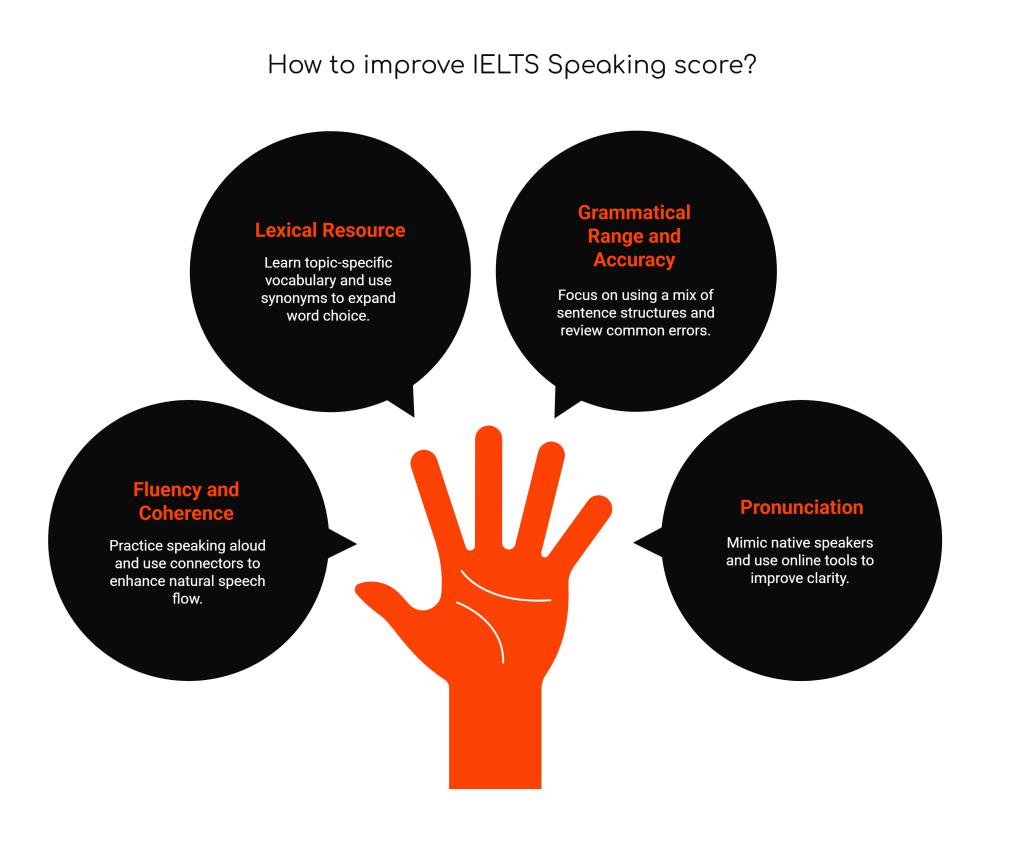
Tips to Improve in Each Criterion
Fluency and Coherence
- Practice speaking aloud daily.
- Record yourself and listen for pauses.
- Use connectors like “firstly,” “in contrast,” and “as a result.”
Lexical Resource
- Learn topic-specific vocabulary.
- Use synonyms and collocations.
- Practice paraphrasing.
Grammatical Range and Accuracy
- Focus on a mix of sentence structures.
- Review common grammar mistakes (e.g., subject-verb agreement).
- Practice with IELTS Speaking sample questions.
Pronunciation
- Listen to native speakers and mimic their intonation.
- Use online pronunciation tools (e.g., YouGlish, Forvo).
- Work on stressed and unstressed syllables.
Final Thoughts
The IELTS Speaking band descriptors offer clear guidance on what examiners look for—and understanding them is the first step to improving your performance. Work on all four criteria consistently, track your progress, and focus on real communication rather than memorized answers.
Whether you’re aiming for a Band 6 or Band 8+, aligning your practice with the official scoring system will give you the best chance at success.
#IELTSGuidePhil #IELTS #IELTSSpeaking #IELTSBandDescriptors #IELTSPreparation #IELTSTips #IELTSExam #Band7Plus #IELTSVocabulary #IELTSGrammar #IELTSFluency #IELTSPronunciation
 IELTS Guide Phil
Leave a comment