
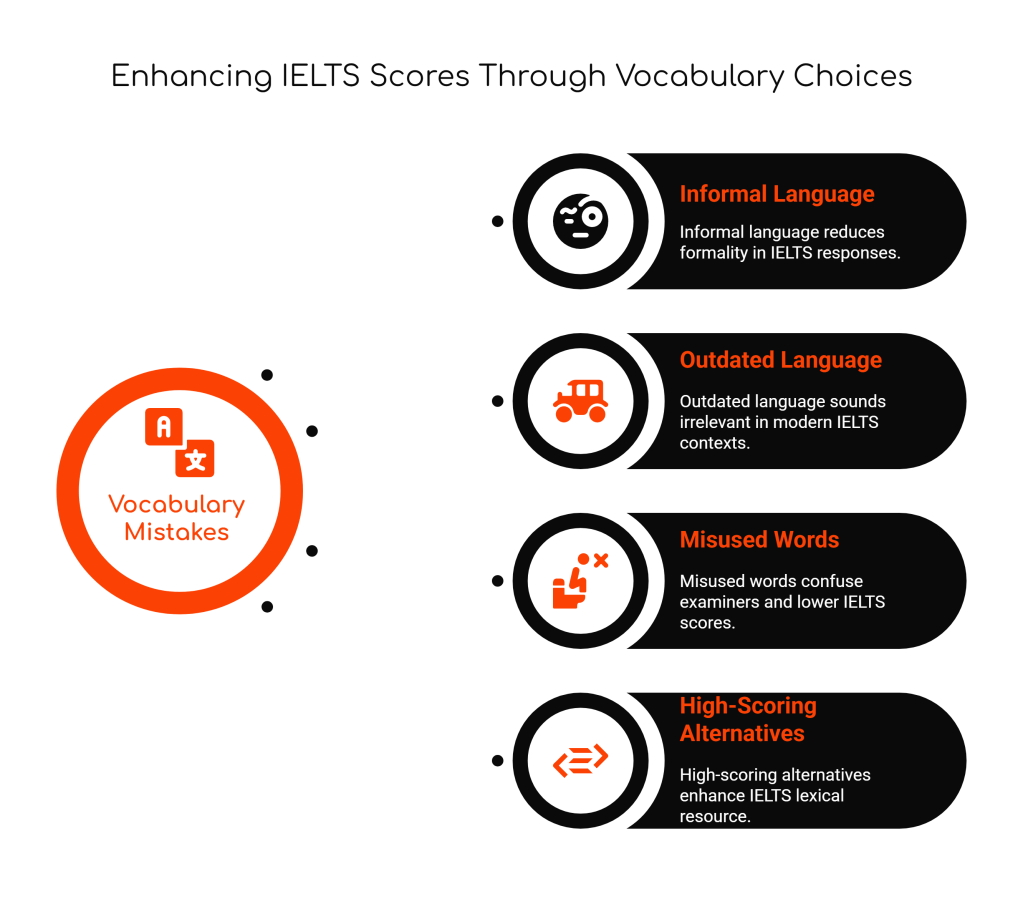
Enhance your score by avoiding informal, outdated, and misused words and phrases
In IELTS Speaking and Writing, vocabulary can make or break your score. Using inappropriate, colloquial, or outdated language might confuse the examiner or reduce the formal tone required—especially in Writing Task 2. This comprehensive list highlights 100 common vocabulary mistakes, explains what’s wrong with them, and provides high-scoring alternatives you should use instead.
100 Common Vocabulary Mistakes and Better Alternatives
- A lot of stuff → Many things / a variety of items
- Kids → Children / young learners
- Gonna → Going to
- Wanna → Want to
- Cool (as in “That’s cool”) → Interesting / impressive
- Get (overused) → Receive / obtain / become
- Thing → Item / issue / object / matter
- Big (overused) → Significant / substantial / major
- Small → Minor / modest / limited
- Good → Effective / beneficial / appropriate
- Bad → Ineffective / problematic / harmful
- Cheap → Inexpensive / affordable
- Expensive → Costly / high-priced
- Sick (slang) → Unwell / ill
- Awesome → Excellent / outstanding / remarkable
- Really (overused intensifier) → Extremely / highly / exceptionally
- Nice → Pleasant / enjoyable / agreeable
- Stuff (generic) → Materials / equipment / belongings
- Guy → Man / person / individual
- Thingy → Item / object / device
- Kind of → Somewhat / to a certain extent
- Sort of → Relatively / moderately
- Like (as filler) → Remove or rephrase the sentence
- You know → Unnecessary filler – delete it
- Cool down (for calm) → Compose oneself / relax
- Freak out → Become very upset / panic
- Hang out → Spend time / socialise
- Chill (as verb) → Relax / unwind
- Go nuts → Get extremely excited / act irrationally
- Old-fashioned (when vague) → Outdated / obsolete
- Nowadays (overused intro word) → In the modern era / at present
- It’s like → Rephrase for clarity and precision
- Thing is → The key point is / the main issue is
- Loads of → Numerous / a large number of
- Tons of → A significant amount of
- Guy (again) → Individual / male person
- Pretty (as intensifier) → Fairly / reasonably
- Totally → Completely / entirely / absolutely
- Awesome sauce → Impressive / notable
- Epic fail → Significant failure / major setback
- Hot (for popular) → Trending / widely discussed
- Yucky → Unappetizing / unpleasant
- Blah blah blah → And so on / et cetera
- Big deal → Important issue / notable concern
- Boring → Uninspiring / monotonous / repetitive
- Ugly (blunt) → Unattractive / unpleasant-looking
- Dead tired → Exhausted / fatigued
- Cool with it → Accept it / comfortable with it
- Get mad → Become angry / frustrated
- Creepy → Unsettling / disturbing
- Hard (vague) → Challenging / demanding / complex
- Easy → Straightforward / simple
- Go crazy → Lose control / become highly emotional
- Junk → Waste / trash / useless materials
- Mess up → Make a mistake / disrupt
- Screw up → Fail / make an error
- Busted → Caught / discovered / apprehended
- Bombed the test → Performed poorly
- Ain’t → Is not / are not
- Meh → Unremarkable / indifferent
- No clue → Unaware / uncertain
- Talk trash → Speak disrespectfully / criticise
- Throw shade → Insult / subtly criticise
- Hit me up → Contact me / get in touch
- Lame → Weak / ineffective / disappointing
- Ditch → Skip / avoid / abandon
- Cheesy → Sentimental / cliché
- Suck → Be disappointing / be of poor quality
- Kick off → Begin / commence / start
- Nailed it → Performed well / succeeded
- Out of the blue → Unexpectedly / suddenly
- In a nutshell → In summary / briefly stated
- Sleepy (for quiet place) → Calm / peaceful / subdued
- Fed up → Frustrated / tired of something
- Hot topic → Widely debated issue / current concern
- Mad (for angry) → Angry / furious
- Lousy → Poor / unsatisfactory
- Ripped off → Overcharged / deceived
- Go broke → Become bankrupt / run out of money
- Hit the books → Study intensely
- Crash a party → Attend uninvited
- Pain in the neck → Annoyance / nuisance
- On cloud nine → Extremely happy
- Bite the bullet → Accept something unpleasant
- Spill the beans → Reveal a secret
- Cold feet → Nervousness before a major decision
- Throw in the towel → Give up / surrender
- Call it a day → Stop working / end an activity
- Hit the sack → Go to bed / sleep
- Burn the midnight oil → Work late into the night
- Down in the dumps → Feeling sad / depressed
- Hit the road → Leave / start a journey
- Face the music → Accept consequences
- Kick the bucket → Die (avoid in academic/IELTS)
- Jump the gun → Act too soon
- Piece of cake → Very easy task
- Cost an arm and a leg → Very expensive
- Under the weather → Slightly ill / unwell
- Give the cold shoulder → Ignore / dismiss someone
- Let the cat out of the bag → Reveal a secret unintentionally
Final Thoughts
Avoiding informal, slangy, and outdated vocabulary is essential to achieve a high band score in IELTS Speaking and Writing. Replace generic and conversational words with precise, formal, and context-appropriate alternatives. This not only improves lexical resource but also shows the examiner that you’re capable of handling academic-level English.
#IELTSVocabulary #IELTSTips #AcademicEnglish #IELTSWriting #IELTSSpeaking #HighScoreIELTS #EnglishMistakes #FormalEnglish #IELTSGuidePhil #LearnEnglish #EnglishUpgrade #IELTS
 IELTS Guide Phil
Leave a comment