
Mastering nuanced vocabulary for higher IELTS scores
Not all synonyms are truly interchangeable. Many English words carry subtle differences in tone, usage, and intensity, and misusing them can slightly alter or even obscure your intended meaning. In IELTS, especially in Writing and Speaking, it’s crucial to choose the most accurate and context-appropriate word.
This post explores 100 commonly confused synonym and homonym pairs and explains how they differ—so you can express your ideas with clarity and precision.
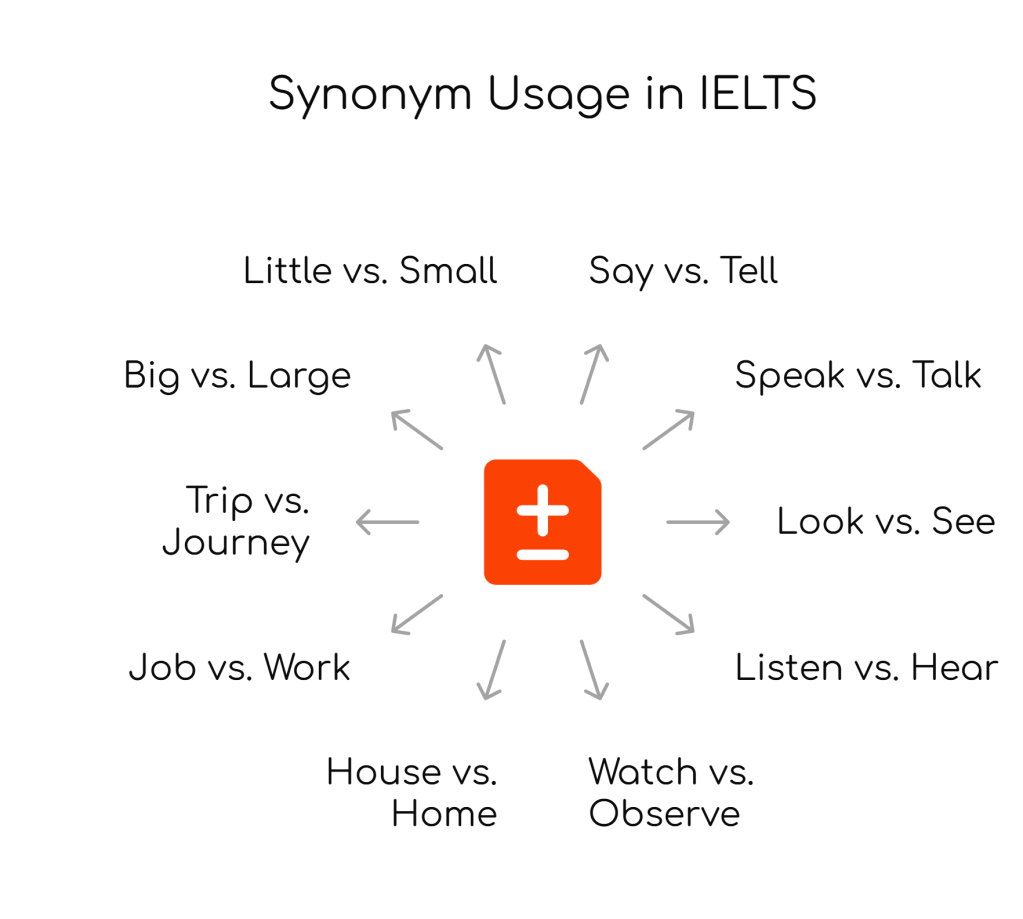
- Say vs. Tell
Say is used to express words generally; tell requires a listener.
E.g.: He said he was tired. / He told me he was tired. - Speak vs. Talk
Speak is more formal or one-way; talk is casual and usually two-way.
E.g.: She spoke at the conference. / We talked for hours. - Look vs. See
Look implies intention; see is passive.
E.g.: Look at that! / I saw her at the mall. - Listen vs. Hear
Listen is active; hear is passive.
E.g.: He listened to music. / I heard a strange noise. - Watch vs. Observe
Watch is casual; observe is formal and analytical.
E.g.: I watched a movie. / The scientist observed the behavior. - House vs. Home
House is a building; home is emotional or personal.
E.g.: That’s a beautiful house. / Home is where the heart is. - Job vs. Work
Job is a specific role; work refers to effort or tasks.
E.g.: She has a great job. / I have a lot of work to do. - Trip vs. Journey
Trip is short and practical; journey is longer or metaphorical.
E.g.: We took a weekend trip. / Life is a journey. - Big vs. Large
Big is informal and general; large is more technical or formal.
E.g.: That’s a big dog. / The large intestine. - Little vs. Small
Little can suggest emotion; small is size-focused.
E.g.: A sweet little girl. / A small room. - End vs. Finish
End is the final point; finish implies completing a task.
E.g.: The movie ended. / I finished my homework. - Speak vs. Address
Speak is neutral; address is formal and audience-specific.
E.g.: He spoke to the crowd. / She addressed the committee. - Lonely vs. Alone
Lonely is emotional; alone is physical.
E.g.: I felt lonely. / I was home alone. - Rob vs. Steal
Rob means taking from a person/place; steal is the act of taking.
E.g.: He robbed a bank. / He stole the money. - Begin vs. Start
Begin is formal; start is neutral.
E.g.: Let us begin. / The race started at noon. - Listen vs. Attend
Listen is passive; attend includes presence and participation.
E.g.: He listened to the talk. / She attended the seminar. - Repair vs. Mend
Repair is technical; mend is often personal or emotional.
E.g.: They repaired the car. / She mended her dress. - Mistake vs. Error
Mistake is casual; error is more serious or technical.
E.g.: I made a mistake. / There was an error in the data. - Speak vs. Talk
(Repeated but notable!)
E.g.: She spoke French fluently. / We talked about the movie. - Speak vs. Converse
Converse is formal or written; speak is general.
E.g.: They conversed professionally. / We spoke briefly. - Assure vs. Ensure
Assure means to remove doubt; ensure means to make certain.
E.g.: I assure you everything is fine. / Please ensure the door is locked. - Bring vs. Take
Bring is toward the speaker; take is away from the speaker.
E.g.: Bring the book here. / Take it to the office. - Borrow vs. Lend
Borrow means to take temporarily; lend means to give temporarily.
E.g.: I borrowed his pen. / He lent me a pen. - Rise vs. Raise
Rise is intransitive (no object); raise is transitive (needs object).
E.g.: The sun rises. / He raised his hand. - Discover vs. Invent
Discover is to find something existing; invent is to create something new.
E.g.: Columbus discovered America. / Edison invented the light bulb. - Historic vs. Historical
Historic means significant; historical means related to history.
E.g.: A historic event. / A historical novel. - Remember vs. Remind
Remember is internal; remind is external.
E.g.: I remembered the date. / He reminded me about the date. - Economic vs. Economical
Economic relates to economics; economical means saving money.
E.g.: Economic policies. / An economical car. - Emigrate vs. Immigrate
Emigrate is leaving; immigrate is arriving.
E.g.: He emigrated from India. / She immigrated to Canada. - Advice vs. Advise
Advice is a noun; advise is a verb.
E.g.: He gave me good advice. / I advise you to rest. - Principal vs. Principle
Principal is a person or main thing; principle is a rule.
E.g.: The school principal. / The principle of equality. - Lose vs. Loose
Lose is a verb; loose is an adjective.
E.g.: Don’t lose your keys. / The shirt is loose. - Compliment vs. Complement
Compliment is praise; complement means to complete.
E.g.: She gave me a compliment. / Red wine complements steak. - Farther vs. Further
Farther refers to physical distance; further to degree or extent.
E.g.: He walked farther. / Let’s discuss this further. - Continual vs. Continuous
Continual is repeated with breaks; continuous is without interruption.
E.g.: Continual delays. / Continuous noise. - Famous vs. Notorious
Famous is positive; notorious is negative.
E.g.: A famous actor. / A notorious criminal. - Sympathy vs. Empathy
Sympathy is feeling for; empathy is feeling with.
E.g.: I feel sympathy for him. / I empathize with his pain. - Assumption vs. Presumption
Assumption is neutral; presumption can imply arrogance.
E.g.: An assumption based on data. / A presumption of guilt. - Anxious vs. Eager
Anxious implies worry; eager implies enthusiasm.
E.g.: She was anxious about the results. / He was eager to start. - Desert vs. Dessert
Desert is dry land; dessert is sweet food.
E.g.: The Sahara Desert. / I love chocolate dessert. - Convince vs. Persuade
Convince changes belief; persuade changes action.
E.g.: He convinced me it was true. / He persuaded me to go. - Among vs. Between
Among is for groups; between is for two items.
E.g.: Divide it among friends. / Divide it between you and me. - Adapt vs. Adopt
Adapt is to adjust; adopt is to take in or begin using.
E.g.: Adapt to new rules. / Adopt a child. - Assistance vs. Attendance
Assistance means help; attendance means being present.
E.g.: I need assistance. / His attendance is required. - Ensure vs. Insure
Ensure is to make certain; insure is about financial protection.
E.g.: Ensure safety. / Insure your car. - Precede vs. Proceed
Precede means to come before; proceed means to go forward.
E.g.: Darkness precedes the storm. / Please proceed with caution. - Imply vs. Infer
Imply is done by speaker; infer is done by listener.
E.g.: He implied I was wrong. / I inferred he was upset. - Accept vs. Except
Accept means to receive; except means to exclude.
E.g.: I accept your gift. / Everyone except John is here. - Allusion vs. Illusion
Allusion is a reference; illusion is a false image.
E.g.: An allusion to Shakespeare. / A visual illusion. - Amount vs. Number
Amount is for uncountables; number for countables.
E.g.: A large amount of water. / A large number of people. - Historic vs. Legendary
Historic means significant in history; legendary means mythical or famous.
_E.g.: A historic treaty. / A legendary hero.* - Moral vs. Morale
Moral is about right and wrong; morale is mood or spirit.
_E.g.: Moral values. / Team morale is high.* - Practical vs. Pragmatic
Practical is functional; pragmatic is results-focused.
_E.g.: A practical solution. / A pragmatic approach.* - Conscious vs. Conscientious
Conscious is being awake/aware; conscientious means diligent.
_E.g.: He was conscious after the fall. / She’s a conscientious student.* - Discreet vs. Discrete
Discreet means tactful; discrete means separate.
_E.g.: Be discreet about it. / Discrete units of information.* - Official vs. Officious
Official is formal or authorized; officious is meddling.
_E.g.: An official announcement. / An officious colleague.* - Prescribe vs. Proscribe
Prescribe means recommend; proscribe means forbid.
_E.g.: The doctor prescribed medicine. / The law proscribes this act.* - Stationary vs. Stationery
Stationary means not moving; stationery means writing materials.
_E.g.: A stationary bike. / I bought some stationery.* - Explicit vs. Implicit
Explicit is clearly stated; implicit is implied.
_E.g.: An explicit warning. / Implicit trust.* - Urban vs. Suburban
Urban refers to cities; suburban to outskirts.
_E.g.: Urban development. / Suburban lifestyle.* - Sensual vs. Sensuous
Sensual implies physical pleasure; sensuous implies appeal to senses.
_E.g.: A sensual massage. / A sensuous painting.* - Censor vs. Censure
Censor means suppress content; censure means express disapproval.
_E.g.: The film was censored. / He was censured by the board.* - Ingenious vs. Ingenuous
Ingenious means clever; ingenuous means naive or honest.
_E.g.: An ingenious idea. / An ingenuous reply.* - Flaunt vs. Flout
Flaunt means show off; flout means disregard.
_E.g.: She flaunted her success. / He flouted the rules.* - Mitigate vs. Alleviate
Mitigate reduces severity; alleviate reduces pain or burden.
_E.g.: Mitigate the risk. / Alleviate the pain.* - Defuse vs. Diffuse
Defuse is to calm; diffuse is to spread.
_E.g.: Defuse the tension. / The scent diffused through the room.* - Elicit vs. Illicit
Elicit means to draw out; illicit means illegal.
_E.g.: Elicit a response. / Illicit trade.* - Ensure vs. Assure vs. Insure
Ensure = make certain; assure = remove doubt; insure = financial protection.
_E.g.: Ensure safety. / Assure success. / Insure property.* - Affect vs. Effect
Affect is a verb; effect is a noun.
E.g.: The weather affects mood. / The law had a big effect. - Complement vs. Supplement
Complement completes; supplement adds.
_E.g.: Wine complements food. / Vitamins supplement diet.* - Acceptable vs. Tolerable
Acceptable meets standards; tolerable is barely endurable.
_E.g.: Acceptable behavior. / Tolerable pain.* - Appraise vs. Apprise
Appraise means to assess; apprise means to inform.
_E.g.: Appraise the value. / I will apprise you of the results.* - Personal vs. Personnel
Personal relates to individual; personnel refers to staff.
_E.g.: Personal opinion. / Military personnel.* - Adverse vs. Averse
Adverse is unfavorable; averse is reluctant.
_E.g.: Adverse effects. / He is averse to change.* - Altogether vs. All together
Altogether means entirely; all together means in a group.
_E.g.: That’s altogether wrong. / We arrived all together.* - Canvas vs. Canvass
Canvas is a material; canvass is to seek opinions.
_E.g.: A canvas painting. / Canvass for votes.* - Envelop vs. Envelope
Envelop is a verb; envelope is a noun.
_E.g.: Darkness enveloped the town. / Put the letter in an envelope.* - Council vs. Counsel
Council is a group; counsel is advice or a lawyer.
_E.g.: City council. / He gave me legal counsel.* - Hoard vs. Horde
Hoard is a stash; horde is a crowd.
_E.g.: A hoard of gold. / A horde of tourists.* - Proceed vs. Precede
(Repeat from earlier but worth emphasizing.)
E.g.: The ceremony preceded the dinner. / We may now proceed. - Moot vs. Mute
Moot means debatable or irrelevant; mute means silent.
E.g.: That point is moot. / She remained mute during the meeting. - Prescribe vs. Describe
Prescribe means to officially recommend; describe means to explain.
E.g.: The doctor prescribed rest. / He described the scene in detail. - Appraise vs. Evaluate
Appraise is usually financial or material; evaluate is broader, including abstract ideas.
E.g.: Appraise the house. / Evaluate the situation. - Ingenious vs. Creative
Ingenious suggests cleverness and innovation; creative is more general.
E.g.: An ingenious device. / A creative solution. - Classic vs. Classical
Classic means timeless; classical relates to ancient art or culture.
_E.g.: A classic novel. / Classical music.* - Depreciate vs. Devalue
Depreciate is a gradual reduction in value; devalue is a sudden or intentional reduction.
E.g.: Cars depreciate over time. / The currency was devalued. - Uninterested vs. Disinterested
Uninterested means not interested; disinterested means impartial.
_E.g.: He was uninterested in the topic. / A disinterested judge is essential.* - Council vs. Counsel
Council is a group; counsel is advice or a lawyer.
_E.g.: The city council met today. / She sought legal counsel.* - Verbal vs. Oral
Verbal relates to words; oral refers specifically to spoken words.
_E.g.: A verbal agreement. / An oral presentation.* - Ensure vs. Guarantee
Ensure means to make certain; guarantee is a stronger promise or legal assurance.
_E.g.: Please ensure accuracy. / We guarantee a refund.* - Judicial vs. Judicious
Judicial relates to judges or courts; judicious means wise.
_E.g.: Judicial powers. / A judicious decision.* - Sensibility vs. Sensitivity
Sensibility is capacity for emotion or appreciation; sensitivity is responsiveness.
_E.g.: She has artistic sensibility. / He has skin sensitivity.* - Discrete vs. Distinct
Discrete means separate; distinct means clearly different.
_E.g.: Discrete data points. / A distinct flavor.* - Reluctant vs. Resistant
Reluctant means unwilling; resistant means able to withstand.
_E.g.: He was reluctant to help. / This material is water-resistant.* - Moral vs. Ethical
Moral is personal; ethical is societal or professional.
_E.g.: His moral beliefs. / An ethical dilemma.* - Continual vs. Perpetual
Continual means frequently recurring; perpetual means never-ending.
_E.g.: Continual interruptions. / Perpetual motion.* - Connotation vs. Denotation
Connotation is implied meaning; denotation is literal meaning.
_E.g.: “Home” connotes warmth. / The denotation is a place to live.* - Compelled vs. Obliged
Compelled is forced by internal/external pressure; obliged is duty or etiquette.
_E.g.: He felt compelled to act. / I’m obliged to help you.* - Historic vs. Epochal
Historic means notable in history; epochal means marking a new era.
_E.g.: A historic election. / An epochal shift in technology.* - Permit vs. License
Permit is authorization for a specific activity; license is broader and ongoing.
_E.g.: A building permit. / A driver’s license.*
Conclusion
Understanding subtle differences between similar or similar-sounding words is essential for achieving clarity, precision, and sophistication in IELTS. While synonyms might appear interchangeable, small nuances can shift meaning significantly—especially in formal writing and speaking contexts. Mastering these distinctions will boost your vocabulary and improve your IELTS band score.
#IELTSGuidePhil #IELTS #IELTSVocabulary #IELTSTips #AcademicEnglish #IELTSWriting #IELTSSpeaking #Synonyms #Homonyms #CommonMistakes #WordUsage #IELTSPreparation #EnglishForIELTS
 IELTS Guide Phil
Leave a comment