
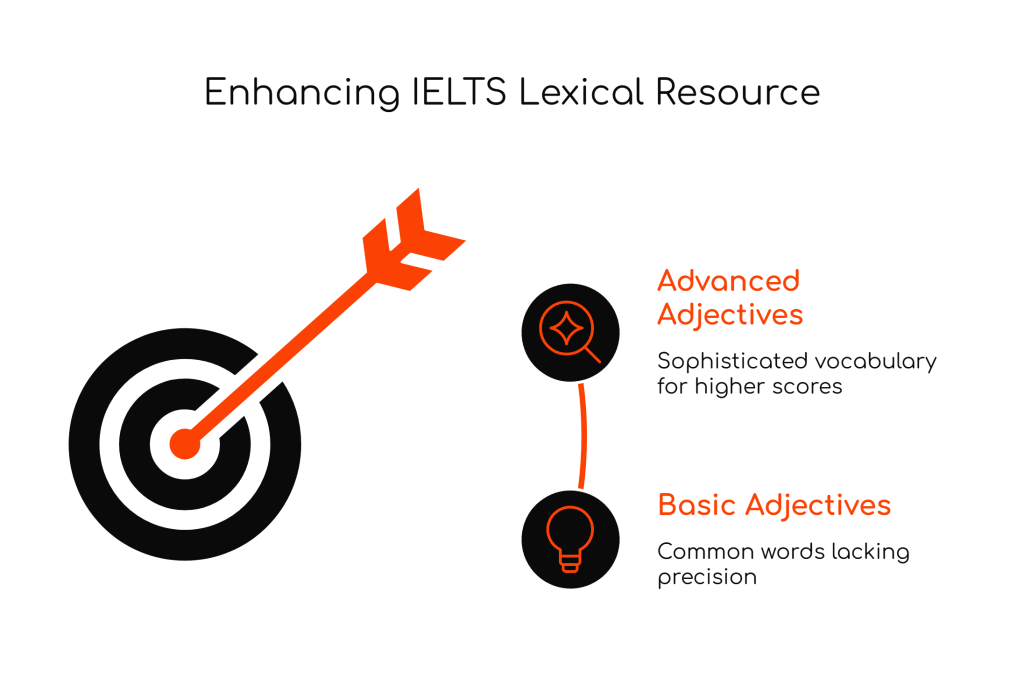
In IELTS Speaking and Writing, using high-level adjectives instead of basic ones can greatly improve your lexical resource score. Basic adjectives like “good,” “bad,” “big,” or “nice” are commonly used, but they often lack the precision and sophistication needed for a higher band score. In this post, you’ll find 100 advanced adjectives categorized by their simpler counterparts, with definitions and example sentences to guide your usage.
1. Basic: Good
- Beneficial – producing good results. “Exercise is beneficial to your health.”
- Advantageous – providing benefits. “Working from home can be advantageous for productivity.”
- Favorable – showing approval or advantage. “The results were favorable.”
- Profitable – producing financial gain. “The investment was highly profitable.”
- Excellent – extremely good. “She gave an excellent presentation.”
2. Basic: Bad
- Detrimental – causing harm. “Smoking is detrimental to health.”
- Harmful – damaging. “Air pollution is harmful to children.”
- Unfavorable – not good. “The weather was unfavorable for hiking.”
- Inferior – of lower quality. “The product was inferior to the original.”
- Deplorable – shockingly bad. “The living conditions were deplorable.”
3. Basic: Big
- Enormous – very large. “They made an enormous mistake.”
- Massive – huge. “The company made a massive profit.”
- Tremendous – extremely large or great. “There was tremendous pressure to succeed.”
- Colossal – very big in size or importance. “They suffered a colossal loss.”
- Substantial – considerable in size. “We saw a substantial increase in sales.”
4. Basic: Small
- Minute – extremely small. “A minute amount of error can change the result.”
- Tiny – very small. “The baby held a tiny hand.”
- Modest – not large. “She made a modest income.”
- Compact – small but efficient. “It’s a compact apartment.”
- Petite – small and delicate. “She wore a petite dress.”
5. Basic: Happy
- Elated – extremely happy. “She was elated after receiving the news.”
- Ecstatic – overwhelmingly happy. “He was ecstatic about the results.”
- Joyful – full of joy. “The children were joyful.”
- Content – satisfied. “He was content with his job.”
- Delighted – very pleased. “We were delighted to see them.”
6. Basic: Sad
- Miserable – very unhappy. “She felt miserable after the breakup.”
- Depressed – deeply unhappy. “He was diagnosed as clinically depressed.”
- Downcast – low in spirits. “She looked downcast after the exam.”
- Sorrowful – full of sorrow. “The news left us sorrowful.”
- Gloomy – feeling sad or pessimistic. “It was a gloomy day.”
7. Basic: Nice
- Pleasant – enjoyable. “It was a pleasant experience.”
- Charming – very pleasant or attractive. “He had a charming smile.”
- Delightful – giving great pleasure. “The meal was delightful.”
- Appealing – attractive. “Her idea was quite appealing.”
- Gracious – kind and polite. “He gave a gracious reply.”
8. Basic: Smart
- Intelligent – high mental capacity. “She is incredibly intelligent.”
- Brilliant – exceptionally clever. “He had a brilliant solution.”
- Astute – sharp and perceptive. “An astute observation.”
- Wise – showing good judgment. “A wise decision.”
- Insightful – showing deep understanding. “Her comment was insightful.”
9. Basic: Important
- Significant – having great meaning. “This is a significant discovery.”
- Crucial – very important. “Timing is crucial.”
- Essential – absolutely necessary. “Water is essential for life.”
- Vital – extremely important. “It is vital to stay informed.”
- Fundamental – forming a necessary base. “This is a fundamental principle.”
10. Basic: Interesting
- Captivating – holding interest. “The book was captivating.”
- Engaging – charming and appealing. “An engaging story.”
- Fascinating – extremely interesting. “The documentary was fascinating.”
- Intriguing – arousing curiosity. “An intriguing idea.”
- Compelling – evoking interest. “Her argument was compelling.”
11. Basic: Fast
- Rapid – happening quickly. “There was a rapid response to the fire.”
- Swift – moving quickly. “She made a swift decision.”
- Speedy – quick. “The process was speedy.”
- Prompt – done without delay. “He gave a prompt reply.”
- Expeditious – done with speed and efficiency. “An expeditious solution was required.”
12. Basic: Slow
- Sluggish – lacking energy. “The economy is sluggish.”
- Lethargic – drowsy or sluggish. “He felt lethargic after lunch.”
- Gradual – happening slowly. “The change was gradual.”
- Unhurried – not rushed. “She moved at an unhurried pace.”
- Delayed – late. “The train was delayed.”
13. Basic: Strong
- Powerful – having great strength. “A powerful message.”
- Sturdy – solid and strong. “A sturdy table.”
- Robust – strong and healthy. “A robust economy.”
- Forceful – full of force. “He made a forceful argument.”
- Resilient – able to recover. “She is emotionally resilient.”
14. Basic: Weak
- Frail – weak and delicate. “He looked frail after the illness.”
- Feeble – lacking strength. “A feeble attempt.”
- Delicate – easily broken. “A delicate structure.”
- Vulnerable – open to harm. “The species is vulnerable to extinction.”
- Tenuous – weak or slight. “A tenuous connection.”
15. Basic: Tired
- Exhausted – very tired. “She felt exhausted after the run.”
- Weary – physically or mentally tired. “He was weary from work.”
- Fatigued – extremely tired. “They were fatigued after the long flight.”
- Drained – emptied of energy. “He looked drained after the meeting.”
- Drowsy – sleepy. “The medication made her drowsy.”
16. Basic: Cold
- Chilly – uncomfortably cold. “It was a chilly evening.”
- Frigid – extremely cold. “The frigid air bit his face.”
- Icy – very cold or unfriendly. “She gave him an icy stare.”
- Wintry – characteristic of winter. “A wintry landscape.”
- Frosty – very cold and icy. “A frosty reception.”
17. Basic: Hot
- Scorching – extremely hot. “A scorching summer day.”
- Boiling – very hot. “The water was boiling.”
- Searing – intensely hot. “The searing sun.”
- Blistering – very hot and intense. “Blistering temperatures.”
- Sweltering – uncomfortably hot. “It was sweltering inside.”
18. Basic: Loud
- Deafening – extremely loud. “The music was deafening.”
- Thunderous – very loud. “Thunderous applause.”
- Piercing – high and loud. “A piercing scream.”
- Boisterous – noisy and lively. “Boisterous children.”
- Resounding – echoing loudly. “A resounding success.”
19. Basic: Quiet
- Silent – completely quiet. “The room was silent.”
- Muted – soft and quiet. “A muted tone.”
- Hushed – very quiet. “A hushed conversation.”
- Soft-spoken – speaking softly. “He was soft-spoken.”
- Tranquil – peaceful and quiet. “A tranquil garden.”
20. Basic: Dirty
- Filthy – very dirty. “His clothes were filthy.”
- Grimy – covered with dirt. “The window was grimy.”
- Squalid – extremely dirty. “Squalid conditions.”
- Muddy – full of mud. “Muddy boots.”
- Stained – marked or discolored. “A stained shirt.”
Conclusion
Using high-level adjectives instead of simple ones can transform your speaking and writing responses from average to exceptional. Not only do these words help convey your ideas more precisely, but they also showcase your lexical flexibility—something IELTS examiners are keen to see. Make a habit of using these adjectives in your daily practice and watch your score improve.
#IELTS #IELTSVocabulary #IELTSWriting #IELTSSpeaking #LexicalResource #IELTSTips #HighLevelAdjectives #LearnEnglish #AcademicEnglish #IELTSGuidePhil
 IELTS Guide Phil
Leave a comment