
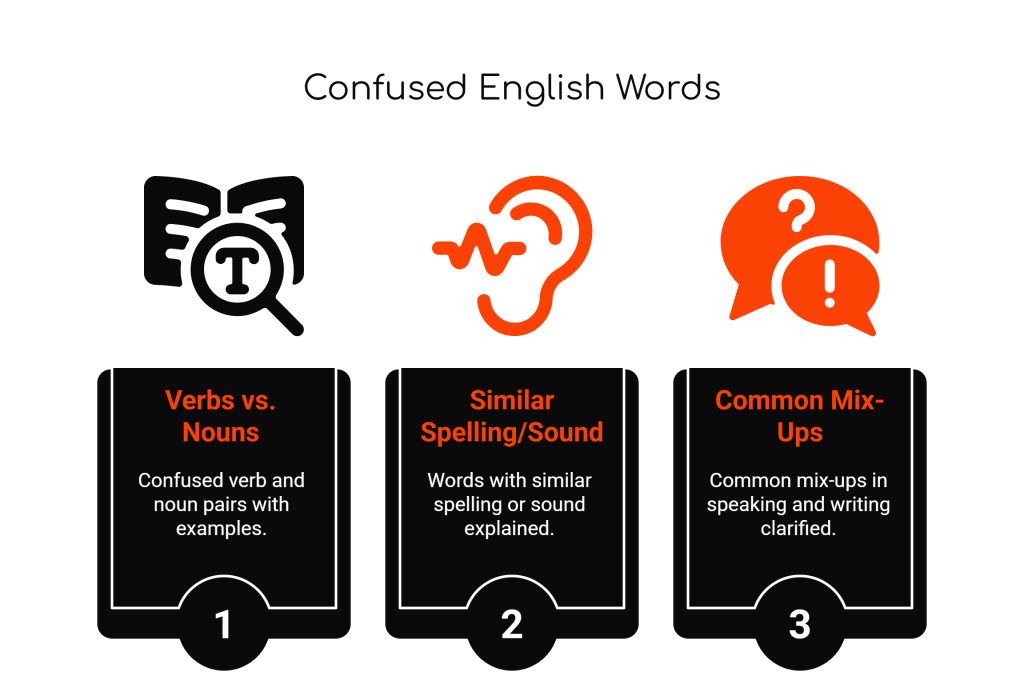
English can be tricky, especially when it comes to words that look or sound similar but have different meanings. These confusing pairs often appear in IELTS Writing and Speaking tests, and using them incorrectly can lower your score. In this guide, we break down 100 commonly confused words and expressions, providing clear definitions and example sentences to help you master them.
1–20: Verbs vs. Nouns
- Affect (v.) vs. Effect (n.)
To influence vs. a result
Example: The weather can affect your mood. / The new law had a positive effect. - Advise (v.) vs. Advice (n.)
To recommend vs. a recommendation
Example: I advise you to study daily. / She gave me useful advice. - Accept (v.) vs. Except (prep.)
To receive vs. excluding
Example: He accepted the gift. / Everyone is invited except Tom. - Assure (v.) vs. Ensure (v.) vs. Insure (v.)
To guarantee vs. to make certain vs. to protect financially
Example: I assure you everything is fine. / Please ensure the doors are locked. / I insured my car last week. - Compliment (n./v.) vs. Complement (n./v.)
Praise vs. to complete or enhance
Example: She gave me a nice compliment. / That scarf complements your outfit. - Emigrate (v.) vs. Immigrate (v.)
To leave a country vs. to come into a country
Example: He emigrated from India. / She immigrated to Canada. - Prescribe (v.) vs. Proscribe (v.)
To recommend medicine vs. to forbid
Example: The doctor prescribed antibiotics. / The policy proscribes smoking indoors. - Raise (v.) vs. Rise (v.)
To lift something vs. to go up by itself
Example: Raise your hand. / Prices rise every year. - Lay (v.) vs. Lie (v.)
To place something vs. to recline
Example: Lay the book on the table. / I need to lie down. - Lose (v.) vs. Loose (adj.)
To misplace vs. not tight
Example: Don’t lose your phone. / These jeans are too loose. - Adapt (v.) vs. Adopt (v.)
To adjust vs. to take as one’s own
Example: He adapted quickly. / They adopted a new strategy. - Acceptable (adj.) vs. Accessible (adj.)
Allowed vs. easy to reach or enter
Example: That behavior is not acceptable. / The library is accessible by bus. - Allude (v.) vs. Elude (v.)
To hint at vs. to escape
Example: He alluded to his past. / The suspect eluded capture. - Assent (n./v.) vs. Ascent (n.)
Agreement vs. upward movement
Example: She gave her assent. / The ascent was steep. - Capital (n.) vs. Capitol (n.)
City or money vs. government building
Example: London is the capital. / The protest was held at the Capitol. - Defuse (v.) vs. Diffuse (v.)
To calm or disarm vs. to spread out
Example: She helped defuse the situation. / Light diffused through the room. - Discreet (adj.) vs. Discrete (adj.)
Careful, tactful vs. separate, distinct
Example: Be discreet when discussing it. / The data was divided into discrete groups. - Principal (n./adj.) vs. Principle (n.)
Main or head of school vs. a rule or belief
Example: The principal spoke at the assembly. / Honesty is an important principle. - Stationary (adj.) vs. Stationery (n.)
Not moving vs. writing materials
Example: The car remained stationary. / I bought new stationery. - Than (conj.) vs. Then (adv.)
Comparison vs. time sequence
Example: She’s taller than me. / First we eat, then we play.
21–60: Similar Spelling or Sound
- Their / There / They’re
Possessive / Place / They are
Example: Their house is big. / The book is over there. / They’re going to the cinema. - Its vs. It’s
Possessive / It is
Example: The cat licked its paw. / It’s a sunny day. - Your vs. You’re
Possessive / You are
Example: Your bag is open. / You’re very kind. - Whose vs. Who’s
Possessive / Who is
Example: Whose phone is this? / Who’s coming to dinner? - Farther vs. Further
Distance / Degree or extent
Example: He walked farther than me. / We need to discuss this further. - Among vs. Between
In a group / In relation to two things
Example: Share it among friends. / Choose between tea and coffee. - Ensure vs. Insure
To make sure / To provide insurance
Example: Please ensure safety. / I insured my laptop. - Fewer vs. Less
Countable / Uncountable
Example: Fewer students passed. / Less water is needed. - Imply vs. Infer
To suggest / To conclude
Example: He implied I was wrong. / I inferred he was upset. - Historic vs. Historical
Important / Related to history
Example: A historic victory. / A historical document. - Elicit vs. Illicit
To draw out / Illegal
Example: His speech elicited applause. / The trade was illicit. - Precede vs. Proceed
Come before / To continue
Example: A speech will precede the dinner. / Please proceed to the next page. - Access vs. Excess
Entry / Surplus
Example: I have access to data. / Avoid excess sugar. - Appraise vs. Apprise
Evaluate / Inform
Example: She appraised the painting. / I’ll apprise him of the situation. - Council vs. Counsel
Group / Advice or lawyer
Example: The city council met today. / He needs legal counsel. - Desert vs. Dessert
Dry place / Sweet treat
Example: The Sahara is a desert. / I love chocolate dessert. - Eminent vs. Imminent
Famous / About to happen
Example: An eminent professor. / Danger is imminent. - Loose vs. Lose
Not tight / Misplace
Example: My shoe is loose. / I don’t want to lose it. - Moral vs. Morale
Principle / Spirit or attitude
Example: The moral of the story. / Team morale is low. - Personal vs. Personnel
Private / Staff
Example: It’s a personal issue. / The personnel were trained.
61–100: Common Mix-Ups in Speaking and Writing
- Prejudice vs. Bias
Preconceived opinion / Inclination or tendency
Example: Racial prejudice is a major issue. / He showed a bias toward his friend. - Respectfully vs. Respectively
With respect / In the order mentioned
Example: She spoke respectfully. / John and Mary are 12 and 14, respectively. - Sight vs. Site vs. Cite
Vision / Location / To reference
Example: She lost her sight. / It’s a construction site. / Please cite your sources. - Conscious vs. Conscience
Awake or aware / Moral sense
Example: He was conscious after the fall. / His conscience wouldn’t let him lie. - Altogether vs. All together
Completely / In a group
Example: It’s altogether wrong. / We sang all together. - Breach vs. Breech
Violation / Baby’s position during birth
Example: A breach of contract. / The baby was in breech position. - Hoard vs. Horde
To collect / Large group
Example: He hoards old coins. / A horde of tourists arrived. - Illicit vs. Elicit
Illegal / To draw out
Example: Illicit drugs were found. / His joke elicited laughter. - Ingenious vs. Ingenuous
Clever / Naive or innocent
Example: An ingenious invention. / She gave an ingenuous smile. - Loose vs. Lose
Not tight / To misplace
Example: My belt is loose. / I always lose my keys. - Device vs. Devise
Tool / To invent
Example: This device is helpful. / They devised a new strategy. - Deny vs. Refuse
Say something isn’t true / Decline something offered
Example: He denied the accusation. / She refused the offer. - Economic vs. Economical
Relating to the economy / Cost-effective
Example: Economic growth is vital. / This car is economical. - Official vs. Officious
Formal or authorized / Meddlesome
Example: An official statement. / He was an officious manager. - Oppress vs. Repress
To dominate cruelly / To hold back
Example: The regime oppressed the people. / He repressed his emotions. - Persecute vs. Prosecute
Harass based on beliefs / Take legal action
Example: They were persecuted for their faith. / The company was prosecuted. - Principal vs. Principle
Main or head / Rule or belief
Example: The school principal is kind. / He follows the principle of fairness. - Reluctant vs. Reticent
Unwilling / Quiet or reserved
Example: She was reluctant to speak. / He remained reticent during the meeting. - Than vs. Then
Comparison / Time
Example: She is taller than me. / We’ll eat, then go out. - Waive vs. Wave
To give up a right / A hand gesture or swell
Example: They waived the fee. / She gave a friendly wave. - Vain vs. Vein vs. Vane
Proud / Blood vessel / Weather tool
Example: She’s very vain. / A vein was visible. / The wind vane spun. - Allusion vs. Illusion
Reference / False impression
Example: The novel makes an allusion to Shakespeare. / It was just an illusion. - Definite vs. Definitive
Clear / Final or conclusive
Example: I need a definite answer. / This is the definitive guide. - Continual vs. Continuous
Repeated over time / Uninterrupted
Example: Continual problems arose. / A continuous hum filled the air. - Climactic vs. Climatic
Exciting / Related to climate
Example: The film had a climactic ending. / Climatic changes are occurring globally. - Compliment vs. Complement
Praise / To enhance
Example: Thanks for the compliment! / This wine complements the meal. - Foreword vs. Forward
Intro in a book / Ahead
Example: I read the foreword. / Please move forward. - Hanger vs. Hangar
For clothes / Airplane garage
Example: I need more hangers. / The aircraft is in the hangar. - Gorilla vs. Guerrilla
A primate / Irregular soldier
Example: We saw a gorilla at the zoo. / Guerrilla tactics were used. - Prescribe vs. Proscribe
Authorize / Forbid
Example: Doctors prescribe medicine. / The law proscribes discrimination. - Disassemble vs. Dissemble
Take apart / Conceal truth
Example: He disassembled the computer. / Don’t dissemble your feelings. - Canvas vs. Canvass
Fabric / Solicit opinions
Example: The painting was on canvas. / Let’s canvass the neighborhood. - Capital vs. Capitol
Main city or money / Legislative building
Example: Rome is the capital of Italy. / The Capitol building is historic. - Cue vs. Queue
Signal / Line
Example: That was my cue to leave. / We waited in a queue. - Altar vs. Alter
Religious table / To change
Example: They married at the altar. / Please alter your plans. - Born vs. Borne
Given birth / Carried
Example: She was born in July. / The weight was borne by the bridge. - Dual vs. Duel
Two / Fight
Example: He holds dual citizenship. / A duel took place at dawn. - Phase vs. Faze
Stage / To disturb
Example: This is a new phase. / His attitude didn’t faze me. - Brake vs. Break
To stop / To separate or rest
Example: Hit the brake! / Take a short break. - Loathe vs. Loath
To hate / Reluctant
Example: I loathe injustice. / He was loath to admit it.
Conclusion
Understanding the subtle differences between commonly confused words can significantly improve your accuracy and confidence in IELTS Speaking and Writing. With consistent practice and awareness, you’ll not only avoid common pitfalls but also make a stronger impression on your examiner.
#IELTSGuidePhil #IELTS #IELTSVocabulary #CommonlyConfusedWords #EnglishTips #IELTSSpeaking #IELTSWriting #LearnEnglish #GrammarTips #WordConfusion #EnglishMistakes #IELTSGuidePhil
 IELTS Guide Phil
Leave a comment