
These completion tasks in the IELTS Reading section test your ability to understand details, logical connections, and paraphrased information from specific sections of the passage. While the format may vary (summary, notes, tables, or flow-charts), the skills you need are consistent: information scanning, understanding relationships, and vocabulary awareness.
What Are Summary, Note, Table, or Flow-chart Completion Tasks?
You are given an incomplete summary, note list, table, or flow-chart, and you must complete it using:
- Words from the passage (when instructed),
- Or words from a given box/list.
These tasks often summarize a section of the passage in a condensed or visual form.
Instructions will specify:
- How many words/numbers you can use (e.g. “NO MORE THAN TWO WORDS”)
- Whether to choose from the passage or a box of options
Example (Summary Completion)
Instructions: Complete the summary below using NO MORE THAN TWO WORDS from the passage.
Text from Passage:
“Insects such as bees are essential pollinators. Without them, many plant species would struggle to reproduce. Habitat loss and pesticide use are among the biggest threats they face.”
Summary:
Bees are vital for ______. However, their survival is threatened due to habitat destruction and the use of ______.
Answers:
- pollination
- pesticides
Both answers come directly from the passage, follow the word limit, and fit grammatically.
Types of Completion Tasks
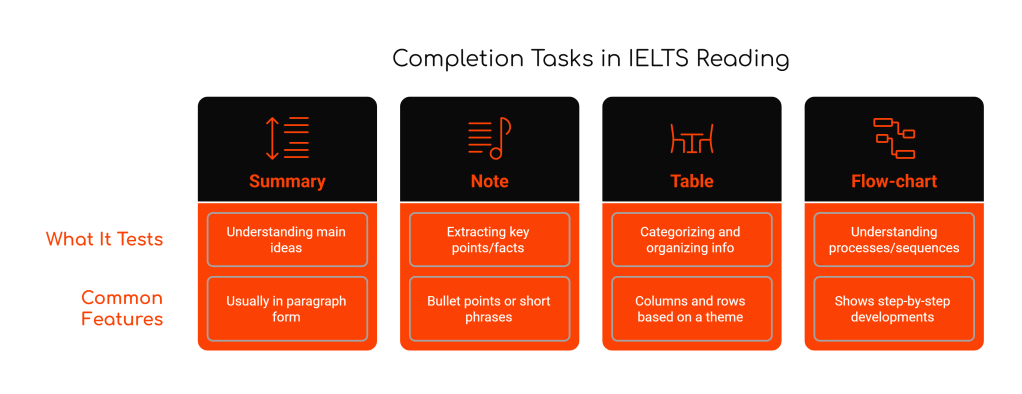
| Type | What It Tests | Common Features |
|---|---|---|
| Summary | Understanding main ideas | Usually in paragraph form |
| Note | Extracting key points/facts | Bullet points or short phrases |
| Table | Categorizing and organizing info | Columns and rows based on a theme |
| Flow-chart | Understanding processes/sequences | Shows step-by-step developments |
Key Strategies
1. Read Instructions First
Know how many words you’re allowed and where to get them from (passage or word box).
2. Understand the Structure
Before reading the passage, study the summary, note, table, or flow-chart. Try to predict what type of words are missing (noun, verb, date, etc.).
3. Find Keywords and Synonyms
Locate keywords in the question and scan the passage for matching ideas, not exact words. The test is full of paraphrasing.
4. Match Grammar and Logic
Your completed sentence or item must be grammatically and logically correct. If the blank follows “an,” your answer must begin with a vowel sound.
5. Double-Check Word Limit
Answers exceeding the word limit (even with correct content) are marked wrong.
Dos and Don’ts
DO:
- Check whether answers must come from a word list or the passage.
- Make sure answers fit grammatically.
- Keep answers concise and within the limit.
- Look for synonyms and paraphrased ideas.
- Practice different formats (tables, flow-charts, summaries).
DON’T:
- Use your own words unless allowed.
- Copy large chunks of text.
- Ignore singular/plural or tense agreement.
- Overlook prepositions or articles.
- Write more words than allowed.
Common Mistakes
- Wrong Word Count
- Exceeding the word limit invalidates the answer.
- Poor Grammar Fit
- If the blank expects a noun, don’t insert a verb.
- Copying the Wrong Part
- Be precise. Don’t include extra or irrelevant words.
- Ignoring Synonyms
- You won’t always find exact words — understand meaning.
FAQs
Q: Are answers in the same order as the passage?
A: Yes, generally the answers appear in the order of the text.
Q: Should I copy words exactly from the passage?
A: Yes, unless you are choosing from a word list, use exact wording from the passage.
Q: What if I use correct meaning but wrong grammar?
A: It will be marked wrong. Grammar must be correct.
Q: Can I use abbreviations or symbols?
A: No, use full standard words unless the abbreviation appears in the passage.
Practice Example (Flow-chart Completion)
Instructions: Complete the flow-chart using NO MORE THAN TWO WORDS.
Flow-chart:
Step 1: Seeds are planted
Step 2: They are watered and kept in ______ conditions
Step 3: After sprouting, they are moved to ______
Passage Excerpt:
“The seeds are initially placed in moist environments to encourage germination. Once the sprouts emerge, they are carefully transplanted into larger pots.”
Answers:
- moist
- larger pots
Final Tips
- Practice all formats (summary, note, table, flow-chart)
- Skim for general meaning, then scan for details
- Check if answers are singular/plural, noun/verb, etc.
- Keep practicing with time pressure to mimic the test
#IELTSGuidePhil #IELTS #IELTSReading #IELTSSummaryCompletion #IELTSFlowChart #IELTSNoteCompletion #IELTSTableCompletion #IELTSReadingTips #IELTSPreparation #IELTSBand7 #IELTSBand8 #StudyIELTS #IELTSAcademic #IELTSPractice #IELTSTest #EnglishForIELTS #IELTSReadingSkills
 IELTS Guide Phil
Leave a comment