
The Short Answer Questions task type in IELTS Reading tests your ability to locate specific factual information in the passage. You’ll need to read carefully and respond with concise answers using words directly from the text—without exceeding the word or number limits.
What Are Short Answer Questions?
In this task, you’re given a set of questions related to factual details in the passage, such as:
- Names
- Dates
- Places
- Events
- Figures or measurements
You must answer briefly—sometimes using only one to three words and/or a number from the passage.
Example
Passage Excerpt:
“The Great Fire of London started in a bakery on Pudding Lane in 1666. It destroyed much of the city over a period of four days, leaving thousands of people homeless.”
Question Instructions: Answer the following questions using NO MORE THAN THREE WORDS AND/OR A NUMBER.
Q1: Where did the fire begin?
Answer: a bakery
Q2: When did it happen?
Answer: 1666
Key Strategies
1. Read the Instructions Carefully
Pay close attention to the word/number limit. Even one extra word will result in a wrong answer.
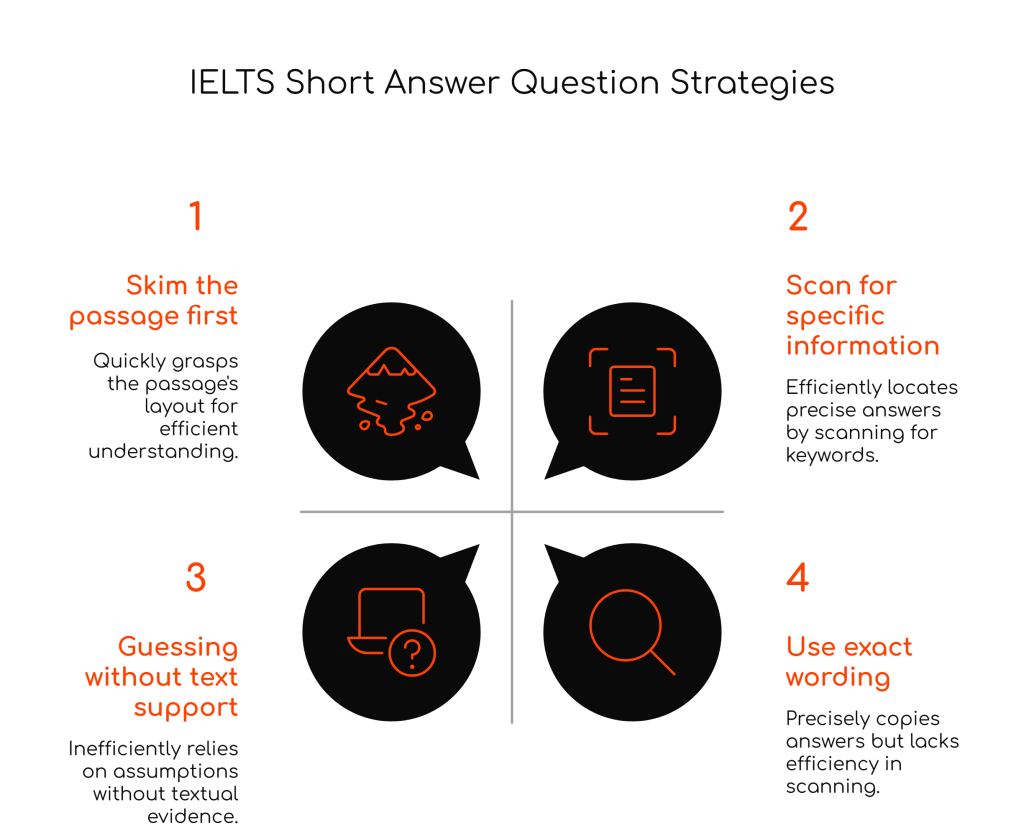
2. Skim the Passage First
Quickly get an idea of the topic, layout, and sections. Identify where facts like dates, names, or locations might appear.
3. Underline Keywords in the Question
Break the question into keywords and synonyms. This will help you scan the text effectively.
4. Scan for Specific Information
You’re not reading for overall meaning—look for specific matches to the question’s information.
5. Use the Exact Wording
You must take the answer directly from the passage. Don’t paraphrase or interpret.
Dos and Don’ts
DO:
- Stay within the word/number limit.
- Copy answers exactly from the passage.
- Match the grammatical form if the question requires it.
- Look out for synonyms in the questions.
- Double-check spelling.
DON’T:
- Add articles like “a” or “the” if it breaks the limit.
- Use your own words or paraphrased answers.
- Leave out units if they’re part of the correct answer (e.g., “10 kg” not just “10”).
- Assume the answer based on prior knowledge.
- Skip re-reading the passage to confirm your answer.
Common Mistakes
- Exceeding the Word Limit
→ If the instruction is “NO MORE THAN TWO WORDS”, don’t write three—even if they seem necessary. - Incorrect Spelling
→ Answers with spelling mistakes are marked incorrect. - Misunderstanding the Question
→ Make sure your answer actually answers what is being asked (e.g., “where” vs “when”). - Guessing Without Text Support
→ All answers must be directly supported by the passage.
Frequently Asked Questions
Q: Are the answers in order in the passage?
A: Usually, yes. The questions typically follow the order of the information in the text.
Q: Should I include articles (a/an/the)?
A: Only if needed and within the word limit.
Q: Are contractions like “don’t” acceptable?
A: No. Always write the full form unless the contraction appears exactly like that in the passage.
Q: Is spelling important?
A: Yes—spelling errors = incorrect answer.
Q: Are abbreviations accepted?
A: Only if they appear exactly like that in the passage.
Practice Mini-Task
Passage Excerpt:
“Marie Curie was awarded the Nobel Prize in Physics in 1903 and again in Chemistry in 1911 for her work on radioactivity.”
Instructions: Answer the questions below using NO MORE THAN TWO WORDS AND/OR A NUMBER.
Q1: In what year did Marie Curie receive her first Nobel Prize?
Answer: 1903
Q2: What subject earned her the second Nobel Prize?
Answer: Chemistry
Final Tips
- Focus on factual, precise answers.
- Practice scanning and locating data fast.
- Review how question words (where, when, what, who, how much) shape your search.
- Don’t overthink or infer—trust the text.
#IELTSGuidePhil #IELTS #IELTSReading #IELTSReadingTips #ShortAnswerQuestions #IELTSPreparation #IELTSTips #IELTSBand7 #IELTSBand8 #EnglishReadingSkills #AcademicReading #StudyIELTS #IELTSPracticeTest #ReadingComprehension
 IELTS Guide Phil
Leave a comment