
When it comes to IELTS Reading, one of the most confusing and misunderstood question types is YES/NO/NOT GIVEN. It tests more than reading comprehension — it challenges your ability to understand attitudes, opinions, and implied meanings.
If this task has ever left you second-guessing yourself, you’re not alone. But with the right strategies, you can turn uncertainty into confidence.
What Are “Identifying the Writer’s Views” Questions?
These questions require you to determine whether a statement reflects the views or claims made by the writer of the passage.
You will need to respond with:
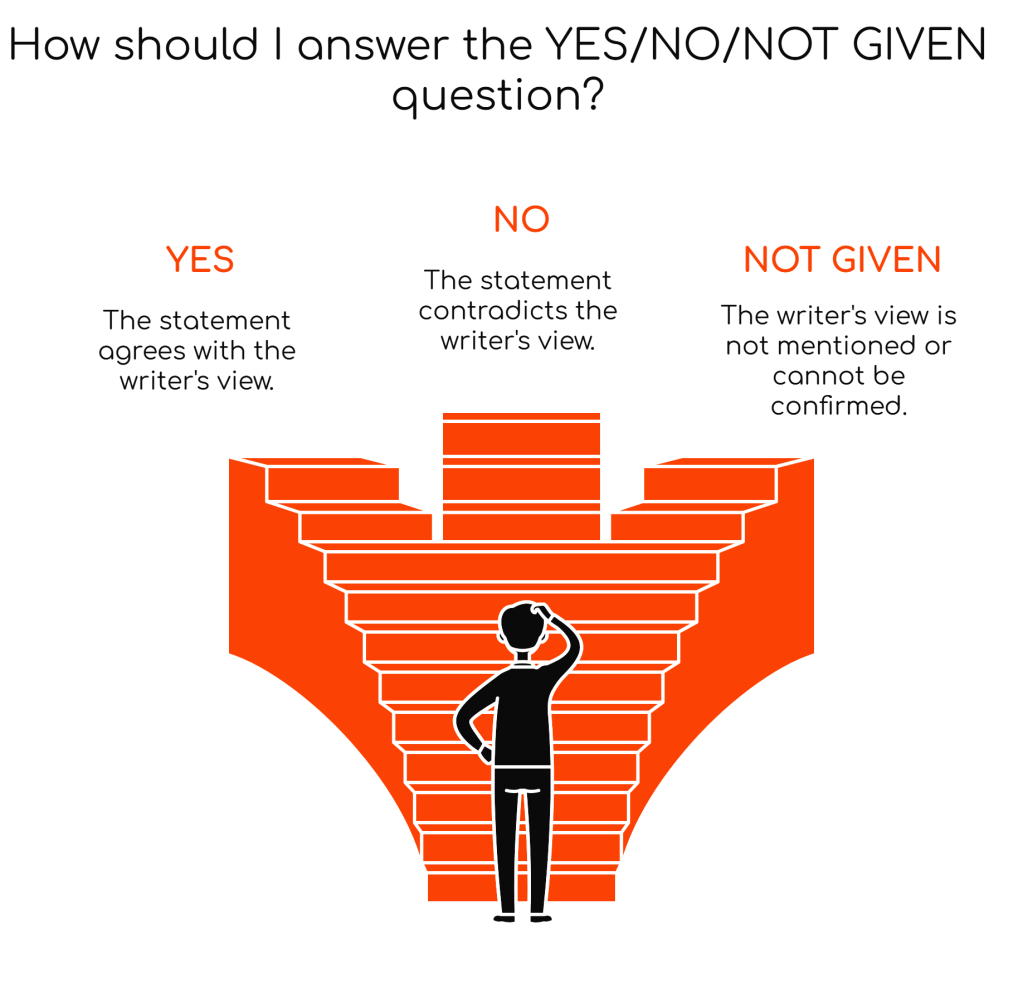
- YES – if the statement agrees with the writer’s view.
- NO – if the statement contradicts the writer’s view.
- NOT GIVEN – if the writer’s opinion is not mentioned or cannot be confirmed from the passage.
Important: These are NOT factual true/false questions. You are analyzing opinions, not facts.
Example Task
Passage Excerpt:
“Although some researchers argue that artificial intelligence will eventually outperform human intelligence, others claim it will never replicate human creativity.”
Statement:
- The writer believes that AI will surpass human intelligence.
Answer: NO
The writer presents both views but does not personally agree with either.
How It’s Different from TRUE/FALSE/NOT GIVEN
| Feature | YES/NO/NOT GIVEN | TRUE/FALSE/NOT GIVEN |
|---|---|---|
| Focus | Writer’s opinion or belief | Factual information |
| Skill Tested | Attitude, stance, evaluation | Fact-checking, detail matching |
| Example prompt | “Do the following statements agree with the views of the writer?” | “Do the following statements agree with the information in the passage?” |
Effective Strategies
1. Read the Instructions Carefully
Always check if it’s a YES/NO/NOT GIVEN or a TRUE/FALSE/NOT GIVEN task. Confusing the two leads to the wrong mindset.
2. Understand the Question Statement First
Break it down into keywords and ideas before you read the text. This helps you scan for relevant information faster.
3. Scan and Locate Relevant Passage
Quickly locate where the topic of the statement is discussed. Don’t read the entire passage — focus on the related paragraph.
4. Match Ideas, Not Just Words
The statement may be paraphrased in the passage. Look for the same meaning, not exact wording.
5. Look for Opinion Indicators
Words like believes, argues, suggests, claims, or according to the writer are key signs of opinion or attitude.
6. Don’t Assume Anything
Base your answer strictly on what’s in the text — no outside knowledge or assumptions!
Dos and Don’ts
Do:
- Read each statement carefully, focusing on attitude.
- Be aware of hedging words (e.g., might, some, often) that soften claims.
- Always locate evidence in the text before deciding.
Don’t:
- Confuse YES/NO/NOT GIVEN with TRUE/FALSE/NOT GIVEN.
- Answer “YES” just because the topic is mentioned — it must show agreement.
- Overthink — if you can’t find the writer’s stance at all, it’s probably “NOT GIVEN.”
Common Mistakes
- Mistaking general statements for specific opinions.
- The writer may mention a fact but not give their opinion.
- Assuming the writer agrees with a quoted expert.
- Just because someone is quoted doesn’t mean the writer shares that view.
- Choosing YES or NO when there’s not enough information.
- If you’re unsure and can’t confirm the opinion, choose NOT GIVEN.
- Getting stuck in the wording.
- Don’t try to match words — focus on matching meaning.
Frequently Asked Questions
Q: How can I tell the difference between “NO” and “NOT GIVEN”?
A: If the writer clearly disagrees, it’s NO. If the writer’s opinion is not stated at all, it’s NOT GIVEN.
Q: Can a paragraph contain multiple answers?
A: Yes. One section of the passage can answer more than one question.
Q: Are YES/NO/NOT GIVEN always in order?
A: Usually, yes — questions tend to follow the order of the text.
Q: Is guessing okay?
A: If you’re truly stuck, make an educated guess. But don’t overthink. Go with the evidence — or lack of it.
Quick Practice with Examples
Let’s take a look at full examples for each answer type: YES, NO, and NOT GIVEN.
Example 1: YES
Statement:
The writer believes that climate change is accelerating due to human activity.
Passage Excerpt:
“There is overwhelming evidence to support the claim that human actions—particularly the burning of fossil fuels—are significantly increasing the rate of climate change.”
Answer: YES
Why?
The statement directly agrees with the writer’s view. The writer clearly supports the idea that human activity is accelerating climate change.
Example 2: NO
Statement:
The writer believes that renewable energy will completely replace fossil fuels in the near future.
Passage Excerpt:
“While renewable sources are increasingly favored, many experts doubt they will be sufficient to meet global energy needs within the next two decades.”
Answer: NO
Why?
The writer’s view contradicts the statement. The passage expresses doubt about renewables fully replacing fossil fuels soon, which is the opposite of what the statement claims.
Example 3: NOT GIVEN
Statement:
The writer believes that government subsidies for electric vehicles are unnecessary.
Passage Excerpt:
“Electric vehicles are gaining popularity worldwide due to advances in battery technology and increased environmental awareness.”
Answer: NOT GIVEN
Why?
The writer mentions electric vehicles, but does not express any opinion about government subsidies. We cannot say whether they agree or disagree — the information is missing.
Summary Table
| Answer Type | What it Means | Example Summary |
|---|---|---|
| YES | Statement agrees with writer’s view | Writer believes humans are causing climate change. |
| NO | Statement contradicts writer’s view | Writer says renewables will NOT fully replace fossil fuels soon. |
| NOT GIVEN | Writer’s view is not mentioned | No information about subsidies for EVs. |
Final Thoughts
Identifying the Writer’s Views can be a mental workout, but it’s an excellent way to test your ability to grasp nuance, tone, and attitude — skills that are crucial for academic reading.
Master this task by:
- Practicing intensive reading
- Training your brain to recognize paraphrasing
- Focusing on the writer’s voice, not your opinion or logic
With consistent practice and smart strategies, you’ll become more confident and accurate in handling this tricky question type.
#IELTSReading #IELTSYesNoNotGiven #IELTSReadingTips #IELTSPractice #IELTSTraining #IELTS2025 #IELTSQuestions #IELTSBlog #StudyIELTS #AcademicEnglish #IELTSBand7 #IELTSBand8 #EnglishForIELTS #IELTSLearners #IELTSReadingStrategies #ReadingComprehension #IELTSPreparation #IELTSReadingTask
 IELTS Guide Phil
Leave a comment