
Short Answer Questions in the IELTS Listening test challenge your ability to extract key information and answer clearly and concisely. Though they may appear simple, this task requires strong listening and comprehension skills, especially under time pressure.
This blog post will guide you through what to expect, how to prepare, and how to avoid common pitfalls.
What Are Short Answer Questions?
Short Answer Questions require you to listen for specific details in the audio and provide short written responses. You’ll often need to answer questions about facts, dates, names, reasons, or places.
What Do They Look Like?
Example (from a lecture about a science fair):
- What time does the fair start?
- Where will the welcome speech be held?
- How many students are expected to attend?
You must write answers within a word limit (usually NO MORE THAN THREE WORDS AND/OR A NUMBER).
Skills Tested
- Scanning and identifying key details
- Following information order in spoken texts
- Recognizing paraphrases and synonyms
- Understanding question forms and focus
Sample Practice
Audio context: A student discusses library services with a librarian.
Short Answer Questions:
- What is the maximum number of books a student can borrow?
- When is the library open on Saturdays?
- What should students bring to use the printer?
Sample Answers:
- Ten
- 9 a.m. to 4 p.m.
- Student ID
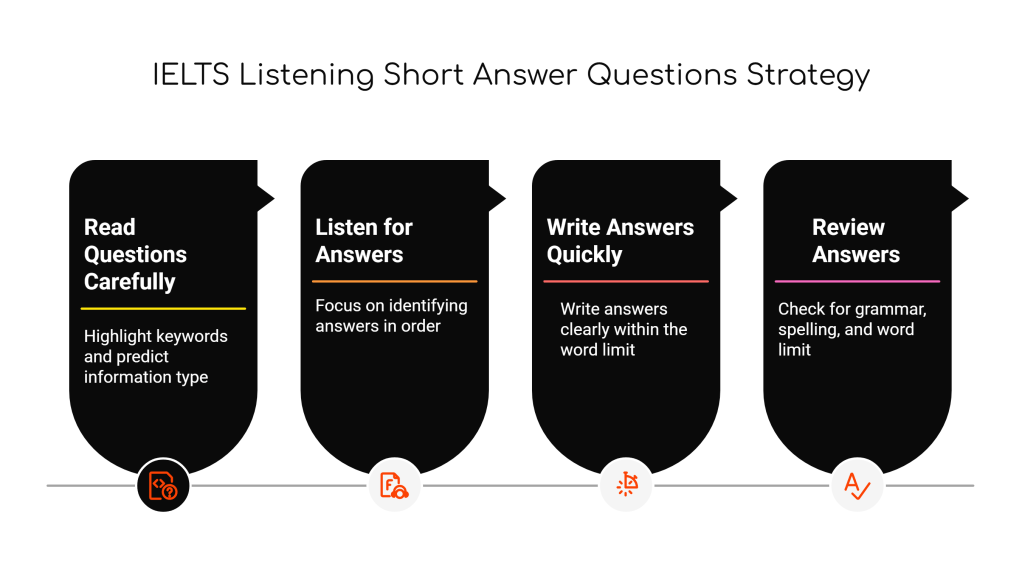
Strategies to Ace Short Answer Questions
Before Listening:
- Read the questions carefully and highlight keywords.
- Pay attention to the question format — who, what, where, when, why, how.
- Predict the type of information (e.g., time, name, reason, number).
While Listening:
- Focus on identifying the answers in order — they follow the flow of the audio.
- Watch out for synonyms and paraphrasing (e.g., “starts at nine” instead of “opens at 9:00 a.m.”).
- Write answers quickly but clearly — don’t wait to be 100% sure, or you’ll miss the next answer.
After Listening:
- Review your answers for grammar and spelling.
- Make sure your answers are concise and within the word/number limit.
Dos and Don’ts
Do:
- Practice note-taking to improve speed and accuracy.
- Use abbreviations while listening, then write full words during review time.
- Double-check the word limit on the question.
Don’t:
- Write full sentences — only the direct answer is needed.
- Ignore small details (e.g., a day of the week or a number).
- Misspell simple words — it will be marked wrong even if the content is correct.
Common Mistakes to Avoid
- Giving answers that exceed the word limit.
- Writing words that don’t match the grammar of the question.
- Leaving blanks because you didn’t recognize the synonym used.
- Confusing similar-sounding words (e.g., “fifteen” vs “fifty”).
Top Tips for Short Answer Questions
- Listen to audiobooks and interviews to get used to hearing natural speech.
- Practice with IELTS question banks, especially with short, fact-based listening tasks.
- Work on recognizing transitions or signpost words like “Now let’s move on to…” or “First of all…”
? Frequently Asked Questions
Q: Are the questions in the same order as the audio?
A: Yes, the answers appear in the same order as the questions.
Q: Do I need to use complete sentences?
A: No. Only write the necessary information — usually a word, phrase, or number.
Q: Is spelling important?
A: Absolutely. Incorrect spelling = incorrect answer.
Q: Can I use numbers instead of writing words?
A: Yes, writing “20” instead of “twenty” is acceptable unless otherwise stated.
Quick Practice
Listen to an announcement about a university workshop. Then answer:
- What is the topic of the workshop?
- Who is the guest speaker?
- What time does the session begin?
(Answers will vary based on audio)
Final Thoughts
Short Answer Questions in IELTS Listening test more than your ability to catch keywords — they assess your attention to detail, vocabulary range, and listening accuracy. With the right preparation and mindset, you can confidently tackle this task and get closer to your dream IELTS band score.
#IELTSGuidePhil #IELTS #IELTSListening #ShortAnswerQuestions #IELTSTips #IELTSPreparation #IELTSPractice #ListeningComprehension #EnglishForIELTS #IELTS2025 #IELTSExam #IELTSListeningTips #IELTSCoach #AcademicEnglish #IELTSLearners #StudyIELTS #Band7IELTS #Band8IELTS #IELTSBlog #ListeningStrategy #IELTSListeningQuestions #IELTSFocus
 IELTS Guide Phil
Leave a comment