
One of the lesser-discussed but sometimes tricky question types in the IELTS Listening test is Pick from a List. This task tests not just your listening ability but also how well you can differentiate between options and identify key details under pressure.
Let’s explore what this task looks like, how to tackle it effectively, and what to avoid.
What Is “Pick from a List”?
In this task, you are presented with a list of options, usually more than the number of answers required. You must choose the correct answers based on what you hear in the recording.
Sample Question:
You will hear a student talking to a professor about elective courses. Choose TWO courses that the student is considering.
Options:
A. Business Management
B. Environmental Science
C. Modern History
D. Graphic Design
E. Linguistics
Answer: B and D
What Skills Are Tested?
- Identifying main ideas and specific details
- Recognizing paraphrases and synonyms
- Making comparisons and distinctions between similar-sounding items
- Avoiding distractors and traps
How Does It Differ from Multiple Choice?
While similar to multiple choice, “Pick from a List” often includes:
- A larger pool of options (5–7 items)
- A requirement to choose more than one item (e.g., Choose TWO or THREE)
- A focus on grouping or filtering information, not just identifying one correct answer
Strategies to Succeed
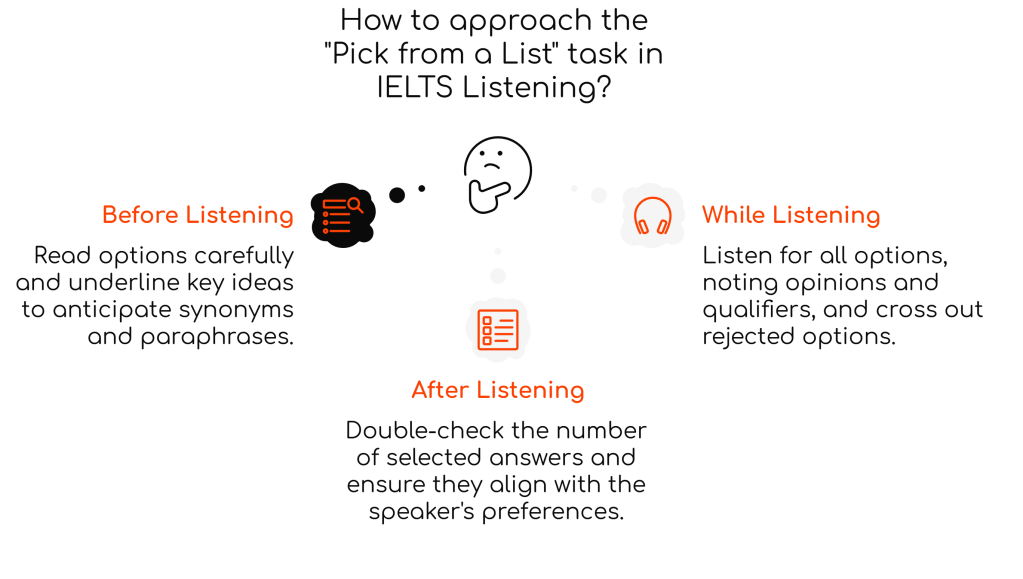
Before Listening:
- Read the list of options carefully. Think about possible synonyms or paraphrases.
- Underline key ideas or terms in each option.
- Look at the instructions to know how many items to select.
While Listening:
- Listen for all options mentioned — some may be discussed and rejected.
- Pay close attention to opinions, preferences, and qualifiers (e.g., “I used to like it,” “but now I prefer…”).
- Cross out options that are clearly ruled out.
After Listening:
- Double-check that you only selected the required number of answers.
- Review your choices logically — do they align with what the speaker actually preferred or chose?
Dos and Don’ts
DO:
- Practice listening for positive, negative, and neutral comments.
- Anticipate alternative phrasing — “Graphic Design” might be “art-focused digital media.”
- Use process of elimination based on what’s ruled out during the audio.
DON’T:
- Choose an answer just because it’s mentioned — not everything mentioned is correct.
- Select more items than the question requires.
- Fall for distractors — watch out for words like “used to,” “thought about,” “wasn’t available.”
Common Mistakes
- Picking options that were discussed but not selected
- Missing negative comments or rejections
- Ignoring instructions like “Choose THREE only”
- Being tricked by similar-sounding items
- Misunderstanding the context or speaker’s true opinion
Expert Tips
- Practice distinguishing positive and negative opinions in dialogues.
- Train yourself to recognize tone changes — hesitation, excitement, disapproval.
- When practicing, try to summarize the reason for each decision the speaker makes.
? Frequently Asked Questions
Q: Can options be mentioned but still be incorrect?
A: Yes. Some items are there just to distract you. Focus on what is chosen, not just mentioned.
Q: Are the answers always in the order of the recording?
A: Not always. You might hear the options in a different order than they appear on the list.
Q: How many words can I write for each answer?
A: You’ll usually just choose letters (A, B, C…) or write down the option itself, depending on the format. Always follow the instructions.
Q: What if I select more options than required?
A: Your answer will be marked incorrect even if some choices are right.
Quick Practice
You will hear a woman talking about her holiday preferences. Choose TWO things she enjoys the most.
A. Visiting museums
B. Hiking in the mountains
C. Going to the beach
D. Trying local food
E. Shopping for souvenirs
Sample answer (based on audio): B and D
Final Thoughts
The Pick from a List task in IELTS Listening requires a mix of strategic thinking, detail recognition, and careful decision-making. With consistent practice and a good grasp of paraphrasing, you’ll be well-prepared to handle this task with confidence and clarity.
#IELTSGuidePhil #IELTS #IELTSListening #PickFromAList #IELTSPreparation #IELTSTips #IELTS2025 #ListeningPractice #ListeningSkills #IELTSPracticeTest #IELTSBlog #StudyIELTS #IELTSBand7 #IELTSBand8 #ListeningStrategy #EnglishForIELTS #IELTSQuestions #IELTSLearners
 IELTS Guide Phil
Leave a comment