
Among all IELTS Listening tasks, Labelling a Map or Plan can be one of the most challenging — especially for visual learners or those unfamiliar with orientation language. But with the right strategies and practice, you can confidently navigate this task and secure your points. You can watch this YouTube video explainer by IELTS Guide Phil.
What Is the Map Labelling Question?
This task appears in Section 2 of the Listening test and involves a map, layout, or plan of a building, street, park, or museum. You must listen to a speaker (usually giving a tour or describing directions) and label the map with the correct place names, letters, or numbers.
You may be asked to:
- Choose answers from a list of options
- Fill in missing labels on the map
Example:
Audio Context:
“Let’s start our tour of the university. To your right, you’ll see the library. Directly opposite is the cafeteria. Next to that, on the left side of the main entrance, is the student union building.”
Map Labels (to complete):
- A = __________
- B = __________
- C = __________
Answers (based on the audio):
- A = Library
- B = Cafeteria
- C = Student union building
Key Strategies
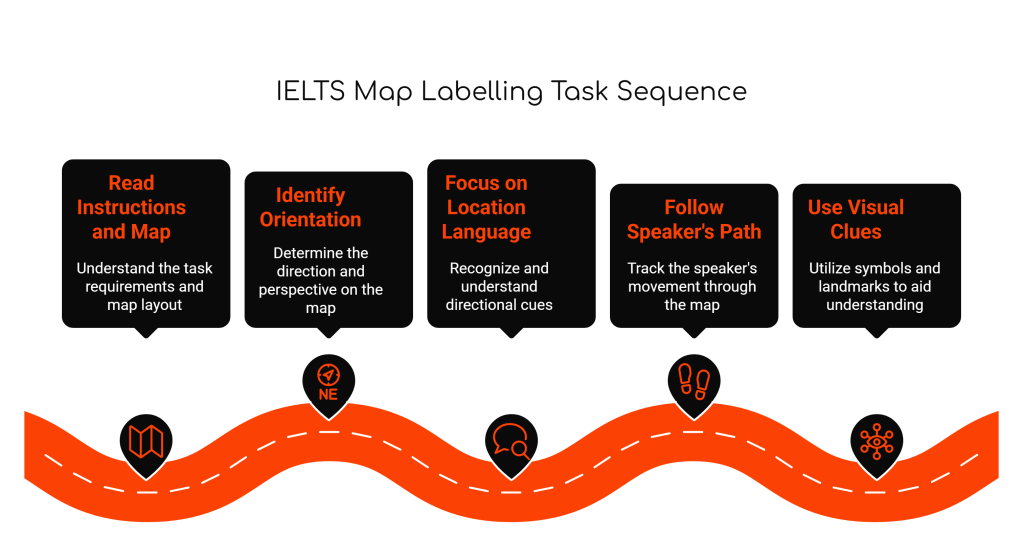
1. Read the Instructions and Map Before the Recording
- Check whether you need to choose from a list or write your own answer.
- Look at the map and the labels already provided. Familiarize yourself with the layout.
2. Identify Orientation
- Where is “north,” “main entrance,” or “you are here”?
These clues help you understand direction as the speaker moves through the space.
3. Focus on Language of Location and Direction
You’ll hear words like:
- “Next to,” “beside,” “behind,” “opposite,” “at the corner,” “in front of,” “between,” “on the right,” “at the end of,” etc.
4. Follow the Speaker’s Path
- The speaker will usually describe the layout in a logical sequence.
- Pay attention to their movement (e.g., turning left/right, going straight).
5. Use the Visual Clues
- Look at the symbols, paths, and landmarks on the map.
- Guess what might fit based on logical placement.
Dos and Don’ts
DO:
- Follow the speaker’s movement closely.
- Use the map’s visual layout to predict answers.
- Practice listening to location descriptions and direction language.
- Use abbreviations in your notes but write the full word on the answer sheet.
DON’T:
- Ignore the labels already provided—they help!
- Panic if you miss one—refocus on the next.
- Confuse “left of” vs “to the left” (they can mean different things depending on the context).
- Assume the direction—always rely on the audio.
Common Mistakes
- Misunderstanding Directions → “To the left of the entrance” might refer to your left or the building’s left — depending on orientation.
- Spelling Errors → If you have to write the answer, misspelled words will be marked incorrect.
- Not Using the Provided Labels → Pre-labeled features are clues to help you follow the description.
- Losing Focus → A single distraction can throw you off. Stay locked in from the start of the recording.
Frequently Asked Questions
Q: Will I always have a list of options?
A: Sometimes, yes. Other times, you’ll need to recall the place names from the audio without options.
Q: Are answers in order?
A: Yes, answers typically follow the order the speaker describes places.
Q: Can I write abbreviations?
A: Only if they appear in the audio or the list of options. Always aim to write the full correct word.
Q: How many times will I hear the audio?
A: Just once, so stay focused.
Q: What if I’m not sure about left or right?
A: Use landmarks and other clues. If you miss one, move on quickly to avoid missing the next.
Practice Tip
Practice with floor plans of buildings or simple maps. Try labeling locations based on recorded directions. You can use:
- Campus tour videos
- Virtual museum tours
- Google Street View walkthroughs
Write down your answers and check if your understanding of direction is accurate.
Final Tips
- Practice describing and visualizing locations.
- Build vocabulary for position and direction.
- Use sample IELTS Listening tests and pause/repeat to reinforce skills.
- Stay calm and visualize the speaker’s journey.
#IELTSGuidePhil #IELTS #IELTSListening #IELTSMapLabelling #IELTSPreparation #ListeningSkills #IELTSTips #AcademicEnglish #IELTSBand7 #IELTSBand8 #MapLabellingPractice #StudyIELTS #IELTS2025
 IELTS Guide Phil
Leave a comment