
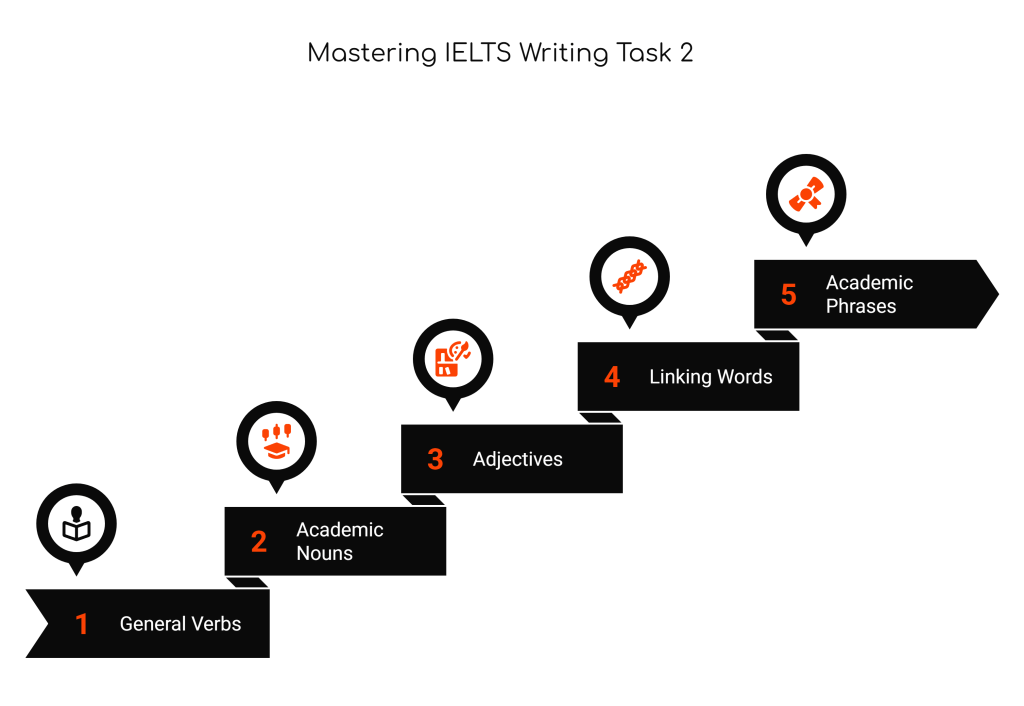
1–20: General Verbs
- Get → obtain, acquire, gain
Students acquire knowledge through various means. - Make → create, produce, construct
Governments must create opportunities for all citizens. - Do → perform, carry out, conduct
The research was conducted over five years. - Have → possess, contain, hold
Many developing countries possess untapped resources. - Say → state, assert, claim
The minister stated that reforms are necessary. - Think → consider, believe, assume
Many people believe that education should be free. - Show → demonstrate, reveal, indicate
The findings reveal a strong correlation. - Give → provide, offer, grant
The program provides financial support. - Take → undertake, accept, assume
Young people must undertake responsibilities early. - Help → assist, support, aid
Governments should assist low-income families. - Improve → enhance, boost, strengthen
This policy enhances economic growth. - Reduce → decrease, minimize, alleviate
The initiative aims to reduce pollution. - Increase → rise, grow, escalate
Tuition fees have escalated in recent years. - Use → utilize, employ, apply
Modern technologies are employed in agriculture. - Cause → lead to, result in, trigger
Deforestation leads to biodiversity loss. - Need → require, necessitate, demand
Urban areas require better infrastructure. - Start → commence, initiate, launch
The government launched a campaign on recycling. - End → conclude, terminate, cease
Hostilities ceased after the agreement. - Support → advocate, promote, uphold
The report advocates for gender equality. - Allow → enable, permit, facilitate
Technology enables remote learning.
21–40: Academic Nouns
- Problem → issue, challenge, concern
Unemployment remains a significant issue. - Solution → remedy, resolution, answer
Education is a long-term solution to poverty. - Result → outcome, consequence, effect
The outcome of the trial was unexpected. - Change → shift, transformation, modification
Climate change involves global temperature shifts. - Difference → disparity, variation, distinction
Income disparities have widened globally. - Opinion → perspective, viewpoint, belief
Many hold the belief that exams are outdated. - Way → method, approach, strategy
A new strategy is required to tackle crime. - Thing → item, object, element
Education is a key element of development. - People → individuals, citizens, members of society
Citizens must be aware of their rights. - Idea → concept, notion, proposal
The proposal to ban plastic bags gained support. - Information → data, details, facts
Accurate data is essential for research. - Job → occupation, profession, career
Teaching is a rewarding profession. - Education → schooling, instruction, academic training
Formal instruction starts at an early age. - Money → income, funds, financial resources
The school lacked sufficient funds. - Government → authorities, administration, state
The state must ensure public safety. - Law → regulation, legislation, legal framework
New regulations were introduced to curb smoking. - Technology → innovation, advancement, tools
Technological advancements have revolutionized medicine. - Health → wellbeing, fitness, condition
Mental wellbeing is often overlooked. - Environment → ecosystem, habitat, surroundings
Industrial waste harms the ecosystem. - Development → progress, growth, expansion
Urban expansion poses environmental risks.
41–60: Adjectives
- Good → beneficial, positive, advantageous
Exercise has numerous beneficial effects. - Bad → harmful, detrimental, adverse
Smoking has adverse health effects. - Important → significant, crucial, vital
Education plays a vital role in society. - Easy → simple, straightforward, effortless
Online registration is now straightforward. - Difficult → challenging, complex, demanding
Parenting can be a demanding task. - Big → large, massive, substantial
Substantial investments are needed in infrastructure. - Small → minor, limited, minimal
The impact was minimal. - Fast → rapid, swift, accelerated
Rapid urbanisation is a global issue. - Slow → gradual, sluggish, delayed
Recovery was sluggish after the recession. - Old → elderly, aged, senior
The elderly often require special care. - Young → youth, adolescent, juvenile
Adolescents need guidance and support. - New → recent, modern, contemporary
Modern societies face complex issues. - Strong → robust, resilient, solid
The economy remained resilient. - Weak → fragile, vulnerable, delicate
Small businesses are vulnerable to inflation. - Clear → evident, apparent, obvious
The benefits are evident. - Unclear → ambiguous, vague, uncertain
The policy goals remain vague. - Safe → secure, protected, risk-free
Children should grow up in secure environments. - Dangerous → hazardous, risky, unsafe
Air pollution poses hazardous risks. - Happy → content, satisfied, joyful
Employees are more productive when content. - Sad → upset, depressed, sorrowful
Unemployment can leave people feeling depressed.
61–80: Linking/Abstract Words
- Because → due to, as a result of, owing to
The delay was due to technical issues. - But → however, nevertheless, on the other hand
Nevertheless, the benefits outweigh the drawbacks. - So → therefore, thus, consequently
Consequently, literacy rates have improved. - Also → in addition, furthermore, moreover
Moreover, it promotes inclusivity. - Very → extremely, highly, exceedingly
The program is highly effective. - Really → genuinely, truly, actually
He genuinely believes in the cause. - Maybe → perhaps, possibly, conceivably
Perhaps more funds are needed. - Always → consistently, invariably, regularly
They consistently meet performance targets. - Often → frequently, commonly, repeatedly
This problem occurs frequently. - Sometimes → occasionally, at times, intermittently
At times, students feel overwhelmed. - Almost → nearly, virtually, practically
The task is virtually impossible. - Too → excessively, overly, disproportionately
The workload is excessively demanding. - Enough → sufficient, adequate, ample
There is not sufficient evidence. - More → additional, further, extra
Additional training is necessary. - Less → reduced, lower, decreased
Reduced emissions benefit the environment. - Many → numerous, several, countless
Numerous studies support this claim. - Few → limited, scarce, minimal
Job opportunities are scarce. - Most → the majority of, the bulk of, the greater part of
The majority of respondents agreed. - All → every, the whole, the entirety of
The whole population was affected. - Some → certain, a number of, various
Certain factors influence consumer behavior.
81–100: Academic Phrases
- A lot of → a large number of, a considerable amount of, a significant quantity of
A large number of people commute daily. - Get better → improve, recover, progress
Healthcare systems must improve. - Get worse → deteriorate, decline, worsen
Conditions have worsened over time. - Go up → rise, increase, escalate
Prices have escalated recently. - Go down → decrease, fall, decline
Pollution levels have fallen. - Look at → examine, analyse, investigate
The report examines global trends. - Talk about → discuss, address, elaborate on
The essay discusses key challenges. - Find out → discover, determine, identify
Researchers identified three key patterns. - Point out → highlight, emphasize, underline
The study highlights the need for reform. - Come up with → devise, develop, formulate
The team developed a new strategy. - Work on → focus on, concentrate on, dedicate effort to
They focused on reducing carbon emissions. - Deal with → address, tackle, cope with
Policies must tackle inequality. - Think about → reflect on, consider, contemplate
Students should consider alternative careers. - Put off → postpone, delay, defer
The meeting was postponed. - Set up → establish, found, initiate
A new fund was established. - Take part in → participate in, engage in, be involved in
Many citizens participate in elections. - Keep on → continue, persist, maintain
The trend continues globally. - Break down → collapse, fail, disintegrate
Talks collapsed due to disagreements. - Bring about → cause, lead to, result in
The reforms brought about social change. - Carry on → continue, proceed, persevere
They proceeded despite the difficulties.
Final Thoughts
Using these formal and academic synonyms will help you improve your coherence, cohesion, and lexical resource in IELTS Writing Task 2. Aim to use a range of vocabulary accurately and appropriately for a higher band score.
#IELTSGuidePhil #IELTS #IELTSWritingTask2 #IELTSVocabulary #IELTSAcademic #Band7Plus #LexicalResource #IELTSPreparation #IELTSEssay #AcademicEnglish #VocabularyForIELTS
 IELTS Guide Phil
Leave a comment