
The IELTS Reading test is designed to assess a wide range of reading skills — from understanding main ideas and specific information to recognizing opinions and logical argumentation. Among the 14 IELTS Reading question types, Multiple Choice Questions (MCQs) are some of the most frequent and challenging.
In this post, we’ll break down everything you need to know about MCQs in IELTS Reading — including how they work, strategies for success, pitfalls to avoid, examples, and helpful FAQs.
What Are Multiple Choice Questions in IELTS Reading?
Multiple Choice Questions require you to choose the correct answer from several options. They may ask you to:
- Choose one correct option (e.g., A, B, C, or D)
- Choose two options from five
- Choose three options from seven
These questions test your ability to understand specific points or the main idea of a section of the passage.
Skills Assessed
- Scanning for specific information
- Skimming for general understanding
- Understanding paraphrasing and synonyms
- Recognizing the writer’s purpose and opinion
- Identifying supporting details and contrasts
Example Question
According to the passage, why did the company change its marketing strategy?
A. To reduce costs
B. To enter new markets
C. To improve customer loyalty
D. To increase social media presence(Correct Answer: C)
The passage states that the company shifted its strategy to “focus on retaining existing customers through loyalty programs.”
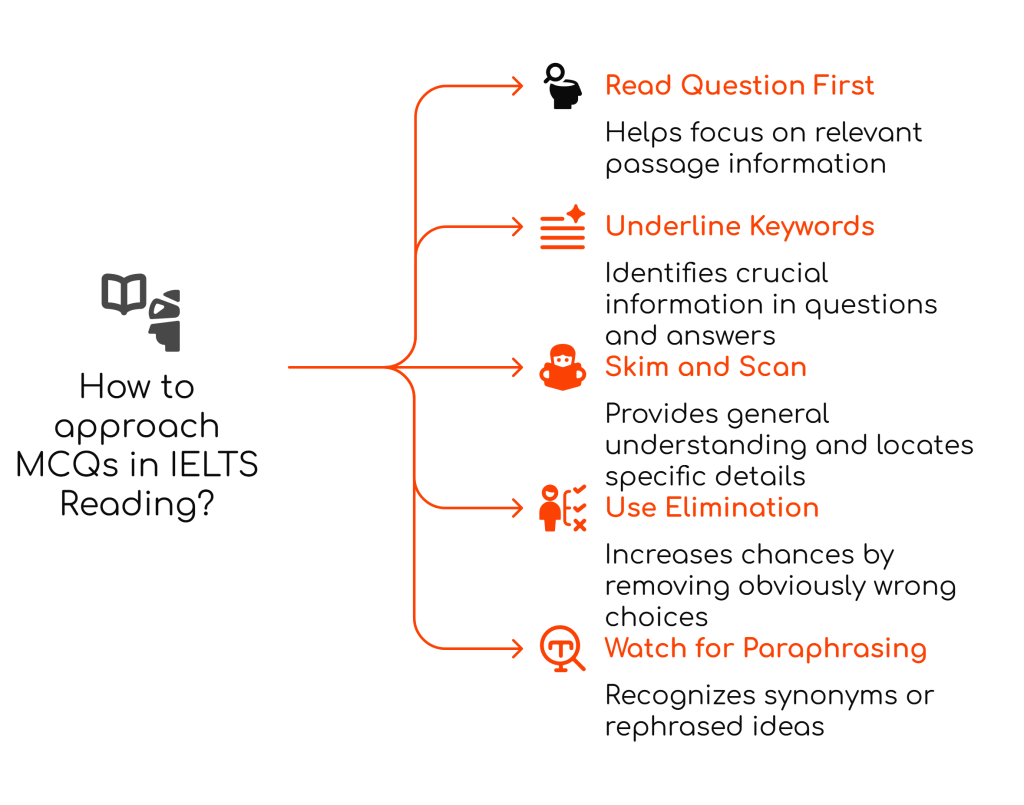
Effective Strategies for MCQs
1. Read the Question First
Always read the question before the passage. This helps you know what to look for.
2. Underline Keywords
Identify key nouns, verbs, and phrases in both the question and the answer choices.
3. Skim and Scan
Quickly skim the passage for general understanding, then scan specific parts for answers.
4. Use Elimination
Even if you’re unsure of the answer, eliminate the obviously incorrect choices to improve your odds.
5. Watch for Paraphrasing
The correct answer may not use the exact words from the passage. Look for synonyms or rephrased ideas.
6. Don’t Assume
Answer based only on what is explicitly stated or clearly implied in the text.
Common Mistakes and How to Avoid Them
| Mistake | How to Avoid |
|---|---|
| Choosing based on general knowledge | Only select answers supported by the passage |
| Focusing on keywords without context | Always read around the keywords to grasp full meaning |
| Rushing through options | Read all choices carefully before deciding |
| Getting stuck on vocabulary | Focus on the idea, not just difficult words |
| Ignoring similar-sounding distractors | Read closely — some options are designed to mislead |
Sample Practice
What is the main reason the author criticizes current urban planning?
A. It ignores economic factors
B. It prioritizes vehicles over pedestrians
C. It fails to include green spaces
D. It increases living costs in cities(Correct Answer: B)
The author argues that modern urban design “continues to prioritize car traffic, often at the expense of pedestrian comfort and safety.”
Frequently Asked Questions (FAQs)
1. Are MCQs harder than other question types?
Not necessarily, but they require close reading and the ability to differentiate between similar options.
2. Will the answer options use the same words as the passage?
Usually not. Expect paraphrasing and synonyms.
3. Can there be more than one correct answer?
Yes. Some MCQs ask you to choose two or three correct answers. Instructions will specify this.
4. Are the questions in the same order as the passage?
Generally, yes. This can help you locate information more easily.
Final Tips for Success
- Develop your vocabulary and paraphrasing awareness
- Practice with real IELTS tests to improve scanning speed
- Highlight key ideas and transitions in the text
- Don’t overthink; trust the passage, not your assumptions
Recommended Practice Resources
- Cambridge IELTS Books (1–18)
- British Council & IDP Practice Tests
- IELTS Liz / IELTS Buddy
- IELTS Reading question simulators and mobile apps
Conclusion
Multiple Choice Questions in IELTS Reading challenge your ability to process complex information, identify details, and understand nuance. But with the right preparation, strategies, and practice, you can navigate MCQs with confidence and precision — and boost your score in the Reading module.
#IELTSGuidePhil #IELTS #IELTSReading #IELTSMultipleChoice #IELTSPreparation #IELTS2025 #IELTSReadingTips #Band8IELTS #IELTSStrategies #IELTSReadingPractice #AcademicIELTS #IELTSBlog
 IELTS Guide Phil
Leave a comment