
The IELTS Reading test includes several question types, each assessing different reading skills. Among them, Matching questions require test-takers to find connections between statements, headings, people, features, or sentence halves and parts of the passage. This guide will walk you through each Matching type, offer sample questions with detailed explanations and passage locations, highlight common pitfalls, and answer FAQs.
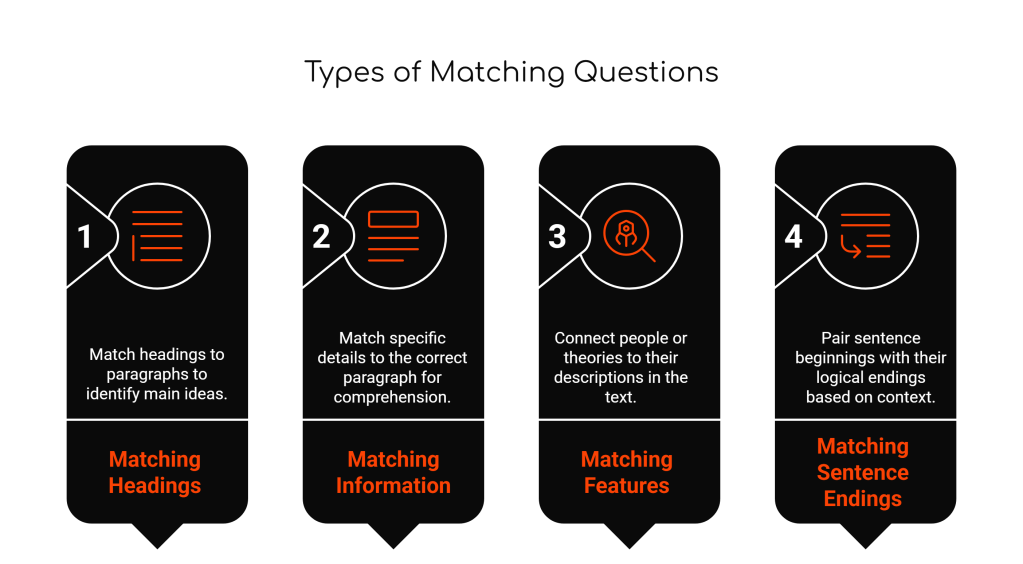
Types of Matching Questions in IELTS Reading
1. Matching Headings
Match a list of headings to sections or paragraphs in a passage. These test your ability to understand the main idea of a section.
2. Matching Information
Match specific details or ideas to the paragraph where they appear. These questions test your scanning and paraphrasing skills.
3. Matching Features
Match people, theories, or items to the correct statement or description from the passage.
4. Matching Sentence Endings
Match the first halves of sentences to their correct endings based on the text.
Skills Assessed
- Skimming and scanning for information
- Identifying paraphrased ideas
- Understanding main ideas versus supporting details
- Making logical connections
- Distinguishing similar options
Sample Questions with Answer Locations
1. Matching Headings
Passage Excerpt:
Paragraph A: Agriculture has transformed significantly over the centuries. Early societies depended on hunting and gathering before the introduction of farming techniques like irrigation and crop rotation.
Paragraph B: Today, extreme weather patterns are affecting crop cycles. Unpredictable rainfall and temperature shifts have led to lower yields and concerns about food security.
Paragraph C: While food production has grown, waste remains a critical problem. Supermarkets discard unsold goods, and consumers often purchase more than needed.
Headings:
- The impact of weather on agriculture
- Food waste in modern societies
- Historical developments in farming
Answers and Explanation:
- Paragraph A → 3: Mentions “transformation of agriculture” and “introduction of farming techniques” → focuses on history.
- Paragraph B → 1: Discusses “extreme weather patterns” and their effects on “crop cycles” → matches weather impact.
- Paragraph C → 2: Talks about “waste” in supermarkets and homes → clearly about modern food waste.
2. Matching Information
Passage:
Paragraph A: Marie Curie was known for her groundbreaking work in radioactivity. Her discoveries led to major advances in medical imaging.
Paragraph B: Thomas Edison held over 1,000 patents and is credited with inventing the phonograph and improving the light bulb.
Paragraph C: Nikola Tesla focused on alternating current technology and envisioned wireless energy transmission long before its time.
Statements:
a. A scientist who imagined future technologies.
b. A scientist whose work contributed to the field of medicine.
c. A scientist associated with a large number of patents.
Answers and Locations:
- a → Paragraph C (Tesla): “…envisioned wireless energy transmission…” → supports futuristic thinking.
- b → Paragraph A (Curie): “…led to major advances in medical imaging…” → clearly ties to medicine.
- c → Paragraph B (Edison): “…held over 1,000 patents…” → directly supports the idea.
3. Matching Features
Passage:
Dr. Khan emphasizes the relationship between nutrition and longevity. Her studies show that plant-based diets improve lifespan and lower disease risk.
Dr. Liang believes genetics determine most aspects of aging, including metabolism and memory retention.
Dr. Ferreira focuses on the impact of social interaction on elderly health, arguing that isolation leads to mental and physical decline.
Match each scientist to their belief:
- i. Aging is most influenced by what we eat
- ii. Genetics is the key driver of aging
- iii. Social engagement affects health in later years
Answers and Locations:
- Dr. Khan → i: “…nutrition and longevity… plant-based diets…” → clear link to diet.
- Dr. Liang → ii: “…genetics determine most aspects of aging…” → supports this view.
- Dr. Ferreira → iii: “…social interaction… isolation leads to decline…” → matches social factor.
4. Matching Sentence Endings
Sentences (A):
- The researchers concluded that exercising regularly…
- Long-term exposure to polluted air…
- Students who slept eight hours the night before…
Sentence Endings (B):
a. …performed better on memory tests.
b. …can significantly reduce heart disease risk.
c. …is linked to increased respiratory issues.
Passage Extract:
“Participants who engaged in moderate physical activity five days a week saw a marked reduction in heart disease.”
“Prolonged exposure to poor air quality led to an increase in respiratory conditions such as asthma.”
“Those who had a full night’s rest scored higher on both concentration and memory assessments.”
Answers and Justification:
- 1 → b: “…reduction in heart disease” → regular exercise lowers risk.
- 2 → c: “…increase in respiratory conditions…” = air pollution.
- 3 → a: “…scored higher on memory assessments…” → better memory after good sleep.
Expert Tips by Matching Type
| Type | Tips |
|---|---|
| Matching Headings | Skim each paragraph for the main idea, especially first and last sentences. |
| Matching Information | Look for specific details and paraphrased phrases in each paragraph. |
| Matching Features | Highlight key names and keywords, then locate them in the passage. |
| Matching Sentence Endings | Read both halves carefully and check that the sentence is grammatically correct and logical. |
Common Mistakes to Avoid
- Keyword traps: Don’t rely solely on matching words — focus on meaning.
- Ignoring grammar: Especially for sentence endings, make sure sentences make sense.
- Reading too much: Don’t try to understand everything. Focus on what’s relevant.
- Answering in order: Matching questions often do not follow the passage order. Be ready to jump around.
Frequently Asked Questions (FAQs)
Q1: Can one paragraph match more than one item?
A: Yes, especially in Matching Information, but not usually in Matching Headings (unless stated otherwise).
Q2: Are the questions and answers always in the same order?
A: No. Matching questions often appear in a random order, requiring flexible navigation of the text.
Q3: Is skimming enough to answer Matching Headings?
A: Yes, skimming is essential — but you should also analyze the main purpose of each paragraph to avoid confusion.
Q4: Can the same letter be used more than once in Matching Features?
A: Sometimes, yes. Always check the instructions for clarification.
Final Advice
- Practice with real IELTS passages.
- Take notes while scanning.
- Underline names, dates, and keywords.
- Improve paraphrasing skills to recognize similar meanings.
- Manage your time—don’t get stuck on one matching question.
Conclusion
Matching questions in IELTS Reading test your comprehension in nuanced ways. By sharpening your ability to recognize paraphrasing, improving your scanning speed, and practicing targeted strategies, you can confidently take on all forms of Matching tasks. Consistent practice is the key to reducing confusion and boosting accuracy — ultimately leading to a higher band score.
#IELTSGuidePhil #IELTS #IELTSReading #IELTSMatching #IELTSTips #IELTSBlog #IELTSPreparation #IELTSReadingPractice #Band7Plus #AcademicIELTS #IELTSQuestions #IELTS2025
 IELTS Guide Phil
Leave a comment