
The IELTS Reading test assesses your ability to read and understand academic or general texts in English. To succeed, you need a strong grasp of vocabulary, critical thinking, time management, and, most importantly, familiarity with each question type. You can watch this YouTube video explainer by IELTS Guide Phil.
Overview of the IELTS Reading Test
- Duration: 60 minutes (no extra time for transferring answers)
- Format:
- Academic: 3 long passages (from books, journals, magazines, newspapers)
- General Training: 3 sections with shorter and more varied texts (e.g., advertisements, notices, work-related content)
- Total Questions: 40
- No negative marking – but accuracy is crucial
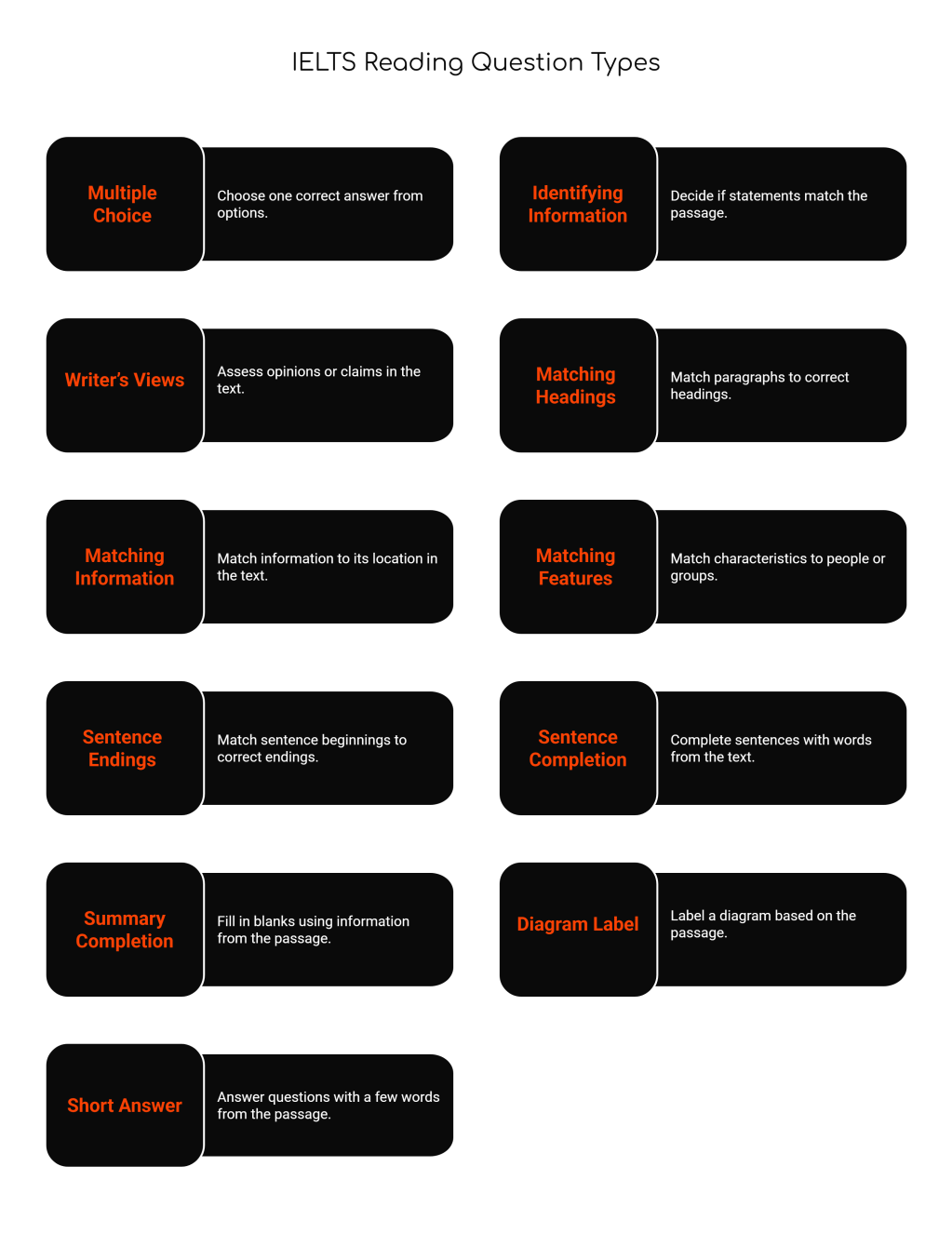
IELTS Reading Question Types
1. Multiple Choice
- Format: Choose one correct answer from 3 or 4 options.
- Skills Tested: Understanding specific details, opinions, or main ideas.
- Tips:
- Read the question first, not the options.
- Eliminate incorrect answers logically.
- Common Mistakes:
- Choosing answers that contain keywords from the text but are incorrect.
- Skimming too quickly and missing details.
2. Identifying Information (True/False/Not Given)
- Format: Decide if the statement matches the passage.
- True = Exactly matches the passage.
- False = Contradicts the passage.
- Not Given = Not mentioned at all.
- Tips:
- Base your answer only on the passage—not background knowledge.
- Look for absolute language like “always,” “never,” “only.”
- Common Mistakes:
- Confusing “False” and “Not Given.”
- Overthinking beyond what’s written.
3. Identifying the Writer’s Views (Yes/No/Not Given)
- Format: Similar to True/False/Not Given, but focused on opinions or claims.
- Tips:
- Pay attention to the author’s tone and opinion markers (e.g., “believes,” “claims,” “argues”).
- Common Mistakes:
- Mistaking factual information for opinion.
- Misjudging the author’s attitude.
4. Matching Headings
- Format: Match each paragraph to the correct heading from a list.
- Skills Tested: Identifying main ideas of paragraphs.
- Tips:
- Focus on the main point, not supporting details.
- Headings are general summaries, not specific facts.
- Common Mistakes:
- Matching based on similar words instead of ideas.
- Ignoring paragraph structure.
5. Matching Information
- Format: Match specific pieces of information to where they appear in the passage.
- Skills Tested: Scanning and locating specific details.
- Tips:
- Use keywords to scan the passage quickly.
- One paragraph may contain multiple pieces of information.
- Common Mistakes:
- Confusing similar facts.
- Spending too long on one match.
6. Matching Features
- Format: Match statements or characteristics to people, groups, or things mentioned in the text.
- Tips:
- Look for names and proper nouns to locate info quickly.
- Common Mistakes:
- Assuming each person or group is used only once (check the instructions!).
7. Matching Sentence Endings
- Format: Match the beginning of a sentence to the correct ending.
- Tips:
- Focus on grammar and meaning.
- Eliminate illogical or ungrammatical combinations.
- Common Mistakes:
- Choosing endings that look right but don’t fit contextually or grammatically.
8. Sentence Completion
- Format: Complete sentences with a word or phrase from the text.
- Tips:
- Observe the word limit (e.g., “NO MORE THAN THREE WORDS”).
- Check grammar compatibility.
- Common Mistakes:
- Exceeding the word limit.
- Incorrect verb forms or articles.
9. Summary, Note, Table, or Flow-chart Completion
- Format: Fill in the blanks using information from the passage.
- Tips:
- Know if you are selecting words from a box or from the text.
- Be mindful of grammatical accuracy.
- Common Mistakes:
- Copying irrelevant phrases.
- Not understanding context.
10. Diagram Label Completion
- Format: Label a diagram based on the passage.
- Tips:
- Focus on spatial language and technical descriptions.
- Common Mistakes:
- Not matching terms exactly from the passage.
- Ignoring the diagram’s structure.
11. Short Answer Questions
- Format: Answer questions with a few words based on the passage.
- Tips:
- Underline question words (what, who, how, etc.).
- Observe the word limit strictly.
- Common Mistakes:
- Giving too much or too little information.
- Misunderstanding question focus.
Common Mistakes to Avoid
- Ignoring instructions and word limits
- Reading every word instead of skimming and scanning
- Getting stuck on one question and running out of time
- Matching based on keywords instead of overall meaning
- Poor time management – not allocating ~20 minutes per passage
- Not checking spelling and grammar
- Leaving blanks – remember, there’s no penalty for guessing
Frequently Asked Questions (FAQs)
1. Is the reading test harder in the Academic module?
Yes, the Academic Reading texts are more complex and technical, while General Training Reading includes simpler texts like ads and letters.
2. Do the questions follow the order of the text?
Most question types follow the same order as the text, but some (e.g., Matching Information) may not.
3. Can I write in all capital letters?
Yes, and it is often recommended for clarity and consistency.
4. Are spelling and grammar important?
Yes. Spelling mistakes = wrong answers, even if the idea is correct.
5. How many questions are there per passage?
Typically 13–14 questions per passage, totaling 40 across all three.
Final Tips for a High Band Score
- Practice every question type under time pressure
- Build reading speed with skimming and scanning techniques
- Expand academic vocabulary to understand difficult texts
- Use past papers and authentic IELTS materials
- Review mistakes and learn why you got them wrong
Mastering the IELTS Reading test means more than just reading—it involves strategy, practice, and the ability to work under pressure. By understanding the format and perfecting your technique, you will be one step closer to your target band score.
Ready to improve your IELTS Reading score? Start practising with real test materials today and apply these tips consistently!
#IELTSGuidePhil #IELTS #IELTSReading #IELTSPreparation #ReadingSkills #IELTSTips #Band8Reading #AcademicEnglish #IELTS2025
 IELTS Guide Phil
Leave a comment