
The IELTS Listening test challenges not only your ability to understand spoken English but also your skill in identifying key details, speaker attitudes, and specific information. Among the most common and tricky question types in the test are Multiple Choice Questions (MCQs).
In this post, we explore everything you need to know about IELTS Listening MCQs—how they work, proven techniques for success, common traps to avoid, and sample practice questions to boost your confidence.
What Are Multiple Choice Questions in IELTS Listening?
Format
- MCQs may ask you to choose:
- One correct answer from three options (A, B, or C), OR
- Two or three correct answers from a list of five or more options
- These questions appear in any of the four sections of the Listening test
- You will hear the audio once only
Skills Tested
- Understanding main ideas, specific information, and speaker attitudes
- Recognizing paraphrasing and distractors
- Processing speech at natural speed
Sample IELTS Listening MCQ
Audio Context: A student is asking a university advisor about joining a fitness club.
Question
- What does the advisor recommend the student do first?
A. Visit the campus gym to see the facilities
B. Register online for a trial membership
C. Check the class schedule on the website
✅ Correct Answer: A
Explanation: The advisor says, “The first thing I suggest is to go and have a look at the gym itself before doing anything else.”
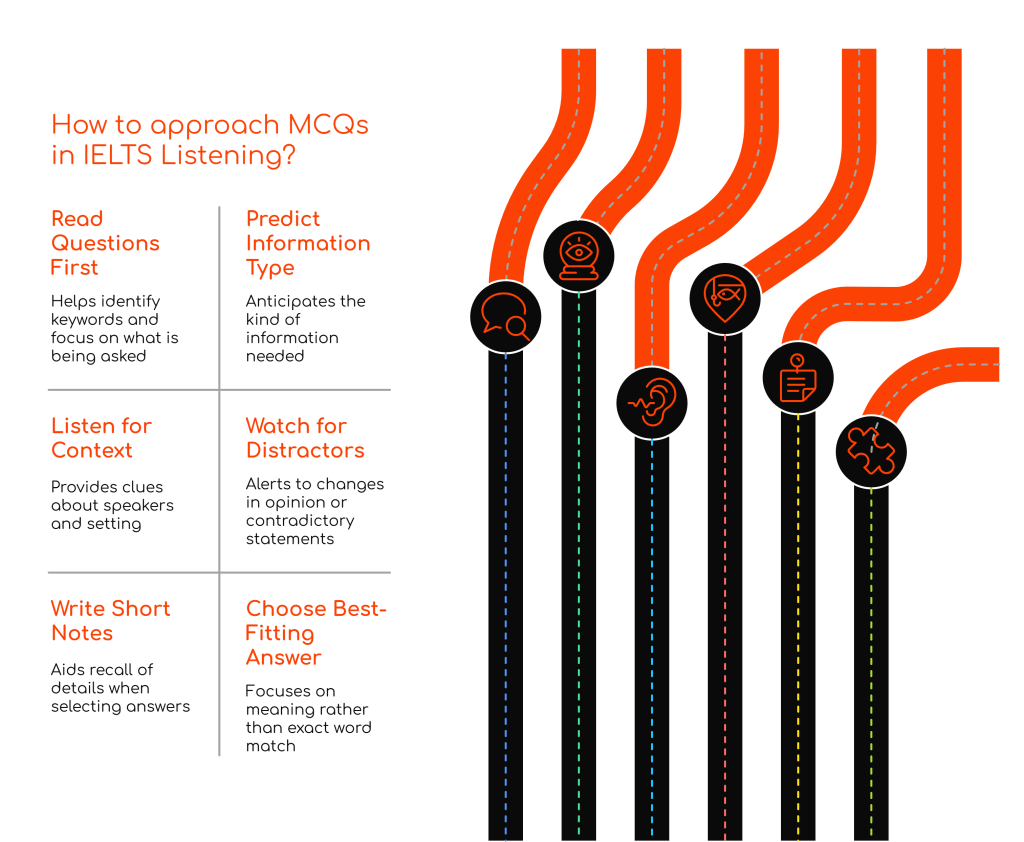
Effective Strategies for IELTS Listening MCQs
1. Read the Questions Before Listening
- Use the time given to underline keywords in the question and options
- Focus on what is being asked (e.g., recommendation, opinion, reason)
2. Predict the Type of Information You Need
- Anticipate whether you will hear a recommendation, an example, a cause, or a consequence
- Prepare your mind to identify synonyms or paraphrased expressions
3. Listen for the Context First
- The beginning of the recording often gives clues about the speakers and setting
- This helps anchor your understanding of the dialogue
4. Watch Out for Distractors
- The speaker may mention all the options but only one is correct
- Be alert for changes in opinion or contradictory statements
5. Write Short Notes While Listening
- Jot down key words beside each option as you hear them
- This helps you recall details when selecting your final answer
6. Choose the Best-Fitting Answer, Not Just Matching Words
- Many test-takers fall into the trap of picking options with exact words from the audio
- Focus on meaning, not just vocabulary match
Common Mistakes to Avoid
- Choosing based on keywords alone
– Words from the audio may appear in more than one option. Always listen for context. - Failing to spot distractors
– The speaker might say, “At first I thought… but actually…” to lead you away from the right answer. - Not reading all options carefully
– Some options may seem plausible but are incomplete or irrelevant. - Missing transitions and contrasts
– Phrases like “however,” “on the other hand,” or “actually” often indicate a change in opinion. - Overthinking
– Don’t make assumptions beyond what is said. Stick to what is clearly stated or implied.
Practice Questions
Audio Context: A woman is talking about her new job.
Question
2. What does the woman like most about her new job?
A. The high salary
B. The flexible hours
C. The friendly colleagues
✅ Correct Answer: C
Explanation: She says, “The pay is decent, and I like the hours, but it’s really the people I work with that make the job enjoyable.”
Frequently Asked Questions (FAQs)
1. How many Multiple Choice Questions are in the IELTS Listening test?
There is no fixed number. You may encounter 2–6 MCQs, depending on the test version.
2. Are MCQs harder than other question types?
They can be challenging due to similar-sounding distractors and paraphrased answers, but with strategy and practice, they become manageable.
3. Can I write the letter (A/B/C) or the full answer?
You must write only the letter (e.g., A, B, or C), as stated in the instructions. Writing the full sentence may be marked incorrect.
4. Do MCQs follow the order of the recording?
Yes, questions generally follow the order of the audio.
5. Can I go back and check my answers?
You cannot re-listen, but you’ll have 10 minutes at the end to transfer answers and make corrections.
Final Tips for Success
- Practice MCQs using authentic IELTS listening recordings
- Focus on improving concentration and note-taking speed
- Familiarize yourself with common distractor patterns
- Build vocabulary to recognize paraphrased options
- Listen actively—pay attention to tone, hesitation, and emphasis
Resources for Further Practice
- Cambridge IELTS Practice Tests (Books 10–18)
- Official IELTS Listening Practice Materials (IELTS.org)
- British Council’s “LearnEnglish” Listening Sections
- Online IELTS platforms with audio + MCQ sets
Conclusion
Multiple Choice Questions in IELTS Listening are a test of both your listening accuracy and your decision-making ability. With the right preparation, a sharp ear, and a solid strategy, you can approach them with confidence and achieve the score you aim for.
#IELTSGuidePhil #IELTS #IELTSListening #IELTSPreparation #IELTSTips #IELTSStrategy #MultipleChoiceQuestions #IELTSPractice #IELTSExam #ListeningSkills #IELTSSuccess #AcademicEnglish #IELTS2025 #IELTSBlog #IELTSCoach #IELTSTraining #IELTSBand7Plus
 IELTS Guide Phil
Leave a comment