
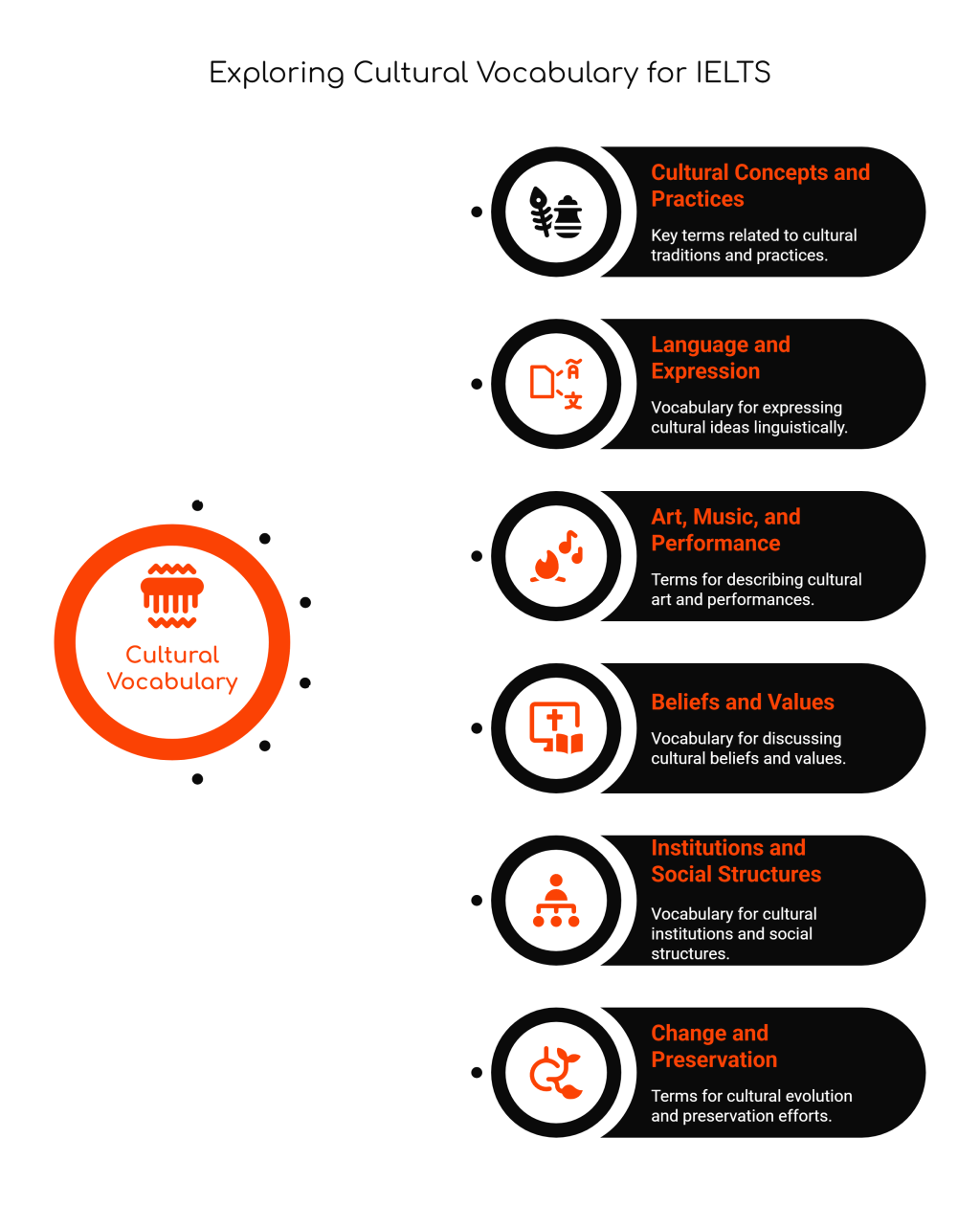
Understanding and using topic-specific vocabulary for Culture and Tradition is essential for achieving a high band score in the IELTS Speaking and Writing sections. This comprehensive guide provides 100 carefully selected words and phrases, complete with definitions and example sentences, to help you articulate your ideas with clarity, depth, and precision.
Cultural Concepts and Practices (1–10)
- Tradition – A custom or belief passed down from generation to generation.
Example: The tradition of storytelling has preserved ancient wisdom across cultures. - Heritage – Cultural elements inherited from past generations.
Example: Preserving cultural heritage is vital for maintaining national identity. - Custom – A habitual practice common to a group of people.
Example: Shaking hands as a greeting is a custom in many Western countries. - Ritual – A ceremonial act performed in a prescribed order.
Example: The wedding ritual lasted several days and involved many symbolic acts. - Ceremony – A formal event held to mark an occasion.
Example: The award ceremony honored achievements in cultural preservation. - Folklore – Traditional stories and legends of a culture.
Example: Folklore often includes moral lessons passed down orally. - Mythology – A collection of myths related to a particular tradition.
Example: Roman mythology shares similarities with Greek narratives. - Cultural identity – A sense of belonging to a cultural group.
Example: Food and language are central to one’s cultural identity. - Norms – Accepted standards of behavior in a society.
Example: Cultural norms shape how individuals interact with each other. - Cultural diffusion – The spread of cultural traits from one society to another.
Example: The popularity of sushi worldwide is a case of cultural diffusion.
Language and Expression (11–20)
- Mother tongue – A person’s first language.
Example: Education in one’s mother tongue supports cultural continuity. - Dialect – A regional form of a language.
Example: Each dialect has its own unique pronunciation and vocabulary. - Multilingualism – The use of multiple languages by an individual or society.
Example: Multilingualism enhances cultural exchange. - Idiomatic expression – A phrase with a figurative meaning.
Example: Idiomatic expressions can be hard to understand across cultures. - Oral tradition – Culture transmitted through spoken word.
Example: Folktales preserved via oral tradition often evolve over time. - Script – A system of writing.
Example: Ancient scripts are crucial for understanding past cultures. - Linguistic heritage – The history and tradition of language use.
Example: Linguistic heritage is a pillar of cultural preservation. - Proverb – A short saying expressing general truth.
Example: Proverbs often reflect a culture’s wisdom and values. - Etymology – The study of word origins.
Example: Studying the etymology of cultural terms can reveal historical ties. - Lexicon – A vocabulary of a language or subject.
Example: Cultural concepts often require specific lexicons.
Art, Music, and Performance (21–30)
- Folk music – Traditional music of a community.
Example: Folk music provides insight into local values and experiences. - Cultural performance – Public artistic expression of tradition.
Example: The cultural performance showcased traditional dances and songs. - Craftsmanship – Skilled creation of handmade items.
Example: The exhibition highlighted traditional craftsmanship. - Traditional attire – Clothing symbolic of a cultural group.
Example: Traditional attire is often worn during festivals and ceremonies. - Artisan – A skilled manual worker in traditional crafts.
Example: Local artisans contribute to cultural sustainability. - Handicrafts – Items made by hand, often with cultural significance.
Example: Tourists often purchase handicrafts as cultural souvenirs. - Cultural artefact – An object made by humans that holds cultural importance.
Example: Museums preserve artefacts that tell cultural stories. - Performance art – Artistic expression involving live presentation.
Example: Performance art can challenge cultural norms. - Traditional dance – A dance form rooted in cultural practice.
Example: Traditional dances vary widely from region to region. - Storytelling – Conveying events through narrative.
Example: Storytelling is an essential part of cultural education.
Beliefs and Values (31–40)
- Ancestor worship – Honoring deceased relatives as part of religion.
Example: Ancestor worship reflects respect for family lineage. - Spirituality – Deep connection to beliefs and the sacred.
Example: Spirituality influences many cultural practices. - Superstition – An irrational belief linked to cultural tradition.
Example: Superstitions often explain natural events in folklore. - Cultural relativism – Understanding cultural practices on their own terms.
Example: Cultural relativism promotes tolerance and understanding. - Taboo – A social or cultural prohibition.
Example: Discussing death is a taboo in certain societies. - Sacred – Regarded with religious or spiritual reverence.
Example: Sacred sites are protected for their spiritual significance. - Secularism – Separation of cultural and religious practices.
Example: Some modern cultures embrace secularism over religious tradition. - Ritualism – Over-reliance on ritual practices.
Example: Critics argue that ritualism can hinder social progress. - Doctrine – A set of beliefs held and taught.
Example: Cultural doctrines often shape ethical standards. - Cosmology – Cultural understanding of the universe.
Example: Traditional cosmologies influence indigenous worldviews.
Change and Preservation (41–60)
- Cultural preservation – Efforts to maintain cultural heritage.
Example: Museums play a crucial role in cultural preservation by showcasing historical artifacts and artworks. - Modernization – Transition from traditional to modern systems.
Example: Modernization has improved healthcare and education but has also led to the decline of some rural traditions. - Urbanization – Expansion of cities, affecting cultural lifestyles.
Example: Urbanization has brought economic growth but has disrupted traditional ways of living. - Globalization – Global integration of cultures and economies.
Example: Globalization allows cultural exchange but may also dilute unique local traditions. - Cultural erosion – Gradual loss of cultural identity.
Example: As young people adopt global fashion trends, traditional dress faces cultural erosion. - Cultural revival – Renewed interest in traditional practices.
Example: The cultural revival of folk music has inspired new generations to learn ancient instruments. - Hybrid culture – A blend of elements from different cultures.
Example: K-pop is a hybrid culture that mixes Western pop with Korean language and style. - Westernization – Adoption of Western culture.
Example: Westernization has influenced local cuisines, fashion, and even values in many parts of Asia. - Acculturation – Cultural change through contact with another group.
Example: Acculturation can result in bilingualism and new social customs in immigrant communities. - Assimilation – Absorption into a dominant culture.
Example: Over time, some minority groups may undergo assimilation and lose their native language. - Cultural resilience – Ability of culture to adapt and survive.
Example: Despite centuries of colonization, many indigenous communities have shown cultural resilience. - Ethnocentrism – Judging another culture by one’s own standards.
Example: Ethnocentrism can lead to misunderstandings and cultural discrimination. - Cultural imperialism – Imposing one culture over another.
Example: Critics argue that global media promotes cultural imperialism by spreading Western ideals. - Intercultural exchange – Mutual sharing between cultures.
Example: Student exchange programs promote intercultural exchange and global understanding. - Diaspora – Dispersal of people from their original homeland.
Example: The Indian diaspora has maintained cultural practices while integrating into different societies. - Cultural adaptation – Adjusting cultural behavior to new environments.
Example: Migrants often undergo cultural adaptation to better fit into their new country’s society. - Syncretism – Fusion of different cultural traditions.
Example: The Day of the Dead is a syncretism of indigenous beliefs and Catholic rituals in Mexico. - Indigenous culture – Original inhabitants’ cultural expressions.
Example: Indigenous culture is often reflected in oral traditions, rituals, and sustainable practices. - Living culture – Traditions still practiced actively.
Example: Japan’s tea ceremony is an example of a living culture passed down through generations. - Archaeological site – Location of historical and cultural artifacts.
Example: Machu Picchu is an archaeological site that reveals much about Inca civilization.
Institutions and Social Structures (61–80)
- Patriarchy – A social system dominated by males.
Example: Many traditional societies are structured around patriarchy, where men hold authority. - Matriarchy – A social system dominated by females.
Example: Some indigenous cultures are built on matriarchy, emphasizing maternal lineage. - Clan – A group of families with a common ancestor.
Example: Clan gatherings often celebrate shared traditions and heritage. - Tribe – A social group with shared customs and language.
Example: Tribal traditions often include unique ceremonies and belief systems. - Caste system – A hierarchical social classification.
Example: The caste system influences marriage and occupation in some cultures. - Monarchy – A system ruled by a royal family.
Example: Monarchies often preserve ceremonial traditions even in modern times. - Chieftaincy – Leadership of a tribal or indigenous community.
Example: The chieftaincy plays a key role in cultural governance and conflict resolution. - Cultural institution – Organization preserving cultural values.
Example: Cultural institutions like museums and archives safeguard historical documents. - Kinship – Social bonds based on blood, marriage, or adoption.
Example: Kinship systems vary greatly across cultures and influence inheritance laws. - Lineage – Direct descent from ancestors.
Example: Many rituals emphasize honoring one’s lineage during family ceremonies. - Elders – Older members regarded with respect.
Example: In traditional societies, elders serve as keepers of wisdom and culture. - Initiation – A rite of passage marking entrance into a group.
Example: The initiation ceremony involved symbolic acts and teachings from elders. - Pilgrimage – A journey to a sacred place.
Example: Pilgrimage is an important cultural and spiritual practice in many religions. - Communal living – A lifestyle shared among a group.
Example: Communal living fosters cooperation and cultural unity. - Feudal system – A hierarchical structure of land and loyalty.
Example: The feudal system shaped medieval culture and social roles. - Totem – A symbol representing a group or clan.
Example: The eagle totem was central to their spiritual beliefs and identity. - Mandate – Authority granted to carry out cultural or religious duties.
Example: The leader received a spiritual mandate to protect traditional practices. - Cultural governance – Management of cultural affairs.
Example: Cultural governance ensures the protection of national heritage sites. - Council of elders – A group guiding decisions in traditional communities.
Example: The council of elders resolved disputes based on customary law. - Sacrament – A sacred ritual with religious significance.
Example: Baptism is considered a sacrament in many Christian traditions.
Global Impact and Contemporary Issues (81–100)
- Cultural appropriation – Unacknowledged use of another culture’s elements.
Example: Wearing sacred symbols as fashion can be seen as cultural appropriation. - Cultural awareness – Understanding and respecting cultural differences.
Example: Cultural awareness helps travelers navigate social norms respectfully. - Inclusivity – Ensuring all cultural groups are respected and represented.
Example: Cultural inclusivity in education fosters empathy and understanding. - Pluralism – Coexistence of diverse cultures within one society.
Example: Pluralism encourages dialogue between different cultural communities. - Cultural sustainability – Maintaining culture for future generations.
Example: Cultural sustainability requires education and documentation. - Representation – How cultures are portrayed in media and society.
Example: Accurate representation helps combat stereotypes. - Cultural sensitivity – Awareness of the impact of one’s actions on other cultures.
Example: Tourists should travel with cultural sensitivity to avoid offense. - Digital heritage – Cultural materials preserved digitally.
Example: Digital heritage projects archive languages and rituals for future study. - Cross-cultural communication – Exchange of ideas between cultures.
Example: Cross-cultural communication is vital in international business. - Global citizenship – Recognizing one’s responsibility within a global culture.
Example: Global citizenship promotes respect and active contribution to diverse communities. - Cultural diplomacy – Using culture to strengthen international relations.
Example: Nations often engage in cultural diplomacy through art exhibitions and festivals. - Heritage site – A location of historical or cultural significance.
Example: The Great Wall of China is a UNESCO World Heritage site. - Cultural commodification – Turning culture into products for sale.
Example: Critics argue that cultural commodification undermines traditional value systems. - Cultural conflict – Disputes arising from cultural differences.
Example: Cultural conflict may occur when traditions clash with modern laws. - UNESCO – United Nations agency that protects cultural heritage.
Example: UNESCO supports projects that safeguard intangible cultural practices. - Cultural capital – Non-financial assets like education, language, and style.
Example: Cultural capital can influence social mobility. - Postcolonial identity – Cultural identity shaped after colonial rule.
Example: Many nations wrestle with postcolonial identity through literature and art. - Ethnic minority – A group with distinct cultural traits within a larger population.
Example: Governments often protect ethnic minority rights to ensure cultural survival. - Cultural exchange program – Organized exchange of cultural experiences.
Example: Students joined a cultural exchange program to learn about life abroad. - Collective memory – Shared remembrance of historical events.
Example: National holidays often reflect a country’s collective memory.
Mastering vocabulary related to Culture and Tradition not only enhances your IELTS performance but also allows you to express your thoughts in a more nuanced and sophisticated manner. Whether you’re writing an essay or speaking about your own cultural experiences, these 100 words will help you communicate with precision, respect, and insight.
#IELTSGuidePhil #IELTS #IELTSVocabulary #IELTSWriting #IELTSSpeaking #CultureAndTradition #IELTSPreparation #AcademicVocabulary #Band9Tips #IELTSBlog #ESLResources #LearnEnglish
 IELTS Guide Phil
Leave a comment