
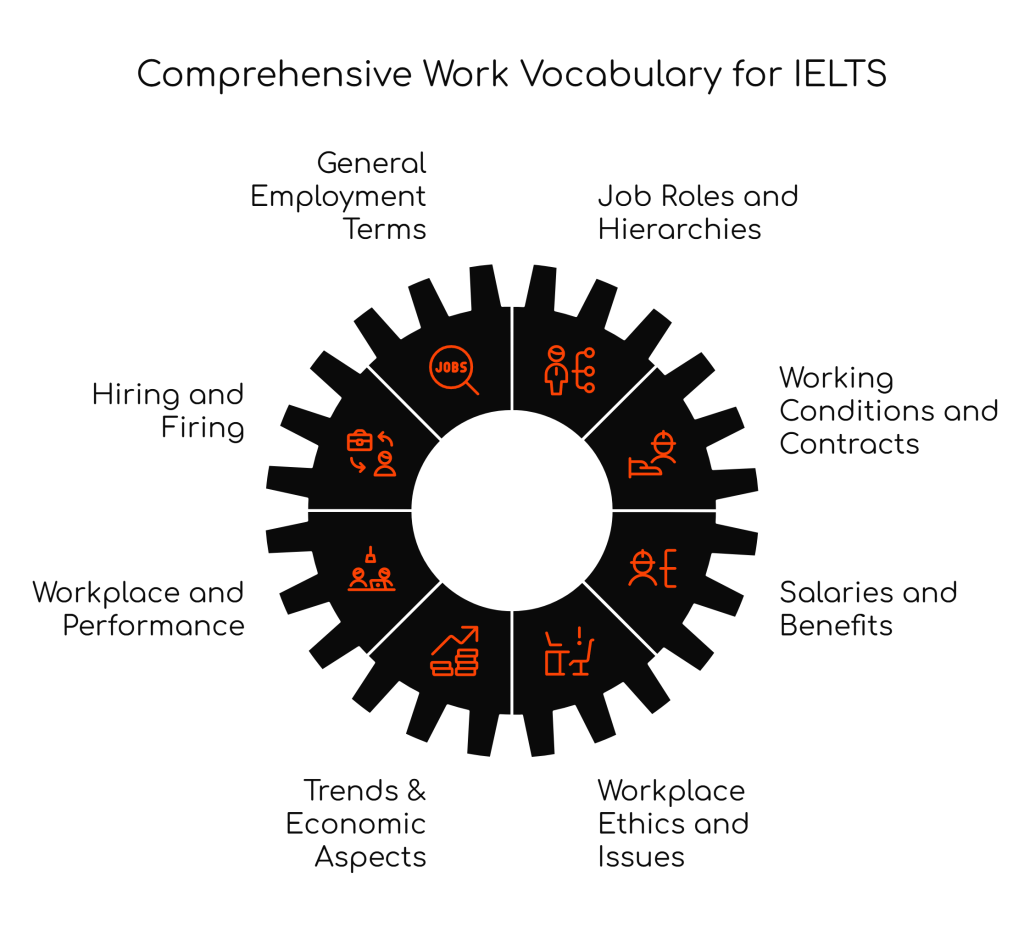
Mastering vocabulary related to work and employment is essential for achieving a high score in IELTS Speaking and Writing. Whether discussing job satisfaction, employment trends, or workplace issues, the right terminology can help you express your ideas clearly and professionally. Below is a curated list of 100 topic-specific words and phrases, complete with definitions and example sentences.
I. General Employment Terms
- Occupation – A person’s usual or principal work or business.
- Her occupation as a civil engineer demands high attention to detail.
- Profession – A paid occupation, especially one requiring formal training and qualification.
- Teaching is often considered a noble profession.
- Career – An occupation undertaken for a significant period of a person’s life.
- He pursued a career in international banking.
- Employment – The state of having paid work.
- Employment opportunities have increased in the tech sector.
- Unemployment – The state of being jobless.
- The government aims to reduce unemployment through job creation programs.
- Job market – The availability of employment and labor.
- The job market has become increasingly competitive.
- Vacancy – An unoccupied position or job.
- There’s a vacancy for a marketing assistant in our department.
- Recruitment – The process of hiring new employees.
- Recruitment agencies help match candidates with suitable employers.
- Workforce – The group of people engaged in or available for work.
- A skilled workforce is essential for economic growth.
- Resignation – The act of leaving a job voluntarily.
- She handed in her resignation to pursue further education.
II. Job Roles and Hierarchies
- Employee – A person employed for wages or salary.
- The company employs over 500 employees globally.
- Employer – A person or organization that hires people.
- Employers must provide a safe working environment.
- Intern – A student or trainee working to gain experience.
- She worked as an intern at a multinational firm during summer.
- Colleague – A person with whom one works.
- He’s respected by both colleagues and superiors.
- Supervisor – Someone who oversees workers.
- The supervisor was responsible for monitoring team progress.
- Manager – A person responsible for controlling or administering an organization.
- The sales manager conducted a performance review.
- Executive – A person with senior managerial responsibility.
- The executive team approved the new strategy.
- Subordinate – Someone lower in rank or position.
- Managers must treat their subordinates with respect.
- Freelancer – A self-employed person offering services to various clients.
- Freelancers enjoy greater flexibility in work hours.
- Entrepreneur – Someone who starts and manages a business venture.
- Many entrepreneurs face financial risk in the early stages.
III. Hiring and Firing
- Application – A formal request for employment.
- He submitted an application for the advertised position.
- Resume (CV) – A summary of qualifications and experience.
- A well-written CV improves your chances of being noticed.
- Interview – A formal meeting for assessing a candidate.
- The interview lasted for over an hour.
- Shortlist – A final list of candidates for a position.
- Five applicants were shortlisted for the role.
- Offer letter – A formal job offer.
- She received an offer letter the day after the interview.
- Probation – A trial period of employment.
- New hires usually undergo a three-month probation period.
- Dismissal – The act of being removed from a job.
- Gross misconduct led to his immediate dismissal.
- Redundancy – Job loss due to a company no longer needing the role.
- Many workers faced redundancy during the recession.
- Termination – The end of an employment contract.
- The contract allowed for early termination with notice.
- Layoff – Temporary or permanent discharge due to economic reasons.
- The company announced layoffs due to decreased demand.
IV. Working Conditions and Contracts
- Full-time – Working the standard number of hours.
- She has a full-time job as a legal assistant.
- Part-time – Working fewer hours than full-time.
- Part-time employees often receive fewer benefits.
- Shift work – A work schedule that rotates through different times of day.
- Nurses often work night shifts.
- Flexible hours – Variable work hours instead of fixed shifts.
- Flexible hours help improve work-life balance.
- Remote work – Working from a location outside the office.
- Remote work has become more common after the pandemic.
- Overtime – Time worked beyond regular hours.
- He earned extra money through overtime shifts.
- Contractual – Based on a formal contract.
- Contractual employees are not always entitled to permanent benefits.
- Freelance – Working independently rather than being employed.
- Freelance writers often juggle multiple clients.
- Self-employed – Working for oneself as a business owner.
- She left her job to become self-employed.
- Internship – A period of work experience offered to students.
- The internship gave her insight into corporate culture.
V. Workplace and Performance
- Productivity – The rate of output per unit of input.
- Increased productivity benefits both workers and employers.
- Efficiency – Achieving maximum productivity with minimum wasted effort.
- Modern tools enhance workplace efficiency.
- Motivation – The reason for acting or behaving in a certain way.
- Employee motivation is crucial for company success.
- Burnout – Exhaustion due to prolonged stress.
- Many employees experience burnout without proper work-life balance.
- Teamwork – Cooperative effort by a group.
- Good teamwork is essential for project success.
- Conflict resolution – Managing and resolving disputes.
- Conflict resolution training helps maintain harmony at work.
- Deadline – The latest time by which something must be completed.
- Meeting deadlines is a key skill in the workplace.
- Promotion – Advancement to a higher position.
- She received a promotion after two years of hard work.
- Demotion – Reduction to a lower rank.
- Repeated errors led to his demotion.
- Recognition – Acknowledgement of achievement.
- Public recognition boosts employee morale.
VI. Salaries and Benefits
- Salary – Regular payment for employment.
- She receives a monthly salary of $3,000.
- Wage – Payment usually calculated on an hourly or daily basis.
- Wages vary depending on the job and location.
- Bonus – Extra compensation for performance.
- The company offered a year-end bonus to all employees.
- Commission – Payment based on sales.
- Sales staff receive commission in addition to their salary.
- Pay rise – An increase in salary.
- She asked her boss for a pay rise after completing a major project.
- Pension – Regular payments made after retirement.
- Employees contribute to a pension scheme throughout their career.
- Health insurance – Coverage for medical expenses.
- Health insurance is one of the most valued employee benefits.
- Sick leave – Time off due to illness.
- He took two days of sick leave last week.
- Paid vacation – Leave with full salary.
- Employees are entitled to 20 days of paid vacation per year.
- Maternity leave – Time off for mothers after childbirth.
- Maternity leave policies vary between countries.
VII. Trends & Economic Aspects
- Labour market – The supply of available workers in relation to available work.
- The labour market is heavily influenced by economic policies.
- Gig economy – A labor market characterized by short-term contracts or freelance work.
- The gig economy offers flexibility but often lacks job security.
- Outsourcing – Delegating work to external organizations.
- Many companies outsource IT services to reduce costs.
- Automation – The use of machines to perform tasks.
- Automation has replaced many manual jobs in manufacturing.
- Globalization – Integration of economies and workforces across the world.
- Globalization has increased competition in the job market.
- Recession – A period of economic decline.
- During the recession, many businesses reduced their workforce.
- Inflation – The rate at which prices increase.
- Wages have not kept up with inflation in some industries.
- Minimum wage – The lowest legal wage that can be paid.
- Raising the minimum wage is a hot topic in employment policy.
- Economic downturn – A decline in economic activity.
- The tourism sector suffered during the recent economic downturn.
- Job creation – The process of providing new jobs.
- Government investment led to significant job creation in infrastructure.
VIII. Workplace Ethics and Issues
- Discrimination – Unfair treatment based on characteristics like race or gender.
- Workplace discrimination is illegal in many countries.
- Harassment – Unwelcome behavior that creates a hostile environment.
- The company enforces a zero-tolerance policy on harassment.
- Workplace culture – Shared values and practices within an organization.
- A positive workplace culture improves employee satisfaction.
- Diversity – Inclusion of people from various backgrounds.
- Diversity in the workplace encourages innovation.
- Equity – Fair treatment for all employees.
- Equity ensures that all staff have equal access to opportunities.
- Transparency – Open communication and honesty in management.
- Transparency in promotion decisions builds trust.
- Whistleblower – A person who exposes unethical behavior.
- The whistleblower reported financial misconduct.
- Code of conduct – A set of rules outlining expected behavior.
- Every employee must adhere to the company’s code of conduct.
- Workplace safety – Measures to protect health and wellbeing.
- Workplace safety training is mandatory in high-risk industries.
- Labor union – An organization that represents workers’ interests.
- The labor union negotiated better wages for its members.
IX. Skills, Training & Career Development
- Soft skills – Interpersonal abilities like communication and teamwork.
- Employers value soft skills as much as technical expertise.
- Hard skills – Specific, teachable abilities.
- Coding is a hard skill required in the tech industry.
- Vocational training – Education focused on practical skills.
- Vocational training prepares students for specific careers.
- Upskilling – Learning new skills to stay current in a job.
- Employees are encouraged to upskill regularly.
- Reskilling – Learning entirely new skills for a different role.
- Reskilling programs help workers transition into new fields.
- Apprenticeship – On-the-job training under experienced workers.
- An apprenticeship offers a blend of work experience and education.
- Mentorship – Guidance provided by a more experienced colleague.
- Mentorship programs support professional growth.
- Certification – A formal qualification showing competency.
- A project management certification boosts job prospects.
- Professional development – Activities that enhance career skills.
- The company funds professional development workshops.
- Lifelong learning – Continuously developing knowledge and skills.
- Lifelong learning is essential in fast-changing industries.
X. Modern Employment Concepts
- Work-life balance – A healthy balance between personal and professional life.
- Remote work can improve work-life balance.
- Job satisfaction – The level of contentment with one’s job.
- Flexible hours often lead to higher job satisfaction.
- Telecommuting – Working from home using technology.
- Telecommuting has become the norm in many industries.
- Digital nomad – Someone who works remotely while traveling.
- Digital nomads rely on internet connectivity to stay productive.
- Co-working space – A shared workspace for independent workers.
- Freelancers often use co-working spaces for networking and focus.
- Hybrid work model – A combination of remote and in-office work.
- Many firms adopted the hybrid model post-pandemic.
- Side hustle – A secondary job or income stream.
- Many employees start side hustles to earn extra income.
- Job hopping – Frequently changing jobs.
- Job hopping is common among younger professionals seeking growth.
- Employee engagement – The emotional commitment of an employee.
- Higher engagement leads to better performance and retention.
- Talent acquisition – The process of attracting and hiring skilled workers.
- Modern talent acquisition involves social media and AI tools.
A strong command of work- and employment-related vocabulary is vital for IELTS success, especially in Speaking Part 3 and Writing Task 2 where employment issues often arise. From discussing trends like remote work and automation to exploring personal career goals, these 100 words provide the precision and variety needed to demonstrate lexical resource and coherence.
To maximize your score:
- Use specific terms over general words.
- Paraphrase using synonyms from this list.
- Support your arguments with clear examples.
Practice incorporating these terms into sample answers and essays, and you’ll notice a significant boost in fluency and professionalism.
#IELTSGuidePhil #IELTS #IELTSVocabulary #IELTSWriting #IELTSSpeaking #WorkAndEmployment #IELTSPreparation #AcademicEnglish #LexicalResource #EnglishForWork #IELTSBand7Plus #IELTSTips #EnglishVocabulary
 IELTS Guide Phil
Leave a comment