
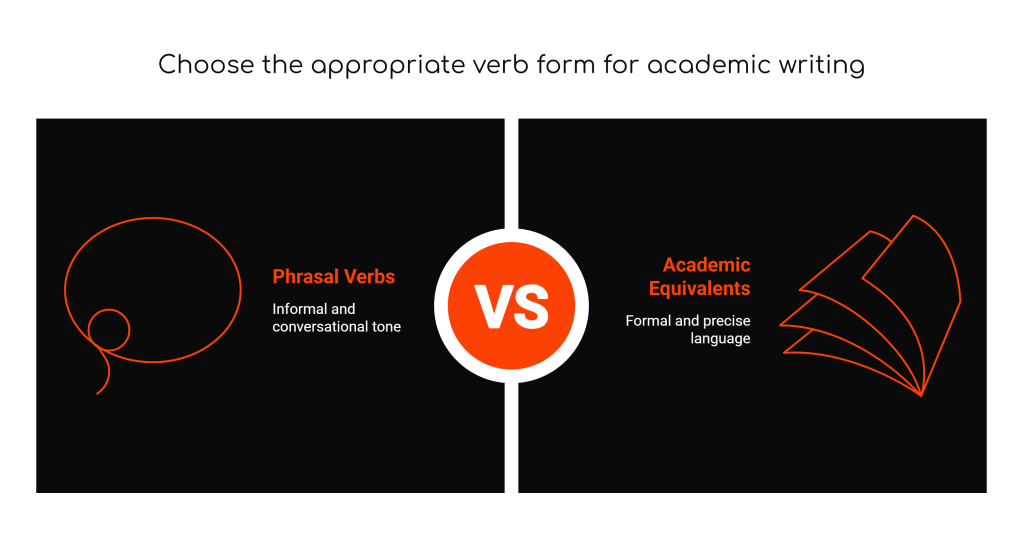
Phrasal verbs are widely used in everyday English, but they often appear too informal for academic and professional writing. In these contexts, using precise and formal vocabulary is not only preferred but expected. This guide presents 100 common phrasal verbs along with their academic equivalents, complete with definitions and example sentences to help you build a more refined and versatile vocabulary.
1. Ask for → Request
Definition: To express a desire for something.
Informal: She asked for more information about the course.
Formal: She requested additional information about the course.
2. Bring up → Introduce / Raise
Definition: To mention a topic for discussion.
Informal: He brought up an interesting point during the meeting.
Formal: He introduced an interesting point during the discussion.
3. Call off → Cancel
Definition: To stop something that was planned.
Informal: They called off the event due to bad weather.
Formal: The event was cancelled due to adverse weather conditions.
4. Carry out → Conduct / Perform
Definition: To complete a task or action.
Informal: The team carried out the experiment successfully.
Formal: The team conducted the experiment successfully.
5. Come across → Encounter
Definition: To find or meet by chance.
Informal: I came across an old friend at the mall.
Formal: I encountered an old friend at the shopping centre.
6. Deal with → Address / Handle
Definition: To take action to solve a problem.
Informal: She dealt with the issue quickly.
Formal: She addressed the issue promptly.
7. Find out → Discover / Determine
Definition: To learn or obtain information.
Informal: We found out the results yesterday.
Formal: We discovered the results yesterday.
8. Get in touch with → Contact
Definition: To communicate with someone.
Informal: I’ll get in touch with him tomorrow.
Formal: I will contact him tomorrow.
9. Give up → Abandon / Quit
Definition: To stop doing something.
Informal: He gave up smoking last year.
Formal: He quit smoking last year.
10. Go on → Continue / Proceed
Definition: To keep doing something.
Informal: She went on talking despite the interruption.
Formal: She continued speaking despite the interruption.
11. Keep on → Continue
Definition: To persist in doing something.
Informal: He kept on asking questions.
Formal: He continued to ask questions.
12. Leave out → Omit
Definition: To exclude or forget something.
Informal: You left out a key detail.
Formal: You omitted a key detail.
13. Look at → Examine / Consider
Definition: To observe or think about something carefully.
Informal: Let’s look at the data again.
Formal: Let us examine the data again.
14. Look into → Investigate
Definition: To explore or study a matter in depth.
Informal: The manager will look into the complaint.
Formal: The manager will investigate the complaint.
15. Make up → Fabricate / Invent
Definition: To create or lie about something.
Informal: He made up the whole story.
Formal: He fabricated the entire narrative.
16. Point out → Indicate / Highlight
Definition: To draw attention to something.
Informal: She pointed out the error.
Formal: She highlighted the error.
17. Put off → Postpone / Delay
Definition: To move an event to a later time.
Informal: We put off the meeting until next week.
Formal: The meeting was postponed until next week.
18. Run into → Encounter / Experience
Definition: To face a difficulty or meet by chance.
Informal: They ran into some problems during the process.
Formal: They encountered several problems during the process.
19. Set up → Establish / Organize
Definition: To initiate or arrange something.
Informal: We set up a new department.
Formal: We established a new department.
20. Show up → Appear / Attend
Definition: To arrive or be present.
Informal: He didn’t show up for the interview.
Formal: He did not attend the interview.
21. Speak about → Discuss
Definition: To talk about a subject.
Informal: We spoke about the issue last night.
Formal: We discussed the issue yesterday evening.
22. Take part in → Participate in
Definition: To join an activity or event.
Informal: Many students took part in the workshop.
Formal: Many students participated in the workshop.
23. Talk about → Discuss / Address
Definition: To mention or examine something.
Informal: He talked about his research.
Formal: He discussed his research.
24. Talk into → Persuade
Definition: To convince someone to do something.
Informal: She talked him into applying for the job.
Formal: She persuaded him to apply for the job.
25. Think about → Consider
Definition: To reflect or contemplate.
Informal: I need to think about your suggestion.
Formal: I need to consider your suggestion.
26. Think over → Reflect on / Evaluate
Definition: To consider something carefully.
Informal: I’ll think it over before deciding.
Formal: I will reflect on it before making a decision.
27. Turn down → Reject / Decline
Definition: To refuse an offer.
Informal: He turned down the invitation.
Formal: He declined the invitation.
28. Work out → Resolve / Solve
Definition: To find a solution.
Informal: We worked out the problem together.
Formal: We resolved the problem together.
29. Back up → Support
Definition: To provide evidence or help.
Informal: Can you back up your argument?
Formal: Can you support your argument?
30. Break down → Analyze
Definition: To divide something into parts for understanding.
Informal: Let’s break down the budget.
Formal: Let us analyze the budget.
31. Come up with → Devise / Propose
Definition: To think of an idea or plan.
Informal: She came up with a brilliant idea.
Formal: She proposed a brilliant idea.
32. End up → Conclude / Result
Definition: To eventually become or do something.
Informal: He ended up leaving early.
Formal: He eventually concluded the meeting early.
33. Go against → Oppose / Contradict
Definition: To resist or challenge something.
Informal: That goes against our values.
Formal: That contradicts our principles.
34. Keep up with → Stay informed / Maintain pace
Definition: To remain updated.
Informal: I can’t keep up with all the changes.
Formal: I cannot stay informed about all the changes.
35. Look forward to → Anticipate
Definition: To await something with excitement.
Informal: I’m looking forward to the results.
Formal: I anticipate the results with interest.
36. Make sure → Ensure
Definition: To guarantee or confirm something.
Informal: Please make sure it’s correct.
Formal: Please ensure its accuracy.
37. Put together → Compile / Assemble
Definition: To gather and organize.
Informal: He put together a report.
Formal: He compiled a report.
38. Set out → Outline
Definition: To explain or describe something systematically.
Informal: She set out her goals clearly.
Formal: She outlined her goals clearly.
39. Show off → Demonstrate / Display
Definition: To present abilities or qualities, often boastfully.
Informal: He likes to show off his skills.
Formal: He tends to display his skills prominently.
40. Turn out → Result / Emerge
Definition: To conclude or develop in a particular way.
Informal: It turned out better than expected.
Formal: The outcome was better than expected.
41. Break up → Disband / Terminate
Definition: To end something.
Informal: They broke up after a year.
Formal: They terminated their relationship after a year.
42. Call for → Require
Definition: To need or demand something.
Informal: The project calls for a lot of work.
Formal: The project requires considerable effort.
43. Carry on → Continue
Definition: To persist in an action.
Informal: She carried on despite the interruptions.
Formal: She continued despite the interruptions.
44. Come in → Arrive / Enter
Definition: To enter or arrive at a location.
Informal: Please come in and sit down.
Formal: Please enter and take a seat.
45. Cut down on → Reduce
Definition: To decrease something.
Informal: You should cut down on sugar.
Formal: You should reduce your sugar intake.
46. Fall behind → Lag / Struggle
Definition: To be delayed or not keep up.
Informal: He fell behind in his studies.
Formal: He lagged in his academic progress.
47. Get ahead → Advance / Progress
Definition: To make progress or gain an advantage.
Informal: She is getting ahead in her career.
Formal: She is advancing in her professional career.
48. Get across → Communicate
Definition: To successfully convey information.
Informal: She got across the message clearly.
Formal: She communicated the message clearly.
49. Get away with → Escape punishment
Definition: To avoid consequences for an action.
Informal: He got away with cheating on the test.
Formal: He escaped punishment for cheating on the exam.
50. Give in → Yield / Surrender
Definition: To accept something after resistance.
Informal: He gave in to the pressure.
Formal: He yielded to the pressure.
51. Go over → Review
Definition: To examine or check carefully.
Informal: Let’s go over the proposal.
Formal: Let us review the proposal.
52. Hand in → Submit
Definition: To deliver something, typically a document.
Informal: You must hand in your assignment by Friday.
Formal: You must submit your assignment by Friday.
53. Hold on → Wait
Definition: To wait for a moment.
Informal: Hold on, I’ll be right back.
Formal: Please wait, I will return shortly.
54. Hold up → Delay
Definition: To cause a delay.
Informal: The traffic held us up.
Formal: The traffic caused a delay.
55. Keep up → Maintain / Stay current
Definition: To maintain a certain level or pace.
Informal: I can’t keep up with all the work.
Formal: I am unable to maintain the pace of the workload.
56. Look after → Care for
Definition: To take care of someone or something.
Informal: She looked after her younger siblings.
Formal: She cared for her younger siblings.
57. Look for → Search for
Definition: To seek or attempt to find something.
Informal: I’m looking for my keys.
Formal: I am searching for my keys.
58. Look into → Investigate
Definition: To examine or inquire about something in detail.
Informal: I will look into the matter.
Formal: I will investigate the matter.
59. Look up to → Admire
Definition: To regard with respect.
Informal: She looks up to her older brother.
Formal: She admires her older brother.
60. Make out → Discern
Definition: To identify or understand something unclear.
Informal: I couldn’t make out what he was saying.
Formal: I was unable to discern what he was saying.
61. Make up → Compose
Definition: To create or constitute.
Informal: He made up a story.
Formal: He composed a narrative.
62. Pass away → Die
Definition: To cease living.
Informal: His grandfather passed away last year.
Formal: His grandfather died last year.
63. Pay back → Reimburse
Definition: To return money owed.
Informal: She paid me back the money she borrowed.
Formal: She reimbursed me for the money she borrowed.
64. Pick up → Collect / Gather
Definition: To gather or accumulate something.
Informal: I’ll pick up the package later.
Formal: I will collect the package later.
65. Put up with → Tolerate
Definition: To endure something unpleasant.
Informal: I can’t put up with his behavior.
Formal: I cannot tolerate his behavior.
66. Run across → Encounter
Definition: To come upon unexpectedly.
Informal: I ran across a great article yesterday.
Formal: I encountered an excellent article yesterday.
67. Run out of → Exhaust
Definition: To use up all of something.
Informal: We ran out of milk.
Formal: We exhausted our supply of milk.
68. Set off → Trigger
Definition: To cause something to happen.
Informal: The alarm went off when I opened the door.
Formal: The alarm was triggered when I opened the door.
69. Show up → Appear
Definition: To arrive or become visible.
Informal: He didn’t show up for the meeting.
Formal: He did not appear at the meeting.
70. Stick to → Adhere to
Definition: To follow or maintain a course of action.
Informal: We should stick to the plan.
Formal: We should adhere to the plan.
71. Take after → Resemble
Definition: To resemble a family member, typically in appearance or character.
Informal: She takes after her mother.
Formal: She resembles her mother.
72. Take over → Assume control
Definition: To take control or charge of something.
Informal: He will take over the project next month.
Formal: He will assume control of the project next month.
73. Tear down → Demolish
Definition: To destroy or break down something.
Informal: They are tearing down the old building.
Formal: They are demolishing the old building.
74. Turn down → Reject
Definition: To refuse or decline an offer.
Informal: He turned down the job offer.
Formal: He rejected the job offer.
75. Turn up → Appear / Arrive
Definition: To show up or be present.
Informal: She turned up late to the class.
Formal: She arrived late to the class.
76. Wake up → Awaken
Definition: To stop sleeping or rouse someone from sleep.
Informal: I wake up early every day.
Formal: I awaken early every day.
77. Work out → Resolve
Definition: To solve a problem.
Informal: We worked out a solution.
Formal: We resolved the issue.
78. Write down → Record
Definition: To make a note of something.
Informal: I’ll write down the address for you.
Formal: I will record the address for you.
79. Catch up → Update / Inform
Definition: To bring someone up to date on something.
Informal: Let’s catch up on the news.
Formal: Let us update each other on the news.
80. Check out → Examine
Definition: To inspect or verify something.
Informal: You should check out that new movie.
Formal: You should examine that new movie critically.
81. Clean up → Clean / Tidy
Definition: To make something clean or neat.
Informal: We need to clean up the room.
Formal: We need to tidy the room.
82. Close down → Shut down
Definition: To cease operations or end an activity.
Informal: The company closed down last year.
Formal: The company shut down last year.
83. Cut off → Disconnect
Definition: To sever or stop something.
Informal: The phone call was cut off.
Formal: The phone call was disconnected.
84. Draw up → Prepare / Draft
Definition: To create or formulate something.
Informal: He drew up the plans for the new building.
Formal: He drafted the plans for the new building.
85. Fall out → Disagree / Argue
Definition: To have a disagreement.
Informal: They fell out after the argument.
Formal: They disagreed after the discussion.
86. Fill out → Complete
Definition: To complete a form or document.
Informal: Please fill out the form.
Formal: Please complete the form.
87. Get back → Return
Definition: To return to a previous place or state.
Informal: He got back from his trip yesterday.
Formal: He returned from his trip yesterday.
88. Get together → Gather
Definition: To meet in a group.
Informal: Let’s get together tomorrow.
Formal: Let us gather tomorrow.
89. Give up → Relinquish / Surrender
Definition: To stop trying or concede something.
Informal: He gave up trying to solve the puzzle.
Formal: He relinquished the effort to solve the puzzle.
90. Go ahead → Proceed
Definition: To continue or go forward with something.
Informal: You can go ahead and start the presentation.
Formal: You may proceed with the presentation.
91. Hang up → Disconnect
Definition: To end a phone call.
Informal: She hung up after the argument.
Formal: She disconnected the call after the dispute.
92. Hold back → Restrain
Definition: To prevent or inhibit an action.
Informal: Don’t hold back your feelings.
Formal: Do not restrain your emotions.
93. Keep from → Prevent
Definition: To stop someone from doing something.
Informal: I kept him from leaving the meeting early.
Formal: I prevented him from leaving the meeting prematurely.
94. Let down → Disappoint
Definition: To fail to meet expectations.
Informal: She let me down when she didn’t show up.
Formal: She disappointed me by not showing up.
95. Put out → Extinguish
Definition: To stop something from burning.
Informal: He put out the fire quickly.
Formal: He extinguished the fire quickly.
96. Run out → Exhaust / Deplete
Definition: To use up completely.
Informal: We ran out of time.
Formal: We exhausted the available time.
97. Set aside → Reserve
Definition: To save something for a later use.
Informal: I set aside money for my vacation.
Formal: I reserved funds for my vacation.
98. Take off → Ascend
Definition: To begin to rise (aircraft).
Informal: The plane took off at 6 AM.
Formal: The plane ascended at 6 AM.
99. Throw away → Discard
Definition: To dispose of something.
Informal: He threw away the old papers.
Formal: He discarded the old documents.
100. Turn up → Arrive
Definition: To appear at a location.
Informal: She didn’t turn up for the meeting.
Formal: She did not arrive at the meeting.
Mastering phrasal verbs and their academic equivalents is crucial for enhancing both written and spoken English in professional and academic settings. By understanding how different prepositions and adverbs can change the meaning of a verb, learners can expand their vocabulary and communicate with greater precision. Whether you’re preparing for exams, engaging in professional discourse, or simply aiming to refine your communication, these phrasal verbs and their academic counterparts will undoubtedly help you express yourself more clearly and confidently.
#IELTSGuidePhil #IELTS #AcademicVocabulary #FormalEnglish #AdvancedEnglish #PhrasalVerbs #EnglishLearning #ESLResources #IELTSTips #WritingSkills #EnglishGrammar #AdvancedEnglishSkills
 IELTS Guide Phil
Leave a comment