
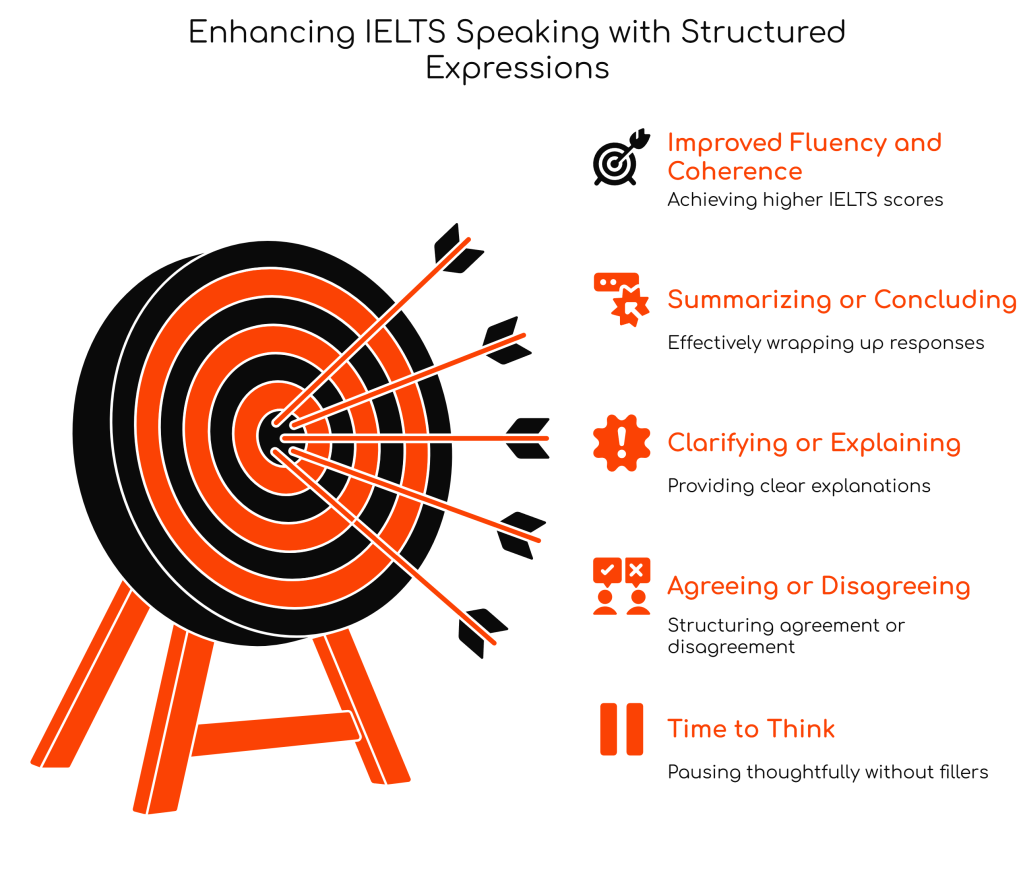
In the IELTS Speaking test, fluency and coherence are essential for achieving a higher band score. Many test-takers often use fillers such as “um,” “uh,” “like,” “you know,” or “actually” when they are searching for words or trying to gather their thoughts. While these fillers are common in natural speech, they can detract from the overall fluency and impact of your response. Replacing these fillers with more structured and sophisticated expressions not only helps you sound more confident but also demonstrates your command of the language.
Here is a comprehensive list of 100 effective expressions to replace fillers, organized by different contexts. These expressions will help you speak more naturally, confidently, and coherently during your IELTS Speaking test.
1. When You Need Time to Think
Instead of using “um” or “uh,” consider the following alternatives to give yourself a moment to gather your thoughts:
- Let me think for a moment.
- That’s an interesting question.
- Hmm, that’s a good point.
- I need to think about that for a second.
- Let me see.
- That’s a tough one.
- Well, to be honest…
- It’s hard to say.
- That’s a bit tricky, but…
- I haven’t really thought about that before.
- I’ll need a second to consider that.
- Hmm, let me think.
- That’s something I haven’t considered yet.
- Let me reflect on that.
- Give me a moment to think about that.
2. Introducing an Idea or Opinion
If you often use fillers like “you know” or “actually” when starting to give your opinion, here are alternatives that will sound more professional:
- In my opinion,
- From my perspective,
- As I see it,
- Personally, I think
- I would argue that
- If you ask me,
- To be honest,
- As far as I’m concerned,
- It seems to me that
- I believe that
- It’s my belief that
- In my view,
- I strongly feel that
- I tend to think that
- I’m inclined to believe that
3. Giving Examples
When you want to provide examples but tend to rely on vague fillers, use these expressions to introduce examples more effectively:
- For instance,
- For example,
- Take, for example,
- Let me give you an example.
- A case in point is
- One good example is
- To illustrate this,
- As an illustration,
- In this case,
- Such as
- Like I said earlier,
- To give you an idea,
- To demonstrate this,
- An example that comes to mind is
- One example that illustrates this is
4. Agreeing or Disagreeing
Instead of using fillers like “well” or “you know” when agreeing or disagreeing, consider these expressions for a more structured response:
- I completely agree.
- I totally agree.
- I agree with that.
- That’s absolutely true.
- I couldn’t agree more.
- That’s exactly what I think.
- I see your point, but I have a different perspective.
- I don’t agree with that.
- I have to disagree with that.
- That’s not really how I see it.
- I’m not so sure about that.
- I’m afraid I don’t agree.
- On the contrary,
- I see it differently.
- I can’t say I agree with that.
5. Clarifying or Explaining
When you’re trying to explain something but tend to fall back on fillers like “actually” or “so,” these expressions can help you sound more organized and clear:
- Let me clarify that.
- What I mean is
- To put it simply,
- In other words,
- Let me put it another way,
- To explain further,
- That is to say,
- What I’m trying to say is
- Allow me to explain.
- So, what I’m saying is
- In a nutshell,
- To elaborate on that,
- The point I’m making is
- In simpler terms,
- To be more specific,
6. Expressing Uncertainty
When you’re uncertain or tentative about something, use these alternatives to sound more polished than relying on fillers:
- I’m not sure, but
- It’s possible that
- I’m not certain, but I think
- It could be that
- I’m not entirely sure, but
- I’m not sure if I understand, but
- I don’t know for sure, but
- That’s just my guess.
- I’m not entirely convinced, but
- I think it’s possible that
- It seems likely that
- I can’t be certain, but
- It’s hard to say for sure, but
- I might be wrong, but
- I’m not sure about that, but I think
7. Summarizing or Concluding
When you’re about to conclude your answer, you can use these expressions to summarize effectively, avoiding vague fillers:
- In conclusion,
- To sum up,
- To conclude,
- Overall,
- In short,
- All in all,
- To wrap things up,
- In a nutshell,
- To bring it all together,
- So, to summarize,
Final Thoughts
Replacing fillers with more structured expressions can significantly improve your fluency and coherence in the IELTS Speaking test. Not only does it show your ability to organize thoughts, but it also demonstrates a higher level of language proficiency. By practicing these expressions and integrating them into your speaking, you can avoid common mistakes and sound more confident and natural when answering questions.
Remember, it’s important to use these expressions appropriately in context. Try not to overuse them, as balance is key to maintaining natural and fluent speech.
Good luck with your IELTS preparation, and don’t forget to practice regularly!
#IELTS #IELTSGuidePhil #IELTSSpeaking #FluencyTips #IELTSPreparation #EnglishSpeakingSkills #AvoidFillers #SpeakFluently #IELTSBandScore #IELTSTips #EffectiveCommunication #SpeakWithConfidence
 IELTS Guide Phil
Leave a comment