
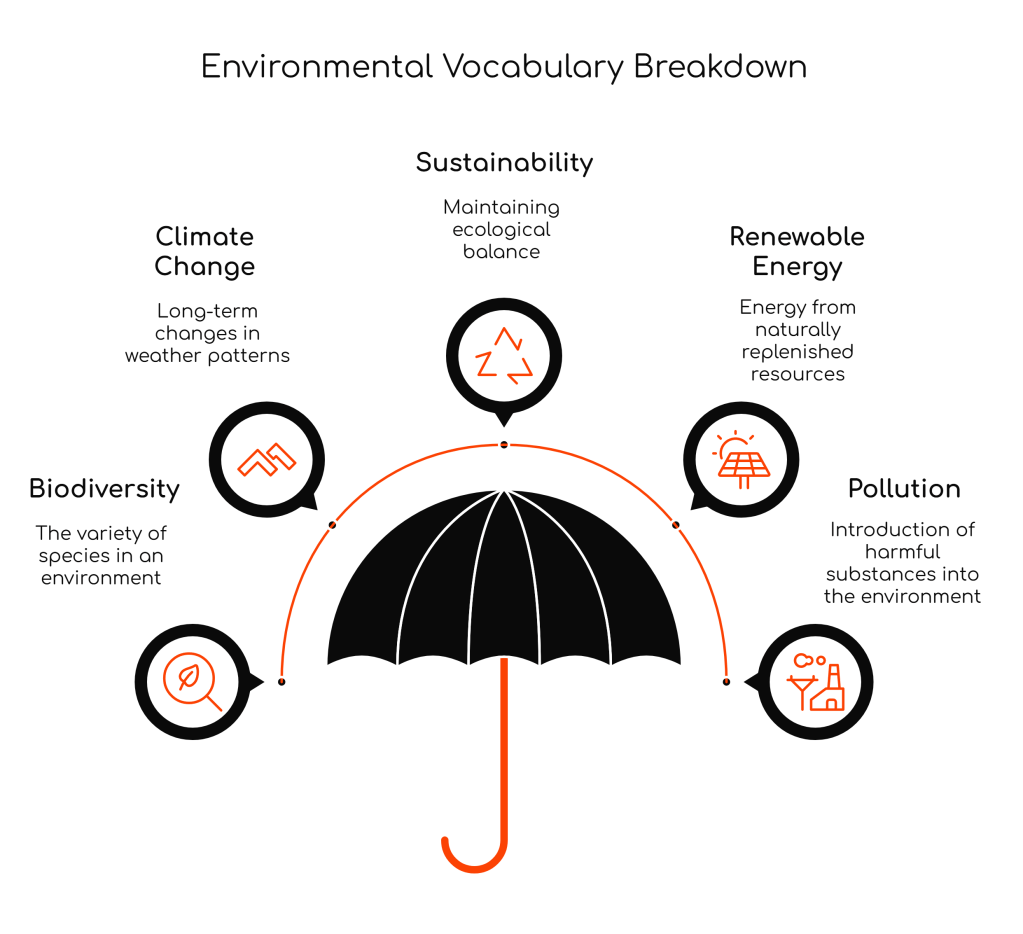
Environmental topics frequently appear in the IELTS Speaking and Writing tests. Whether you’re discussing pollution, climate change, or sustainability, using precise and advanced vocabulary can significantly boost your score.
This guide presents 100 essential environment-related terms with definitions and example sentences—ideal for Task 2 essays and Part 3 speaking questions.
1. Climate & Atmospheric Issues
Climate change – Long-term alteration of temperature and typical weather patterns.
Climate change is influencing rainfall and heatwave patterns worldwide.
Global warming – Increase in Earth’s average surface temperature.
Global warming is accelerating ice cap melting.
Greenhouse gases – Gases that trap heat, like CO₂ and methane.
The rise in greenhouse gases intensifies the greenhouse effect.
Greenhouse effect – Warming due to trapped radiation.
The greenhouse effect keeps Earth habitable but can lead to overheating.
Carbon emissions – Release of carbon dioxide, mainly from burning fossil fuels.
Factories are major sources of carbon emissions.
Carbon footprint – Total carbon emissions caused by an individual or group.
Flying frequently increases your carbon footprint significantly.
Carbon trading – Buying/selling emission allowances to control pollution.
Carbon trading encourages companies to reduce their emissions.
Carbon offset – Actions to compensate for carbon emissions.
Tree planting is a popular carbon offset strategy.
Carbon sequestration – Capturing and storing atmospheric carbon.
Forests serve as natural carbon sequestration systems.
Carbon neutral – Emitting no net carbon emissions.
Many companies aim to be carbon neutral by 2030.
2. Pollution & Waste
Pollution – Introduction of harmful substances into the environment.
Air pollution causes serious respiratory illnesses.
Pollutant – A substance that contaminates.
Nitrogen dioxide is a common pollutant in urban areas.
Toxic waste – Harmful industrial or chemical waste.
Improper disposal of toxic waste endangers wildlife.
Plastic pollution – Accumulation of plastic materials in nature.
Plastic pollution in oceans affects marine ecosystems.
E-waste – Discarded electronic devices.
E-waste is often exported to developing countries.
Waste management – Handling and disposal of waste materials.
Cities must improve waste management systems.
Recycling – Converting waste into reusable material.
Recycling paper reduces deforestation.
Composting – Turning organic waste into fertilizer.
Composting food scraps enriches garden soil.
Zero waste – A lifestyle that aims to produce no waste.
Zero waste living promotes reusable alternatives.
Waste diversion – Redirecting waste away from landfills.
Schools are implementing waste diversion programs.
3. Biodiversity & Ecosystems
Biodiversity – Variety of life in an area.
High biodiversity ensures ecosystem resilience.
Ecosystem – A system formed by interactions between organisms and their environment.
Coral reefs are delicate marine ecosystems.
Ecosystem services – Benefits provided by nature.
Pollination is a vital ecosystem service.
Ecosystem balance – A stable natural system.
Introducing predators can restore ecosystem balance.
Habitat destruction – Elimination of living spaces for species.
Urban sprawl leads to habitat destruction.
Habitat fragmentation – Division of habitats into smaller, isolated sections.
Road construction causes habitat fragmentation.
Habitat restoration – Repairing damaged ecosystems.
Wetland restoration supports endangered birds.
Endangered species – Species at risk of extinction.
Tigers are among the most endangered species.
Extinction – Complete disappearance of a species.
Climate change may accelerate species extinction.
Wildlife conservation – Protecting animals and their habitats.
Wildlife conservation helps maintain biodiversity.
4. Sustainability & Resources
Sustainability – Meeting needs without harming future generations.
Sustainability is essential for long-term survival.
Sustainable development – Development that considers environmental limits.
Sustainable development balances progress with preservation.
Renewable energy – Energy from sources that replenish naturally.
Wind and solar are forms of renewable energy.
Alternative energy – Non-fossil fuel energy sources.
Geothermal energy is a reliable alternative energy source.
Fossil fuels – Non-renewable energy sources like coal and oil.
Burning fossil fuels increases air pollution.
Resource depletion – Using up natural resources.
Overfishing contributes to marine resource depletion.
Sustainable agriculture – Eco-friendly farming practices.
Sustainable agriculture uses organic fertilizers.
Sustainable forestry – Managing forests responsibly.
Selective logging promotes sustainable forestry.
Water conservation – Efficient water usage.
Fixing leaks is a simple water conservation method.
Overconsumption – Using resources beyond sustainable levels.
Overconsumption leads to environmental degradation.
5. Climate Actions & Policy
Climate policy – Laws and actions to combat climate change.
Effective climate policy reduces emissions.
Climate adaptation – Adjusting to climate change impacts.
Flood barriers are part of climate adaptation strategies.
Decarbonization – Reducing carbon output.
Decarbonization is key to achieving net-zero goals.
Energy transition – Moving from fossil fuels to renewables.
The energy transition requires infrastructure investment.
Climate resilience – Ability to recover from climate events.
Communities must build climate resilience.
Environmental justice – Fair treatment in environmental policy.
Environmental justice advocates for marginalized groups.
Green tax – Tax on pollution or carbon emissions.
A green tax encourages cleaner production methods.
Sustainability report – A company’s environmental performance record.
Transparency in sustainability reports is growing.
Emission standards – Legal limits on pollutants from vehicles/factories.
Stricter emission standards reduce air pollution.
Green infrastructure – Eco-friendly urban design.
Green infrastructure includes parks and green roofs.
6. Green Living & Lifestyles
Eco-friendly – Not harmful to the environment.
Eco-friendly products reduce waste.
Eco-conscious – Aware of environmental impact.
Consumers are becoming more eco-conscious.
Minimalism – Lifestyle of simplicity and reduced consumption.
Minimalism helps lower your ecological footprint.
Green consumerism – Buying products that are environmentally responsible.
Green consumerism supports ethical brands.
Ethical sourcing – Obtaining products in an environmentally and socially responsible way.
Ethical sourcing is a key part of sustainability.
Eco-tourism – Responsible travel that conserves nature.
Eco-tourism educates visitors on conservation.
Conscious consumer – Someone who shops with environmental awareness.
Conscious consumers prioritize local goods.
Greenwashing – Misleading claims about eco-friendliness.
Many companies are guilty of greenwashing.
Carbon labeling – Showing carbon emissions on product packaging.
Carbon labeling helps shoppers make informed choices.
Sustainable fashion – Clothing made with minimal environmental impact.
Sustainable fashion uses organic or recycled materials.
7. Science, Innovation & Technology
Biodegradable – Can decompose naturally.
Biodegradable bags break down in the soil.
Non-biodegradable – Cannot be broken down by natural processes.
Non-biodegradable plastics persist in landfills.
Biofuel – Fuel made from living matter.
Biofuel is a cleaner alternative to petrol.
Hydropower – Energy from moving water.
Hydropower is widely used in mountainous regions.
Geothermal energy – Heat energy from within Earth.
Geothermal energy has minimal environmental impact.
Carbon capture – Collecting and storing carbon emissions.
Carbon capture can reduce industrial pollution.
Green tech – Technology that minimizes environmental damage.
Green tech is transforming the energy sector.
Smart grid – Energy networks that use digital tech.
Smart grids improve energy efficiency.
Environmental monitoring – Tracking environmental changes.
Satellite data is used for environmental monitoring.
Sustainable design – Creating buildings that reduce resource use.
Sustainable design includes energy-efficient windows.
8. Cities & Infrastructure
Urbanization – Growth of cities and towns.
Urbanization increases demand for resources.
Overpopulation – Too many people for an area’s resources.
Overpopulation strains public services.
Urban sprawl – Uncontrolled city expansion.
Urban sprawl contributes to habitat loss.
Smart city – Urban area using tech to improve efficiency.
Smart cities promote sustainable living.
Public transport – Shared transport systems.
Public transport reduces carbon emissions.
Sustainable transport – Eco-friendly transportation methods.
Cycling is a form of sustainable transport.
Green spaces – Parks and natural areas in cities.
Green spaces improve mental and physical health.
Noise pollution – Excessive sound in urban areas.
Noise pollution can cause sleep disorders.
Light pollution – Excess artificial light.
Light pollution disrupts wildlife behavior.
Air quality – Measure of pollutants in the air.
Monitoring air quality is essential in cities.
9. Agriculture & Land Use
Deforestation – Cutting down forests.
Deforestation contributes to climate change.
Reforestation – Planting trees in deforested areas.
Reforestation improves biodiversity.
Afforestation – Creating new forests where there were none.
Afforestation helps prevent soil erosion.
Desertification – Spread of desert conditions.
Overgrazing can lead to desertification.
Monoculture – Growing a single crop.
Monoculture reduces soil fertility over time.
Agroforestry – Integrating trees into farming.
Agroforestry increases land productivity.
Soil erosion – Wearing away of topsoil.
Soil erosion threatens food security.
Land degradation – Decline in land quality.
Land degradation is a major global issue.
Organic farming – Growing crops without synthetic inputs.
Organic farming benefits both health and the environment.
Pesticide runoff – Chemicals from farms entering waterways.
Pesticide runoff harms aquatic life.
10. Global Efforts & Agreements
Paris Agreement – International climate change treaty.
The Paris Agreement aims to limit global warming.
Kyoto Protocol – Earlier treaty on emission reduction.
The Kyoto Protocol set binding targets for developed nations.
United Nations Environment Programme (UNEP) – Global environmental authority.
UNEP supports countries in sustainable development.
Sustainable Development Goals (SDGs) – UN global goals, including environmental targets.
SDG 13 focuses on climate action.
Environmental NGO – Non-governmental environmental group.
Greenpeace is a well-known environmental NGO.
Climate summit – Global meetings on climate policy.
World leaders gathered at the climate summit.
Environmental treaty – International agreement on environmental protection.
Countries must honor their environmental treaties.
Bilateral agreement – Environmental deal between two countries.
A bilateral agreement was signed to protect the Amazon.
Carbon tax – Tax on fossil fuel usage.
A carbon tax discourages polluting industries.
Cap and trade – Emission control strategy involving tradable permits.
Cap and trade schemes limit total emissions while offering flexibility.
#IELTS #IELTSGuidePhil #IELTSVocabulary #EnvironmentIELTS #IELTSWritingTips #IELTSSpeakingSkills #SustainableVocabulary #AcademicVocabulary #EcoFriendlyEnglish #IELTSPrep #LexicalResource #ClimateChangeVocabulary
 IELTS Guide Phil
Leave a comment