
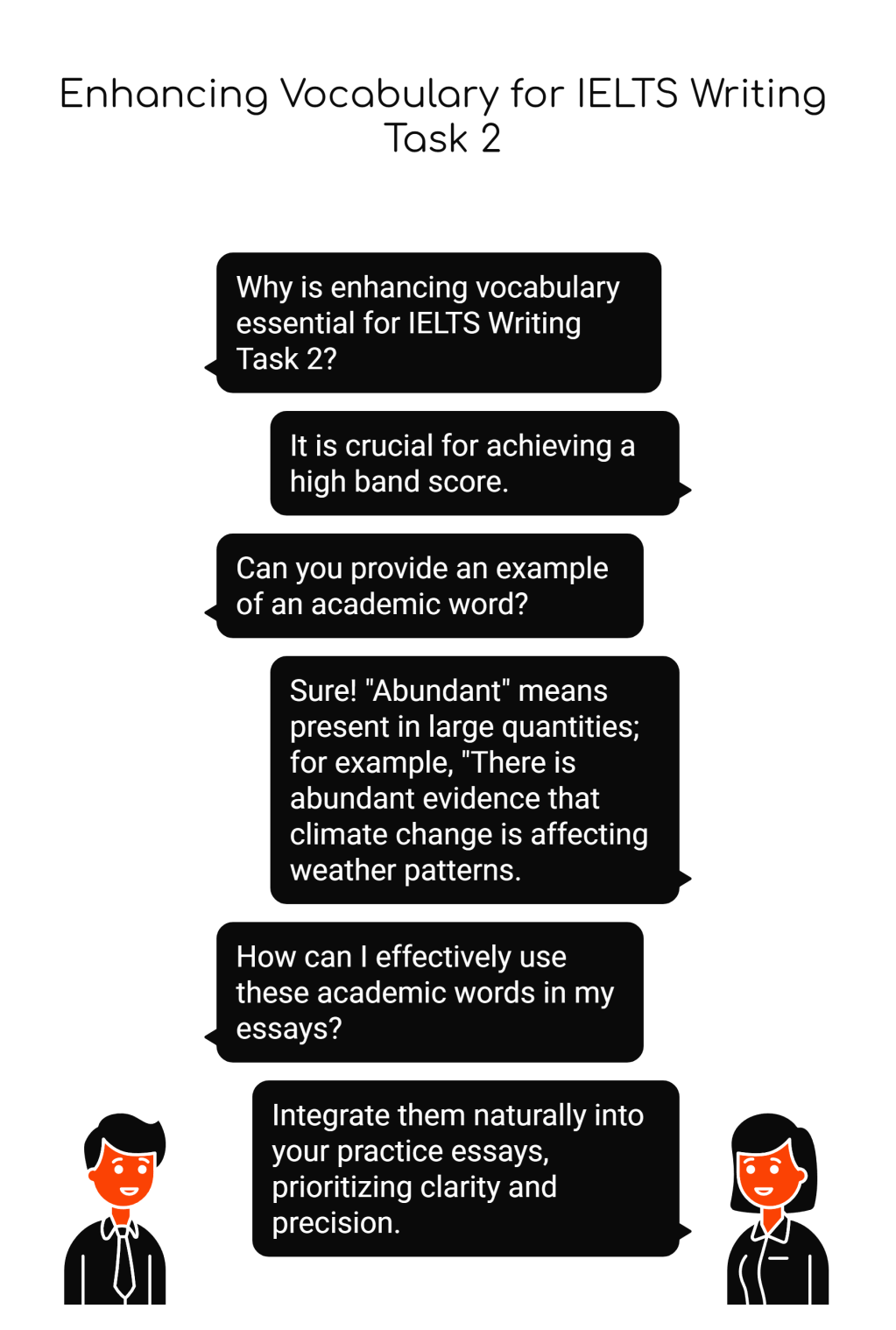
In the IELTS Writing Task 2, the ability to use sophisticated vocabulary is a key factor in achieving a high band score. Academic words not only help to communicate ideas clearly but also demonstrate lexical range. Below is a list of 100 academic words with definitions and example sentences, ideal for use in your IELTS Writing Task 2 essays.
- Abundant – Present in large quantities.
Example: There is abundant evidence that climate change is real. - Accelerate – To increase speed or rate.
Example: Technological advancements are accelerating the development of the healthcare industry. - Accessible – Easy to approach or reach.
Example: Higher education should be accessible to all socioeconomic groups. - Acquisition – The act of obtaining something, especially knowledge or skills.
Example: Language acquisition is faster during early childhood. - Advocate – To publicly recommend or support something.
Example: Many environmentalists advocate for the use of renewable energy. - Aggregate – Formed by combining several elements.
Example: The aggregate data suggests an upward trend in economic growth. - Alleviate – To reduce or ease something, especially pain or hardship.
Example: Public health campaigns aim to alleviate the burden of smoking-related diseases. - Ambiguous – Open to multiple interpretations; unclear.
Example: The policy’s ambiguous wording led to widespread confusion. - Ample – More than enough; sufficient.
Example: There is ample evidence supporting the need for climate action. - Anticipate – To expect something to happen.
Example: Researchers anticipate a decline in fossil fuel consumption over the next decade. - Apparent – Clearly visible or understood.
Example: The benefits of a balanced diet are apparent in improved health outcomes. - Arbitrary – Based on random choice or personal whim.
Example: The grading system seemed arbitrary and lacked transparency. - Assert – To state or declare something strongly.
Example: The report asserts that stricter regulations are necessary to combat pollution. - Assess – To evaluate or estimate the nature or quality of something.
Example: Teachers assess students’ understanding through regular testing. - Attain – To achieve or reach something, especially after effort.
Example: It is important for students to attain a strong grasp of academic writing skills. - Attribute – To regard something as being caused by something else.
Example: Economists attribute the recession to poor government policies. - Bias – A prejudice in favor of or against something.
Example: Media bias often shapes public opinion in unpredictable ways. - Brief – Short in duration or concise in nature.
Example: The manager gave a brief overview of the company’s goals. - Capable – Having the ability to do something.
Example: Students should be capable of critically analyzing academic texts by the end of their degree. - Cease – To stop something from happening.
Example: The company plans to cease operations in the region next year. - Cite – To quote or refer to something as evidence.
Example: Scholars must cite their sources to ensure academic integrity. - Coherent – Logically consistent and easy to understand.
Example: The essay was well-organized and coherent, making it easy to follow the argument. - Commence – To begin something.
Example: The research will commence after the funding is approved. - Compatible – Able to exist or work together without conflict.
Example: The new software is compatible with existing systems. - Comprehensive – Including all elements; thorough.
Example: A comprehensive review of the literature is essential for understanding the topic. - Confer – To grant or bestow something.
Example: The university confers degrees to its graduates in a formal ceremony. - Constitute – To make up or form something.
Example: These measures constitute a significant change in the government’s policy. - Contradict – To assert the opposite of something.
Example: The witness’s testimony contradicted the defendant’s statement. - Contribute – To give or add something in order to help achieve a goal.
Example: Volunteers contribute to improving community well-being. - Conventional – Based on traditional or established practices.
Example: Conventional wisdom often supports the idea of hard work leading to success. - Correlate – To have a mutual relationship or connection.
Example: Research has shown that economic growth correlates with increased living standards. - Crucial – Extremely important.
Example: It is crucial to address climate change to prevent catastrophic consequences. - Cumulative – Increasing in quantity, degree, or force by successive additions.
Example: The cumulative effects of pollution are a growing concern worldwide. - Debate – A formal discussion of opposing viewpoints.
Example: The issue of universal healthcare continues to fuel political debate. - Deduce – To arrive at a conclusion based on evidence or reasoning.
Example: From the available data, scientists deduce that the Earth’s temperature is rising. - Deficit – A shortage or lack of something, especially money.
Example: The country’s budget deficit has led to higher taxes. - Depict – To describe or show something in words or images.
Example: The documentary depicts the harsh realities of life in poverty. - Derive – To obtain something from a source.
Example: The word “biology” is derived from Greek, meaning “study of life.” - Deteriorate – To worsen or decline in quality.
Example: Air quality in major cities has deteriorated due to pollution. - Devote – To dedicate time or resources to something.
Example: She devotes her time to researching renewable energy sources. - Diminish – To make something smaller or less important.
Example: The value of the dollar is expected to diminish over the next year. - Displace – To force something to move from its usual position.
Example: The conflict has displaced millions of people from their homes. - Distinct – Clearly different or separate.
Example: The two strategies offer distinct approaches to solving the problem. - Distort – To twist or change something out of its true meaning.
Example: Media outlets often distort facts to suit their narratives. - Diverse – Showing variety or differences.
Example: Universities benefit from having a diverse student body. - Eliminate – To remove something entirely.
Example: Recycling programs aim to eliminate waste in landfills. - Emphasize – To highlight or give special importance to something.
Example: The teacher emphasizes the importance of critical thinking in academic writing. - Empirical – Based on observation or experience rather than theory.
Example: Empirical research provides valuable insights into consumer behavior. - Enable – To make something possible or easier to do.
Example: Technology enables students to access learning materials remotely. - Encounter – To come across or meet unexpectedly.
Example: The researchers encountered several challenges during their study. - Enhance – To improve or increase the quality of something.
Example: New policies will enhance the effectiveness of healthcare delivery. - Ensure – To make certain that something happens or is the case.
Example: Laws must ensure equal rights for all citizens. - Establish – To create or set something up.
Example: The government plans to establish new regulations for online safety. - Evaluate – To assess the value, quality, or significance of something.
Example: It is important to evaluate the success of the program after its completion. - Evident – Clear or obvious.
Example: The positive outcomes of the program were evident in the data. - Exceed – To go beyond a set limit or expectation.
Example: The company’s profits exceeded forecasts for the third quarter. - Exhibit – To display or present something for others to see.
Example: The artist exhibits her work in galleries around the world. - Expand – To increase in size, number, or importance.
Example: The business plans to expand its operations internationally. - Facilitate – To make something easier or more efficient.
Example: The new software facilitates communication within the team. - Fluctuate – To change or vary irregularly.
Example: Stock prices tend to fluctuate based on market conditions. - Generate – To produce or create something.
Example: The new policy is expected to generate additional job opportunities. - Highlight – To emphasize or bring attention to something.
Example: The report highlights the importance of early childhood education. - Hypothesis – A proposed explanation or educated guess based on limited evidence.
Example: The scientist tested the hypothesis through a series of experiments. - Identify – To recognize or establish something as being a particular thing.
Example: It is important to identify the root causes of educational inequality. - Illustrate – To explain or clarify something through examples or visual aids.
Example: The chart illustrates the changes in unemployment rates over the last decade. - Impact – A strong effect or influence something has on a situation or person.
Example: The government’s economic policies have had a significant impact on small businesses. - Implement – To put into action or execute something.
Example: The university will implement new sustainability measures next year. - Imply – To suggest something without directly stating it.
Example: The speaker’s tone implied that the situation was more serious than anticipated. - Incorporate – To include something as part of a whole.
Example: The new curriculum incorporates a variety of teaching strategies. - Indicate – To show or point out something clearly.
Example: The survey results indicate a growing concern about environmental issues. - Inevitable – Certain to happen; unavoidable.
Example: Technological progress is inevitable in modern society. - Infer – To deduce or conclude information based on evidence.
Example: Based on the results, we can infer that the policy has been effective. - Innovate – To introduce new ideas or methods.
Example: Companies must innovate to remain competitive in a rapidly changing market. - Investigate – To examine something thoroughly to uncover facts or information.
Example: The researchers investigated the causes of urban pollution. - Justify – To provide valid reasons or evidence for something.
Example: The company must justify its decision to lay off employees. - Manipulate – To control or influence something or someone, often unfairly.
Example: Media outlets can manipulate public perception to shape opinions. - Mature – To develop fully or reach a stage of full potential.
Example: The policy has matured over time and is now more effective. - Mitigate – To make something less severe or intense.
Example: Governments must implement measures to mitigate the effects of climate change. - Modify – To make changes or adjustments to something.
Example: The law was modified to account for emerging technologies. - Negate – To nullify or make ineffective.
Example: Lack of preparation can negate the benefits of hard work. - Objective – A specific goal or aim.
Example: The objective of this research is to understand the impact of social media on youth. - Ongoing – Continuing or in progress.
Example: The ongoing debate over healthcare reform is shaping political discourse. - Outcome – The result or consequence of an action or event.
Example: The outcome of the study confirmed the initial hypothesis. - Overestimate – To estimate something as being larger or more significant than it actually is.
Example: Politicians often overestimate their ability to influence public opinion. - Paradigm – A model or example of something, often used in the context of a shift in thinking.
Example: The shift toward renewable energy represents a paradigm change in global energy consumption. - Participate – To take part in something.
Example: Students are encouraged to participate in extracurricular activities to enhance their skills. - Perceive – To become aware of or understand something in a particular way.
Example: People perceive social media’s role in shaping opinions differently across cultures. - Persist – To continue despite difficulties.
Example: Despite setbacks, the organization continued to persist in its mission to reduce poverty. - Policy – A set of principles or guidelines adopted by an organization or government.
Example: The new environmental policy focuses on reducing carbon emissions. - Potential – The capacity to develop or improve in the future.
Example: Solar power has the potential to become the world’s primary energy source. - Predict – To forecast or estimate something that will happen in the future.
Example: Economists predict that inflation will decrease over the coming months. - Prevalent – Widespread or common at a particular time or place.
Example: Obesity is prevalent in many developed countries due to poor dietary habits. - Prohibit – To officially forbid or prevent something.
Example: The law prohibits smoking in public areas to protect public health. - Proportion – A part or share in relation to the whole.
Example: A significant proportion of the budget is allocated to education. - Prospect – The possibility or likelihood of future events.
Example: The prospect of finding a cure for cancer excites the scientific community. - Pursue – To follow or engage in a course of action.
Example: Many students pursue higher education to increase career opportunities. - Reinforce – To strengthen or support something, particularly a belief or behavior.
Example: Positive feedback can reinforce a student’s confidence and motivation. - Sufficient – Adequate or enough for a particular purpose.
Example: The evidence presented was sufficient to support the defendant’s innocence. - Sustainable – Capable of being maintained without depleting resources.
Example: Sustainable farming practices can help preserve the environment for future generations. - Validate – To confirm or support the truth or accuracy of something.
Example: The results of the experiment validate the initial hypothesis.
Final Tip:
To improve your score in IELTS Writing Task 2, it’s crucial to naturally incorporate these academic words into your essays. Focus on clarity and coherence while using a range of vocabulary. By doing so, you will not only enhance your writing but also demonstrate your ability to use high-level vocabulary effectively.
#IELTSwriting #AcademicVocabulary #IELTSprep #IELTSbandscore #StudyTips #AcademicEnglish #IELTSsuccess #IELTSstudent #IELTS #Englishwriting
 IELTS Guide Phil
Leave a comment