
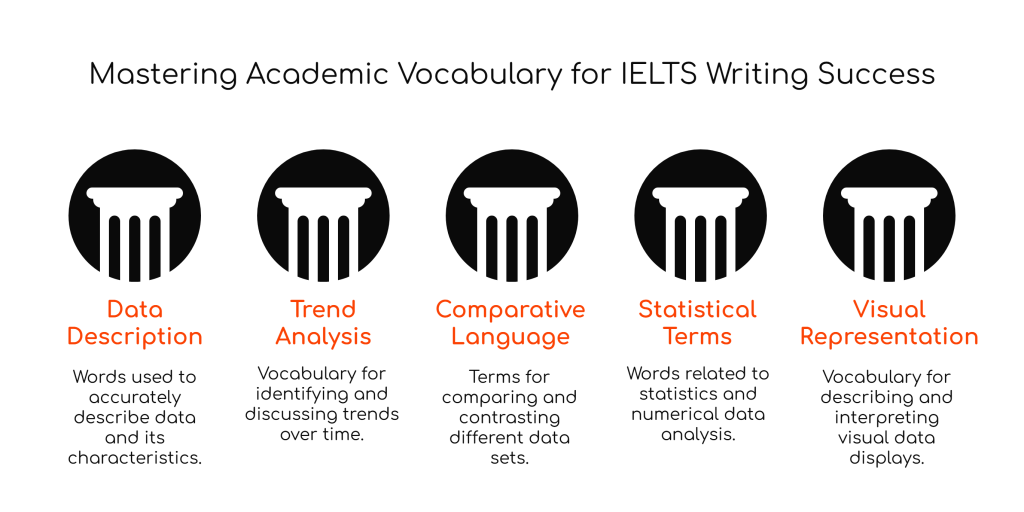
For candidates aiming to achieve a Band 7 or higher in IELTS Writing Task 1 (Academic), lexical precision is a vital criterion. Describing charts, trends, and visuals demands more than just basic vocabulary; it requires a range of academic words used appropriately in context. This A–Z list presents 100 essential academic terms with definitions and model sentences tailored for IELTS Writing Task 1.
A–C: Introducing and Describing Trends
- Account for – To make up or constitute a portion of something.
Females account for nearly 60% of university enrolments. - Approximately – Close to a particular number or amount, but not exactly.
Approximately 75% of the population prefers public transport. - Accelerate – To increase in speed, rate, or extent.
The growth of the IT sector accelerated after 2010. - Aggregate – The total amount or sum of individual parts.
The aggregate consumption of electricity doubled in a decade. - Attain – To reach or achieve a particular level or objective.
The production of cars attained its peak in 2015. - Average – The typical value derived from a set of data.
The average household income rose steadily. - Climb – To increase gradually over time.
The figures for internet users climbed in the last five years. - Compare – To examine similarities and/or differences.
The chart compares mobile usage across four countries. - Consistent – Marked by regularity or steady progress.
There was a consistent increase in fuel prices. - Constitute – To form or compose a whole.
Tourists constitute a large portion of the population in the summer.
D–F: Describing Declines and Movement
- Decline – A decrease in quantity or value.
There was a sharp decline in oil exports in 2013. - Demonstrate – To clearly show or exhibit.
The graph demonstrates the shift in employment sectors. - Dip – A temporary or slight decrease.
Sales dipped briefly in the second quarter. - Distribute – To spread out or allocate.
The data is distributed unevenly across the regions. - Double – To increase by twofold.
The number of graduates doubled over ten years. - Drop – To fall abruptly or substantially.
The price of gold dropped significantly in 2008. - Exceed – To go beyond a particular limit.
Expenditure exceeded income during the first half. - Expand – To increase in size or quantity.
The population expanded rapidly between 1990 and 2000. - Fluctuate – To vary irregularly in level or amount.
Fuel prices fluctuated throughout the year. - Forecast – To predict based on current data.
The figures are forecast to rise in the next decade.
G–I: Interpreting Trends and Changes
- Generate – To produce or create.
The industry generated over 1 million jobs. - Gradual – Occurring slowly and steadily.
There was a gradual increase in literacy rates. - Growth – An increase in quantity or development.
Economic growth was steady during the 1990s. - Highlight – To emphasize or draw attention to.
The diagram highlights key stages in the process. - Increase – To become larger or greater.
There was a significant increase in energy usage. - Indicate – To reveal or point to something.
The chart indicates that imports grew in 2020. - Interval – A regular space of time between events.
Data was collected at five-year intervals. - Involve – To include as a part of a process.
The process involves five distinct steps. - Illustrate – To explain using visual examples.
The bar chart illustrates survey results. - Identify – To recognize or distinguish.
Trends are easy to identify in the line graph.
J–L: Movement and Labelling Data
- Jump – To rise suddenly and sharply.
Profits jumped in the final quarter. - Level off – To stabilize after a period of change.
The population leveled off after 2015. - Lead to – To result in a consequence.
This led to a significant decrease in carbon emissions. - Lower – To reduce in number or amount.
The number of applicants was lowered in 2018. - Label – To assign a name or title.
Each part of the diagram is clearly labeled. - Largely – Primarily or mainly.
The population is largely urban. - Link – To associate or connect.
The data links education level with salary. - Limit – To restrict the extent of something.
The policy limited the amount of waste produced. - List – To enumerate items.
The table lists various economic indicators. - Locate – To place or identify position.
The buildings are located across different zones.
M–O: Measurement and Observation
- Maintain – To keep steady or unchanged.
The numbers maintained a steady rate. - Mark – To indicate a specific point or event.
The graph marks significant changes in traffic. - Measure – To quantify or assess.
The survey measured public opinion. - Moderate – Of average size or degree; not extreme.
There was a moderate rise in temperature. - Multiply – To increase significantly.
The cost multiplied over five years. - Narrow – To reduce in width or difference.
The gap between age groups narrowed over time. - Noticeable – Easily seen or detected.
There was a noticeable shift in preferences. - Number – A total quantity or amount.
The number of residents remained stable. - Observe – To notice or examine closely.
We can observe a gradual decline in exports. - Occupy – To take up space or position.
Females occupied half of the workforce.
P–R: Presenting and Projecting Data
- Peak – To reach the highest point.
Sales peaked in December. - Percent – A portion out of one hundred.
Over 80 percent of users preferred smartphones. - Period – A duration of time.
Data was collected over a ten-year period. - Present – To display or exhibit.
The chart presents data from multiple sources. - Proportion – A part or fraction of a whole.
The proportion of male students was higher. - Project – To estimate future values.
Population growth is projected to rise. - Range – To vary between limits.
The temperature ranged between 20°C and 30°C. - Record – To formally note data.
The data recorded a drop in water usage. - Reduce – To decrease in amount or size.
The program reduced waste significantly. - Remain – To stay unchanged.
Numbers remained steady throughout the period.
S–U: Stability and Trends
- Show – To make visible or evident.
The graph shows trends in car ownership. - Significant – Noticeable or important.
There was a significant increase in earnings. - Stabilize – To become steady.
Employment levels stabilized after 2020. - Statistic – A numerical representation.
The statistic highlights regional differences. - Steady – Regular and constant.
There was a steady climb in productivity. - Survey – A systematic collection of data.
The survey asked about daily habits. - Symbolize – To represent symbolically.
The diagram symbolizes energy flow. - Trend – A general direction or tendency.
The upward trend continued into 2019. - Triple – To become three times as much.
Sales tripled within a year. - Undergo – To experience or endure a process.
The city underwent major redevelopment.
V–Z: Visual Tools and Representation
- Vary – To change or differ.
Results vary depending on age group. - Visual – A graphical representation.
The visual depicts population distribution. - Volume – The quantity or amount.
The volume of sales increased. - Widen – To expand in range or scope.
The gap widened over the years. - Yield – To produce or result in.
The factory yielded twice the output in 2020. - Zone – A defined area or sector.
Industrial zones are shaded in grey. - Zoom in – To focus on a specific detail.
The inset zooms in on specific data. - Converge – To become similar or meet.
Income levels converged by the end of the decade. - Depict – To illustrate through visuals.
The chart depicts gender distribution. - Emphasize – To highlight the importance of something.
The diagram emphasizes key stages. - Outline – To summarise the main points.
The chart outlines the main features. - Reflect – To show a true representation.
The data reflects recent improvements. - Represent – To stand for or symbolise.
Each bar represents a different country. - Signify – To indicate or suggest meaning.
The colour red signifies high risk. - Summarize – To present a concise overview.
The overview summarizes the main trends. - Clarify – To make something clearer.
The annotations clarify complex data. - Explain – To describe or define in detail.
The labels explain each process clearly. - Group – To arrange into categories.
Items are grouped by category. - Map – To show data spatially.
The map shows urban expansion. - Note – To observe or highlight.
It is worth noting the seasonal patterns. - Portray – To depict accurately.
The figure portrays regional output. - Relate – To establish a connection.
The table relates income to expenditure. - Segment – To divide into parts.
The pie chart segments data into five parts. - Tabulate – To organize systematically.
The results are tabulated below. - Track – To follow over time.
The chart tracks price changes over time. - Uncover – To reveal unknown data.
The graph uncovers hidden trends. - Verify – To confirm with evidence.
The data verifies previous findings. - Zoom out – To view a broader context.
The graphic zooms out to show overall context.
Final Thoughts
To excel in IELTS Writing Task 1, you must not only interpret visuals accurately but also use language that is formal, academic, and precise. Incorporate these words naturally, avoid repetition, and aim to vary your sentence structures to showcase grammatical range.
This vocabulary guide serves as a practical resource for learners looking to elevate their academic writing, and it can be revisited throughout your IELTS preparation journey.
#IELTS #IELTSGuidePhil #IELTSVocabulary #IELTSWritingTask1 #AcademicWriting #IELTSPreparation #WritingSkills #DataDescription #IELTSBand7Plus #IELTSGrammar #Task1Language #IELTSLexicalResource
 IELTS Guide Phil
Leave a comment