
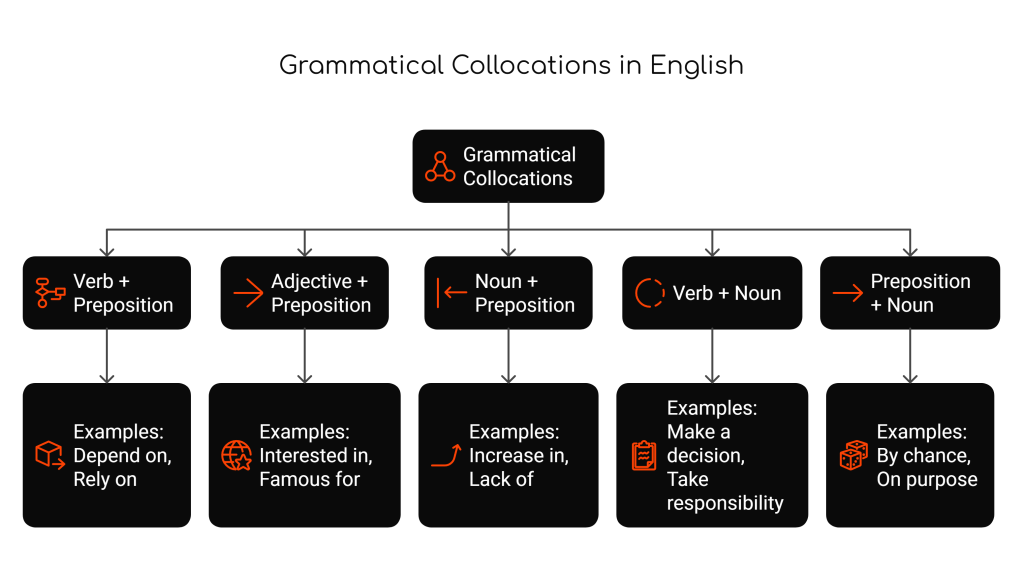
What Are Grammatical Collocations?
Grammatical collocations are natural word pairings in English that follow specific grammatical structures. These combinations include verb + preposition, adjective + preposition, noun + preposition, and many more.
Mastering these collocations enhances fluency, accuracy, and natural expression in English. Below is a categorized list of 100 common grammatical collocations with examples.
1. Verb + Preposition (1-20)
- Depend on – It depends on the weather.
- Rely on – She relies on her friends for support.
- Believe in – Do you believe in ghosts?
- Apologize for – He apologized for being late.
- Suffer from – Many people suffer from allergies.
- Object to – I object to your proposal.
- Insist on – She insisted on paying the bill.
- Agree with – I agree with your opinion.
- Cope with – He cannot cope with stress well.
- Result in – The delay resulted in a missed flight.
- Contribute to – Exercise contributes to good health.
- Lead to – The policy changes led to better efficiency.
- Apply for – She applied for a scholarship.
- Count on – You can count on me.
- Look forward to – I look forward to our trip.
- Blame for – He blamed me for the mistake.
- Succeed in – She succeeded in solving the problem.
- Think about – I am thinking about moving abroad.
- Apologize to – He apologized to his teacher.
- Hear about – Have you heard about the new policy?
2. Adjective + Preposition (21-40)
- Interested in – She is interested in learning Spanish.
- Famous for – The city is famous for its cuisine.
- Good at – He is good at solving problems.
- Bad at – She is bad at remembering names.
- Responsible for – He is responsible for the project.
- Afraid of – He is afraid of the dark.
- Proud of – She is proud of her achievements.
- Worried about – He is worried about his exam.
- Capable of – She is capable of handling pressure.
- Married to – She is married to an engineer.
- Addicted to – He is addicted to coffee.
- Aware of – She is aware of the risks.
- Opposed to – They are opposed to the decision.
- Satisfied with – He is satisfied with the results.
- Excited about – She is excited about the new job.
- Jealous of – He is jealous of his friend’s success.
- Familiar with – Are you familiar with this software?
- Angry at – She is angry at him for being late.
- Tired of – I am tired of waiting.
- Different from – This book is different from the others.
3. Noun + Preposition (41-60)
- Increase in – There is an increase in crime rates.
- Lack of – The lack of resources is a problem.
- Advantage of – One advantage of this method is its efficiency.
- Reason for – What is the reason for your delay?
- Solution to – The solution to the problem is simple.
- Key to – Hard work is the key to success.
- Interest in – He has a deep interest in history.
- Need for – There is a great need for innovation.
- Damage to – The damage to the car was severe.
- Response to – His response to criticism was impressive.
- Effect on – The new law has an effect on businesses.
- Difference between – What is the difference between these two terms?
- Cause of – The cause of the accident is unknown.
- Rise in – There has been a rise in temperatures.
- Decrease in – We noticed a decrease in sales.
- Respect for – She has great respect for her teacher.
- Fear of – His fear of heights prevents him from climbing.
- Example of – This is an example of good writing.
- Solution for – There is no easy solution for this issue.
- Influence on – Parents have a strong influence on children.
4. Verb + Noun (61-80)
- Make a decision – We need to make a decision soon.
- Take responsibility – He took responsibility for his actions.
- Give advice – She gave me great advice.
- Pay attention – Please pay attention to the lecture.
- Catch a cold – I caught a cold last week.
- Break a record – He broke the world record in swimming.
- Lose interest – He lost interest in the game.
- Run a business – She runs a successful business.
- Earn money – He earns a lot of money.
- Save time – Online shopping saves time.
- Do homework – She does her homework after school.
- Do business – We do business with international clients.
- Do research – He is doing research on climate change.
- Do the dishes – She always does the dishes after dinner.
- Do your best – Always do your best.
- Make a mistake – He made a big mistake.
- Make an effort – She made an effort to improve.
- Make progress – He is making progress in English.
- Make money – She makes a lot of money online.
- Take a break – Let’s take a break.
5. Preposition + Noun (81-100)
- By chance – We met by chance in a café.
- On purpose – He did it on purpose.
- In advance – Please book your tickets in advance.
- At risk – His health is at risk.
- In charge of – She is in charge of the project.
- In touch with – We keep in touch with old friends.
- Under pressure – He works well under pressure.
- Out of order – The elevator is out of order.
- In need of – She is in need of help.
- In control of – He is in control of his emotions.
- On time – The train arrived on time.
- In trouble – He is in trouble with the police.
- Out of stock – The item is out of stock.
- At the moment – She is busy at the moment.
- At the end – We’ll meet at the end of the street.
- In a hurry – She left in a hurry.
- On the way – He is on the way to the office.
- Under the impression – I was under the impression you were coming.
- On the phone – He is on the phone right now.
- Out of reach – The cookies are out of reach of children.
Final Thoughts
Grammatical collocations are essential for fluency and natural-sounding English. By practicing these combinations, you’ll enhance your writing, speaking, and comprehension skills.
✅ Which collocations do you use the most? Comment below! 😊
#IELTS #IELTSPrep #IELTSTraining #IELTSGuidePhil #IELTSSuccess #IELTSPractice #IELTSExam #StudyAbroad #Grammar #Collocations
 IELTS Guide Phil
Leave a comment