
Overview
IELTS Writing Task 2 requires you to write an essay in response to a question or statement. Your response should be at least 250 words and completed within 40 minutes. This guide will provide a structured approach to writing a high-scoring response, including essay structure, key writing techniques, and common mistakes to avoid. You can watch this YouTube video explainer by IELTS Guide Phil.
Step-by-Step Guide
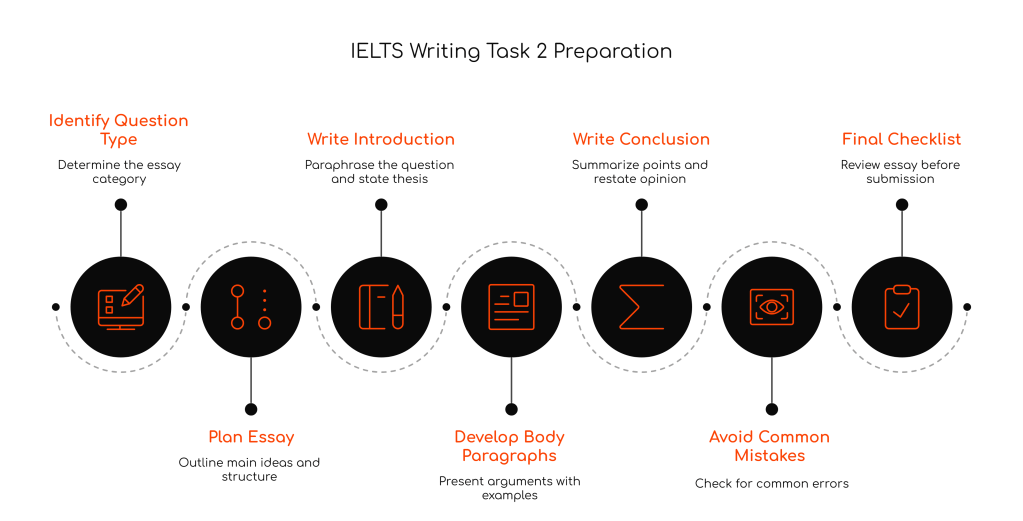
1. Understand the Question Type
Before writing, identify the essay type. IELTS Task 2 questions generally fall into these categories:
Opinion Essays (Agree/Disagree) – You must take a position and justify it.
Discussion Essays – You must discuss both sides of an issue and provide your own opinion.
Problem-Solution Essays – You need to describe a problem and propose solutions.
Advantages-Disadvantages Essays – You must discuss both the benefits and drawbacks of a topic.
Two-Part Questions (Direct Questions) – You must answer two related questions.
Example Question:
“Some people think that children should learn to cook in school. Others believe that it is a waste of time. Discuss both views and give your opinion.”
2. Plan Your Essay (5 Minutes)
Analyze the question – Identify keywords and essay type.
Brainstorm ideas – Write down relevant points for both sides (if needed).
Choose a clear position – Make sure your opinion is strong and consistent.
Outline your structure – Decide what each paragraph will discuss.
Basic Essay Structure:
Introduction – Paraphrase the question and state your thesis (your position).
Body Paragraph 1 – First main idea with explanation and example.
Body Paragraph 2 – Second main idea with explanation and example.
Conclusion – Summarize your ideas and restate your opinion.
3. Write an Effective Introduction
DO:
Paraphrase the topic using synonyms and different sentence structures.
Clearly state your position or introduce both views (depending on the essay type).
Keep it concise (2-3 sentences).
Example (Discussion Essay Introduction):
“There is ongoing debate about whether schools should include cooking in the curriculum. While some argue that it is an essential life skill, others believe it takes time away from more important subjects. This essay will examine both perspectives before stating my own view.”
Why this works: It rephrases the question and outlines what the essay will discuss.
4. Develop Strong Body Paragraphs
DO:
Start each paragraph with a clear topic sentence.
Explain your idea with supporting details.
Provide an example (real-world or hypothetical).
Use linking words to ensure cohesion (e.g., Moreover, In contrast, Therefore, For example).
Example (Supporting Cooking in Schools):
“One reason why cooking should be taught in schools is that it promotes healthy eating habits. If children learn to prepare their own meals, they are more likely to make nutritious choices and avoid fast food. For instance, a recent study showed that teenagers who took cooking classes were 40% less likely to consume junk food regularly.”
Why this works: It presents a clear argument, explanation, and example.
5. Write a Strong Conclusion
DO:
Summarize the main points without repeating them exactly.
Restate your opinion (if applicable).
Keep it short (2-3 sentences).
Example:
“In conclusion, while some believe that cooking lessons in school take time away from academic subjects, I believe they are essential for promoting healthier lifestyles and independence. Schools should integrate cooking into their curriculum to prepare students for the future.”
Why this works: It reinforces the essay’s message in a clear, concise way.
Common Mistakes to Avoid
Writing fewer than 250 words.
Not answering all parts of the question.
Using an informal tone.
Overcomplicating sentences with excessive jargon.
Lack of cohesion (disorganized ideas, no linking words).
Band 7+ Model Answer (Discussion Essay Example)
Topic:
“Some people think that children should learn to cook in school. Others believe that it is a waste of time. Discuss both views and give your opinion.”
Model Answer:
Cooking is an essential skill, yet there is debate over whether it should be taught in schools. While some argue that it is an unnecessary subject, others believe it provides valuable life skills. This essay will examine both perspectives before presenting my viewpoint.
On one hand, opponents of cooking in schools argue that it distracts from core academic subjects. Schools have limited time, and prioritizing mathematics, science, and languages ensures students are better prepared for professional careers. For instance, countries with rigorous academic curricula, such as Japan, have higher educational performance without mandatory cooking classes.
On the other hand, supporters contend that learning to cook fosters independence and healthy habits. Many young adults lack basic cooking skills and rely on processed food, which contributes to obesity. A study conducted in the UK found that students who took cooking classes were 30% more likely to prepare home-cooked meals, leading to healthier dietary choices.
In my opinion, schools should include cooking in their curriculum as it equips students with lifelong benefits. While academic subjects are crucial, basic cooking knowledge ensures individuals can maintain a balanced diet and develop self-sufficiency.
In conclusion, while some people believe cooking lessons are a waste of time, I firmly believe they offer essential life skills. Schools should integrate these lessons to promote healthier lifestyles and prepare students for the future.
Why this works:
Addresses both sides and provides a clear opinion.
Uses a range of linking words and sentence structures.
Provides specific examples and logical reasoning.
Maintains a formal, academic tone.
Final Checklist Before Submission
Did you fully address the essay question?
Did you organize your ideas logically?
Did you use a variety of linking words?
Is your vocabulary and grammar diverse?
Did you check for spelling and grammatical errors?
Is your response at least 250 words?
Conclusion
By following this structured approach, you can improve your IELTS Writing Task 2 performance and achieve a Band 7+ score. Practice writing different essay types and refine your argumentation skills. Good luck!
#IELTSGuidePhil #IELTSWriting #Band7Plus #IELTSPreparation #IELTSWritingTask2 #IELTSWritingTips #AcademicWriting #EssayWriting #IELTSEssay #WritingSkills #IELTSStudy
 IELTS Guide Phil
Leave a comment