
Overview
IELTS Writing Task 1 (General Training) requires candidates to write a letter based on a given situation. The response should be at least 150 words and completed within 20 minutes. This task assesses the ability to communicate effectively in different contexts, requiring an appropriate tone—formal, semi-formal, or informal. This guide provides a structured approach to crafting a high-scoring response. You can watch this YouTube video explainer by IELTS Guide Phil.
Step-by-Step Guide
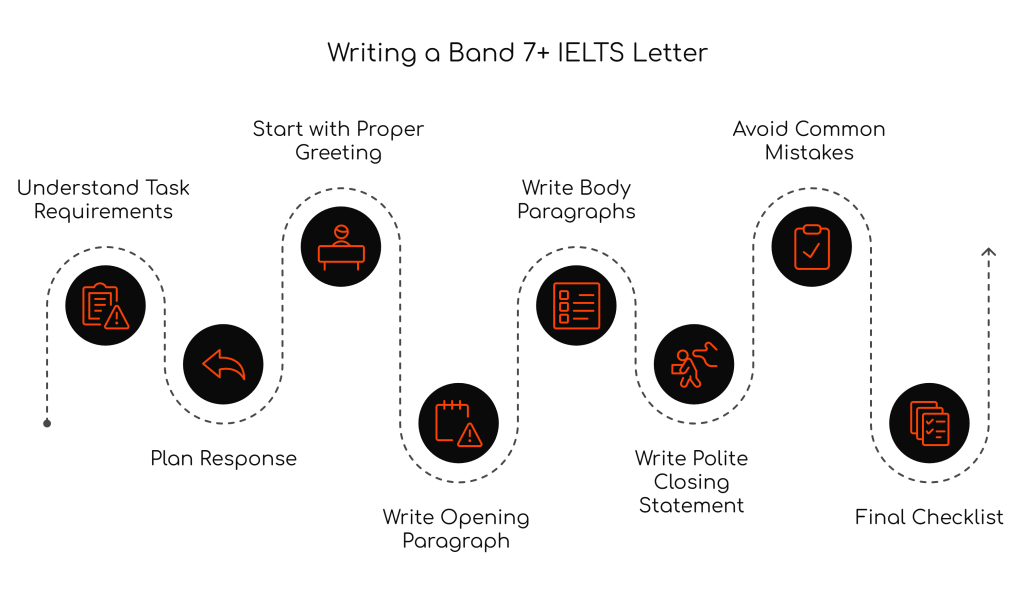
1. Understand the Task Requirements
Before writing, carefully analyze the given prompt:
- Identify the type of letter: formal, semi-formal, or informal.
- Determine the purpose of the letter (e.g., request, complaint, invitation, apology).
- Ensure that all three bullet points in the prompt are addressed.
Example Question:
You recently stayed at a hotel and were dissatisfied with the service. Write a letter to the manager. In your letter:
- Describe the problems you faced.
- Explain why you were dissatisfied.
- State what you expect the manager to do.
2. Plan Your Response (2–3 Minutes)
A well-structured letter consists of four key components:
- Salutation: Appropriate greeting based on the formality.
- Introduction: Clearly state the reason for writing.
- Body Paragraphs: Address each bullet point in a separate paragraph.
- Closing: Provide a polite concluding statement and suitable sign-off.
3. Start with the Proper Greeting
The salutation should match the level of formality required.
Do:
- Use Dear Sir/Madam for formal letters when the recipient’s name is unknown.
- Use Dear Mr. Smith if the recipient’s last name is known.
- Use Dear John for informal letters.
Why this works: It ensures the letter has the appropriate tone from the beginning.
4. Write the Opening Paragraph (State the Purpose)
The introduction should be direct and polite.
Do:
- Clearly explain the reason for writing.
- Be concise and relevant.
Example (Formal Letter): I am writing to express my dissatisfaction with my recent stay at your hotel, where I encountered several issues that significantly affected my experience.
Why this works: It immediately informs the reader of the letter’s purpose.
5. Write the Body Paragraphs (Detailed Explanation)
Each bullet point in the prompt should be addressed in separate paragraphs.
Do:
- Use linking words (e.g., Firstly, Additionally, However).
- Provide specific details while maintaining the appropriate tone.
Example (Describing Problems in a Complaint Letter):
Firstly, the room I was given was not properly cleaned upon my arrival, with dust on the furniture and stains on the bedsheets. Additionally, despite multiple requests, the air conditioning was never fixed, making it difficult to sleep comfortably.
Example (Requesting an Action):
I would appreciate it if you could provide a partial refund for my stay or offer a complimentary service to compensate for the inconvenience.
Why this works: It maintains clarity, provides details, and makes the request polite yet firm.
6. Write a Polite Closing Statement
The closing should be respectful and aligned with the letter’s tone.
Do:
- Thank the recipient, if appropriate.
- Indicate any necessary follow-up actions.
- Use a proper sign-off.
Examples:
- Formal: I look forward to your response at your earliest convenience. Yours faithfully, [Your Name]
- Semi-formal: I appreciate your time and assistance. Yours sincerely, [Your Name]
- Informal: Hope to hear from you soon! Take care, [Your Name]
Why this works: It ensures the letter ends professionally and appropriately.
Common Mistakes to Avoid
- Using the wrong tone (e.g., being too casual in a formal letter).
- Not covering all three bullet points, leading to an incomplete response.
- Writing fewer than 150 words, which results in a penalty.
- Using contractions (e.g., I’m, don’t) in formal letters.
- Grammar and spelling mistakes, which can lower the score.
Band 7+ Model Answer (Formal Complaint Letter Example)
Dear Sir/Madam,
I am writing to express my dissatisfaction with my recent stay at your hotel. Unfortunately, my experience was far from satisfactory due to several service-related issues.
Firstly, upon arrival, I found that my room had not been cleaned properly, as there was dust on the furniture and stains on the bedsheets. Additionally, the air conditioning unit was not functioning, and despite multiple requests to the reception, no action was taken to resolve this issue. As a result, I had an uncomfortable stay.
Furthermore, I was disappointed with the customer service. The staff at the front desk were unresponsive to my concerns, making my stay even more frustrating. Given these issues, I believe that a partial refund or a complimentary stay in the future would be a fair resolution.
I hope you will address these concerns promptly. I look forward to your response.
Yours faithfully,
[Your Name]
Final Checklist Before Submission
- Did you use the correct tone (formal, semi-formal, or informal)?
- Did you address all three bullet points?
- Is the response logically structured?
- Did you use a range of vocabulary and grammar?
- Is the letter at least 150 words long?
- Did you proofread for errors?
Conclusion
By following this structured approach, candidates can enhance their IELTS Writing Task 1 (General Training) performance and achieve a Band 7+ score. Consistent practice with different letter types will further improve writing skills and ensure success.
#IELTSGuidePhil #IELTSWriting #GeneralTraining #IELTSTips #IELTSPreparation #IELTSExam #WritingSkills #IELTSLetterWriting #IELTSBand7 #EnglishProficiency #WorkAbroad
 IELTS Guide Phil
Leave a comment