
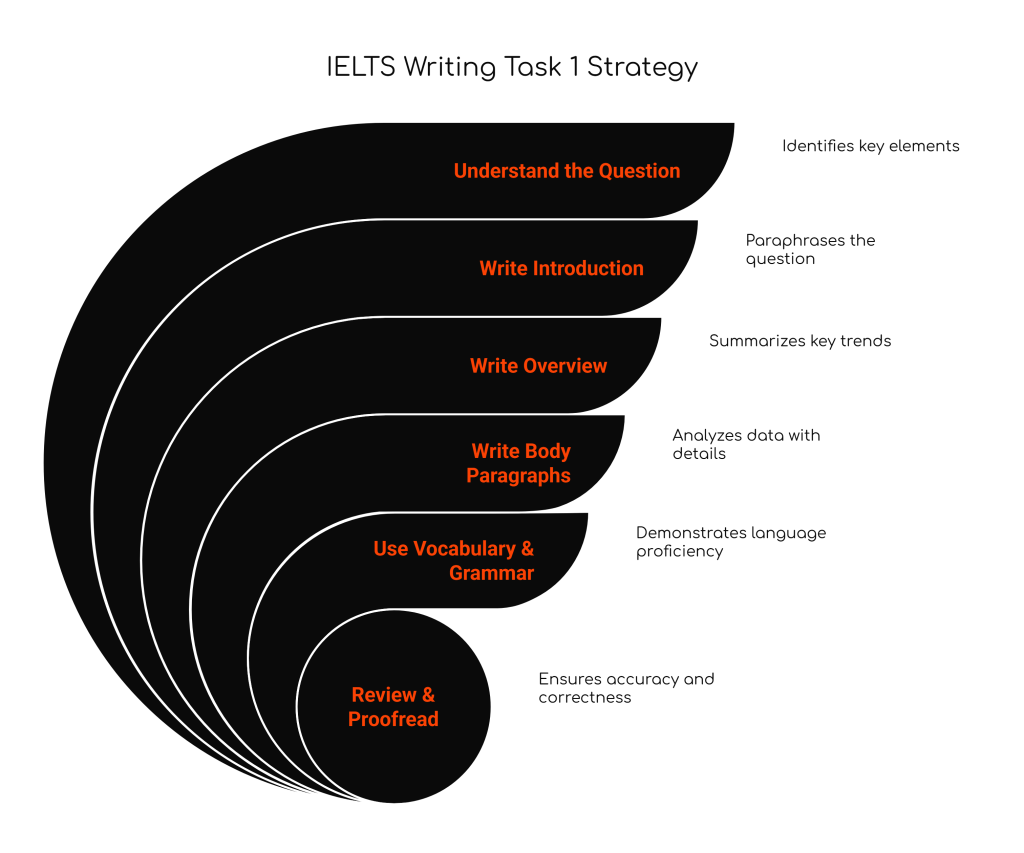
Overview
IELTS Writing Task 1 (Academic) requires candidates to describe and analyze visual data in at least 150 words within a 20-minute timeframe. This task assesses the ability to interpret and summarize information effectively. Among the various question types, line graphs are particularly common. This guide provides a structured approach to crafting a high-scoring response based on a line graph. You can watch this YouTube video explainer by IELTS Guide Phil.
Step-by-Step Guide
1. Understand the Question
Before writing, carefully examine the given graph:
- Identify key elements such as the subject, time period, and units of measurement.
- Observe trends, comparisons, and significant fluctuations.
- Note any anomalies or unusual patterns in the data.
Example Question:
The line graph below shows the number of international students enrolling in universities in Country X from 2010 to 2020.
2. Plan Your Response (2–3 Minutes)
A well-structured response consists of four key components:
- Introduction: Paraphrase the question and introduce the graph.
- Overview: Summarize key trends without mentioning specific figures.
- Body Paragraphs: Group related trends and provide precise data references.
- Key Features: Highlight peak points, sharp increases or declines, and steady patterns.
3. Write the Introduction (Paraphrase the Question)
A strong introduction restates the prompt using different wording.
Do:
- Use synonyms and restructuring to avoid repetition.
- Keep it clear and concise.
Example: The given line graph illustrates the number of international students enrolling in universities in Country X between 2010 and 2020.
Why this works: The sentence avoids directly copying the question while maintaining clarity.
4. Write the Overview (Summarize Key Trends)
The overview provides a summary of the most significant trends.
Do:
- Identify overall increases, decreases, or fluctuations.
- Highlight notable trends without specific data.
Example: Overall, the number of international student enrollments showed an upward trend over the decade, with a sharp increase after 2015. However, there was a brief decline in 2018.
Why this works: It presents a broad summary without unnecessary detail.
5. Write the Body Paragraphs (Detailed Data Analysis)
The body paragraphs should systematically describe the data.
Do:
- Group similar trends together.
- Use comparative language (e.g., twice as high, a gradual increase).
- Include specific numerical data.
Example Paragraph 1 (2010–2015):
Between 2010 and 2015, the number of international enrollments remained relatively stable, fluctuating between 10,000 and 12,000 students. The lowest point was in 2012 when the figure dropped slightly to 9,500, but it recovered to 12,000 by 2015.
Example Paragraph 2 (2015–2020):
From 2015 onwards, the figure increased significantly, reaching a peak of 25,000 students in 2019 before experiencing a slight decline to 23,000 in 2020.
Why this works: It provides a structured breakdown of trends with specific data points.
6. Use a Variety of Vocabulary & Grammar
Demonstrating lexical and grammatical diversity is crucial for achieving a high score.
Do:
- Use varied vocabulary to describe trends.
- Incorporate different sentence structures, including passive voice and complex sentences.
Example Vocabulary:
Increase: climbed, surged, rose steadily, peaked at
Decrease: declined, dropped, plummeted, fell sharply
Fluctuations: fluctuated, varied, remained unstable
Example Sentences:
- The number of enrollments rose sharply from 2015 to 2019, peaking at 25,000 students.
- A steady increase was observed from 2010 to 2015, followed by a sharp growth after 2015.
- Enrollments fluctuated slightly between 2010 and 2015 before experiencing a dramatic surge in the following years.
Why this works: Using a diverse range of expressions enhances lexical resource and grammatical range, key IELTS scoring criteria.
7. Review & Proofread (Final 2 Minutes)
Before submitting, conduct a final check.
Do:
- Review grammar, spelling, and punctuation.
- Ensure numerical accuracy.
- Confirm a word count of at least 150.
- Eliminate redundant phrases or repetition.
Why this works: Minor errors can lower scores, making proofreading essential.
Common Mistakes to Avoid
- Copying the question instead of paraphrasing.
- Providing opinions rather than an objective description.
- Using informal language inappropriate for academic writing.
- Writing fewer than 150 words, resulting in a penalty.
- Listing data without analysis, making the response ineffective.
- Omitting the overview, which is essential for a high score.
Band 7+ Model Answer (Based on the Line Graph Example)
The given line graph illustrates the number of international students enrolling in universities in Country X between 2010 and 2020.
Overall, the number of enrollments exhibited an upward trend, with a significant rise after 2015. Although the figure remained relatively stable in the early years, there was a noticeable increase in later years, peaking in 2019 before experiencing a slight decline in 2020.
From 2010 to 2015, the number of international enrollments fluctuated between 10,000 and 12,000 students, with a minor dip in 2012. From 2015 onwards, the figure increased significantly, reaching a peak of 25,000 students in 2019 before experiencing a slight decline to 23,000 in 2020.
However, after 2015, a significant increase occurred, with enrollments doubling from 12,000 to 25,000 by 2019. In 2020, the number slightly declined to 23,000.
Final Checklist Before Submission
- Is there a paraphrased introduction?
- Does the overview summarize key trends?
- Are the body paragraphs well-structured and logically grouped?
- Is there a range of vocabulary and sentence structures?
- Is the response free of errors?
- Have you written at least 150 words?
Conclusion
By following this structured approach, candidates can enhance their IELTS Writing Task 1 performance and achieve a Band 7+ score. Consistent practice with real IELTS questions will further refine writing skills and ensure success.
#IELTSGuidePhil #IELTSWriting #AcademicEnglish #IELTSTips #IELTSPreparation #IELTSExam #WritingSkills #IELTSWritingTask1 #IELTSBand7 #EnglishProficiency #StudyAbroad
 IELTS Guide Phil
Leave a comment