
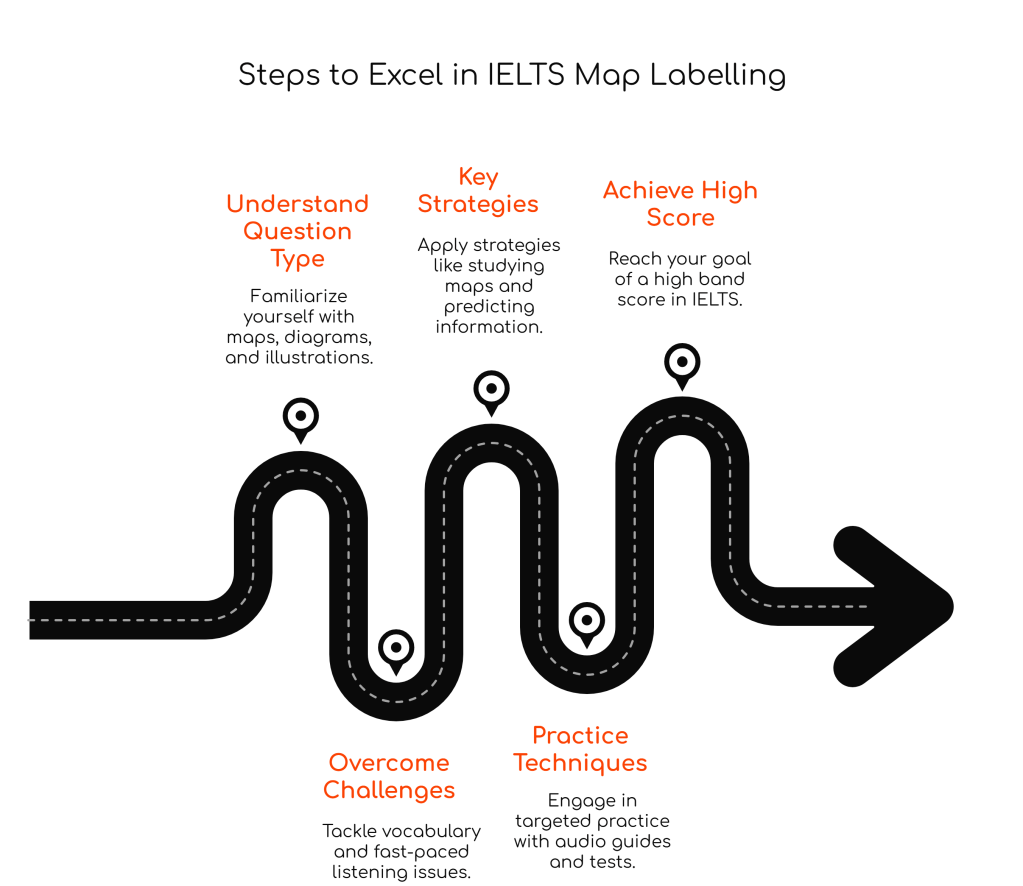
Labelling maps, diagrams, and illustrations is a common task in the IELTS Listening test, often appearing in Section 2. This section typically involves a monologue where a speaker, such as a tour guide or a presenter, describes a location, object, or process. While this task seems straightforward, many test-takers find it challenging due to unfamiliar vocabulary, fast-paced speech, and the need to follow directions accurately. To succeed, candidates must develop strong listening and visualization skills while employing effective strategies. This comprehensive guide provides the techniques, practice methods, and essential tips needed to excel in this section and achieve a higher band score.
Understanding the Question Type
In map, diagram, and illustration labelling tasks, you are required to listen carefully and label the given diagram or map with the correct words or phrases. The answers may involve filling in labels, identifying locations, or describing features.
Types of Tasks You May Encounter
- Maps:
These questions often involve a tour of a building, park, campus, or city layout. The speaker provides information about various points of interest, and you need to identify and label these places accurately. - Diagrams:
Diagrams may feature objects, life-cycle processes, or mechanical structures that the speaker describes in detail. Your task is to match the description to the correct part of the diagram. - Illustrations:
These can be depictions of tools, machines, or other labeled items that the speaker explains step by step.
Typical Question Format
- Label the map/diagram based on the speaker’s description.
- Use ONE word and/or a number for each answer.
- Follow the order of the speaker’s explanation.
Common Challenges and How to Overcome Them
Many candidates struggle with map and diagram labelling tasks due to a variety of factors. Understanding these challenges and adopting effective solutions can significantly enhance your performance.
1. Unfamiliar Vocabulary
Maps and diagrams often feature directional language (e.g., “adjacent to,” “opposite,” “beside”) and technical terms that may not be familiar to test-takers.
✔ Solution:
Familiarize yourself with common spatial and directional vocabulary, such as:
- Directions: left, right, straight ahead, around the corner, at the end
- Prepositions of Place: next to, behind, opposite, beside, beyond
- Spatial Relationships: adjacent to, in the middle of, in front of
2. Fast-Paced Listening
Speakers often mention multiple locations or points quickly, making it difficult to follow along.
✔ Solution:
- Predict potential answers before the audio starts by analyzing the diagram or map.
- Underline or circle key areas and labels to stay focused during the task.
3. Losing Track of Directions
When following spoken directions, it is easy to get confused, especially if the speaker changes course or introduces multiple steps.
✔ Solution:
- Use your pencil to trace the speaker’s directions on the map or diagram as you listen.
- Visualize the speaker’s movements to stay oriented.
4. Distractors and Corrections
Speakers may introduce incorrect information before correcting themselves, leading to confusion.
✔ Solution:
- Stay alert for phrases such as “actually,” “I mean,” or “no, that’s wrong,” which often signal corrections.
Key Strategies for Success
To perform well in map and diagram labelling tasks, a systematic approach is essential. The following strategies can help you maintain accuracy and efficiency during the IELTS Listening test.
1. Analyze the Map or Diagram Before Listening
- Examine the Title and Labels: Get a general idea of the content.
- Identify Cardinal Points: Look for compass directions (North, South, East, West) if provided.
- Note Key Features: Identify fixed landmarks or starting points that the speaker may mention.
2. Predict the Type of Information Needed
Consider what type of information is missing from the diagram or map.
- Places/Locations: Look for gaps where place names or landmarks might fit.
- Directions/Movement: Anticipate phrases describing paths or movements (e.g., “turn left,” “go past”).
- Objects/Parts: Identify gaps where parts of a process, object, or system may be labeled.
3. Pay Close Attention to Directional Language
Speakers often use a variety of phrases to describe directions and positions. Listen for key expressions that indicate movement or location:
- Movement: “Go straight ahead,” “turn left,” “walk past.”
- Location: “It’s opposite the main entrance,” “beside the cafeteria.”
- Relative Positions: “In front of the reception desk,” “between the library and the lab.”
4. Follow the Speaker’s Order and Sequence
Speakers generally describe locations or points of interest in a logical order. Avoid skipping ahead and follow the sequence as described.
Step-by-Step Strategy for Labelling Tasks
Step 1: Preview the Map or Diagram
Use the time before the recording starts to analyze the map or diagram. Look for:
- Titles or labels that provide context.
- Compass directions if they are included.
- Fixed landmarks that serve as reference points.
Step 2: Identify Keywords and Clues
Underline or highlight keywords in the instructions and diagram to help you anticipate the answers.
Step 3: Listen for Synonyms and Paraphrasing
IELTS Listening passages rarely use the exact words that appear on the diagram or map. Instead, the speaker may use synonyms or paraphrased phrases.
Example:
- Diagram Label: “Main Entrance”
- Speaker’s Words: “The front door”
Step 4: Visualize the Movement or Process
As you listen, mentally trace the speaker’s directions on the map or diagram. This technique helps you stay oriented and avoid losing track.
Step 5: Be Aware of Corrections and Distractors
If the speaker corrects themselves or changes directions, make note of the corrected information and adjust your answer accordingly.
Example Practice: Map Labelling
Instructions:
Listen to the following description and label the correct locations on the map.
Map Labels:
Library, Science Lab, Student Lounge, Cafeteria, Parking Lot
Listening Extract Example:
“From the entrance, walk straight ahead. On your right-hand side, you’ll see the library. If you continue down the corridor, the student lounge is on your left. The cafeteria is just past the lounge, at the end of the hall. The science lab is in the building opposite the library, and the parking lot is behind it.”
Answers:
- Library – Right-hand side from the entrance
- Student Lounge – Left side of the corridor
- Cafeteria – End of the hall
- Science Lab – Opposite the library
- Parking Lot – Behind the science lab
Practice Techniques to Improve Your Skills
✅ Listen to Audio Guides and Tours
Practice with real-life audio materials such as museum tours or campus guides to familiarize yourself with directional language and spatial descriptions.
✅ Use IELTS Listening Practice Tests
Focus on Section 2 of practice tests, which frequently feature map and diagram labelling tasks.
✅ Draw Your Own Maps and Diagrams
While listening to audio descriptions, sketch a rough map or diagram and label it according to the speaker’s instructions.
✅ Improve Your Note-Taking Skills
Develop shorthand techniques to quickly jot down key directions, landmarks, and objects.
Final Thoughts
Excelling in labelling maps, diagrams, and illustrations in the IELTS Listening test requires a combination of attentive listening, visualization, and practice. By mastering directional vocabulary, predicting answers, and staying alert for paraphrasing and corrections, you can significantly improve your accuracy in this task. Incorporate these strategies into your IELTS preparation, and you will be well-prepared to achieve a high band score in the Listening section.
#IELTSGuidePhil #IELTSListening #MapLabelling #DiagramLabelling #IELTSTips #ListeningStrategies #IELTSBand8 #IELTSPreparation #HighBandIELTS #ListeningSuccess
 IELTS Guide Phil
Leave a comment