
In IELTS General Training Writing Task 1, candidates are required to write a letter in response to a given situation. The letter may be formal, semi-formal, or informal, depending on the context. Many candidates lose marks due to avoidable mistakes that affect their Task Achievement, Coherence and Cohesion, Lexical Resource, and Grammatical Range and Accuracy scores. Below are the most common errors and practical strategies to address them effectively. You can watch this YouTube video explainer by IELTS Guide Phil.
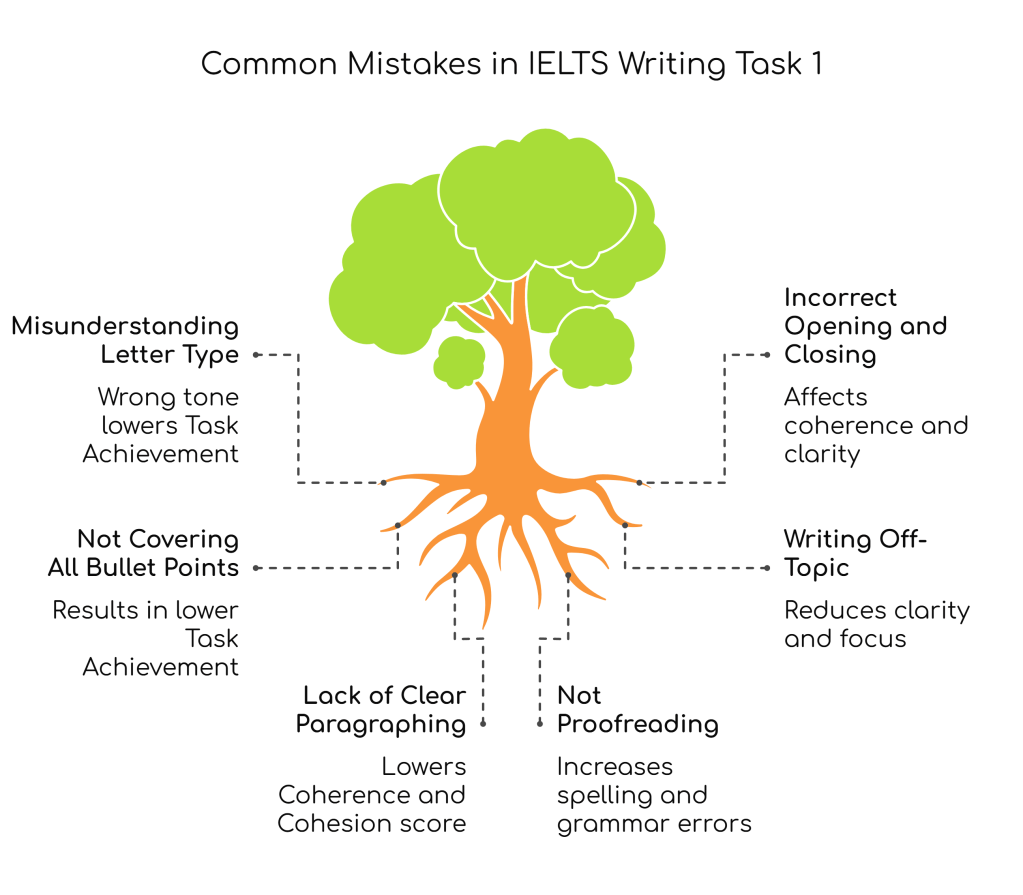
1. Misunderstanding the Letter Type and Tone
Mistake:
Using the wrong tone or style (formal vs. informal) can result in a lower Task Achievement score.
Solution:
Identify the correct tone based on the situation:
- Formal: Writing to someone you do not know well (e.g., a manager or company representative).
- Semi-formal: Writing to someone you know professionally (e.g., a colleague or acquaintance).
- Informal: Writing to a friend or family member.
Example:
- Formal: “I am writing to inquire about…”
- Informal: “I just wanted to ask if…”
2. Incorrect Opening and Closing
Mistake:
Using an informal opening in a formal letter or vice versa affects coherence and reduces the score.
Solution:
Match the opening and closing to the tone:
- Formal:
- Opening: “Dear Sir/Madam,”
- Closing: “Yours faithfully,”
- Semi-formal:
- Opening: “Dear Mr. Smith,”
- Closing: “Yours sincerely,”
- Informal:
- Opening: “Dear John,”
- Closing: “Best regards,” or “Take care,”
3. Not Covering All Bullet Points
Mistake:
Failing to address all three bullet points in the task results in a lower Task Achievement score.
Solution:
Spend 1-2 minutes analyzing the task to identify and plan for all three points.
Dedicate a separate paragraph to each point if possible.
Example Task:
You are planning to move to a new city. Write a letter to your friend and explain:
- Why you are moving
- Describe your new city
- Invite them to visit
Structure:
- Introduction: Briefly state your purpose.
- Paragraph 1: Explain why you are moving.
- Paragraph 2: Describe the new city.
- Paragraph 3: Invite your friend to visit.
- Conclusion: End with a friendly closing.
4. Writing Off-Topic or Adding Irrelevant Details
Mistake:
Going off-topic or adding irrelevant information reduces clarity and focus.
Solution:
Stick to the points mentioned in the task. Avoid adding unnecessary details that do not address the bullet points.
5. Lack of Clear Paragraphing
Mistake:
Writing a letter as one large block of text makes it difficult to read and lowers the Coherence and Cohesion score.
Solution:
Use paragraphs to organize your ideas logically. A clear structure typically includes:
- Opening: Greet the recipient and state the purpose.
- Main Body: Address each bullet point in a separate paragraph.
- Conclusion: End with a polite closing.
6. Overusing Informal or Formal Language
Mistake:
Overusing formal phrases in informal letters or vice versa results in an inappropriate tone.
Solution:
Use appropriate vocabulary and expressions for the letter type:
- Formal: “I am writing to request information regarding…”
- Informal: “I just wanted to ask you about…”
7. Not Stating the Purpose Clearly
Mistake:
A weak or unclear purpose statement confuses the reader and affects coherence.
Solution:
Mention the purpose clearly in the first paragraph.
Example:
- Formal: “I am writing to inquire about the availability of a rental property in your area.”
- Informal: “I just wanted to let you know that I am moving to a new city soon.”
8. Using Incorrect or Inappropriate Salutations
Mistake:
Starting or ending the letter with the wrong salutation can affect the overall tone.
Solution:
Use appropriate salutations for each letter type:
- Formal:
- Opening: “Dear Sir/Madam,”
- Closing: “Yours faithfully,”
- Semi-formal:
- Opening: “Dear Mr./Ms. [Last Name],”
- Closing: “Yours sincerely,”
- Informal:
- Opening: “Dear [First Name],”
- Closing: “Best regards,” or “Take care,”
9. Not Using a Range of Vocabulary
Mistake:
Relying on basic vocabulary and repeating the same words affects the Lexical Resource score.
Solution:
Use a variety of synonyms and phrases to add variety to your writing. Learn different ways to express requests, apologies, suggestions, and invitations.
Examples:
- Request: “Could you please…,” “I would appreciate it if…”
- Apology: “I am sorry for…,” “I apologize for any inconvenience caused.”
- Invitation: “I would love for you to join me…,” “Why don’t you come over…?”
10. Failing to Use Appropriate Tone for Requests or Complaints
Mistake:
Being too direct or impolite in formal letters, or overly formal in informal letters, reduces effectiveness.
Solution:
Be polite and respectful when making requests or complaints. Avoid overly casual language in formal contexts.
Example:
- Formal: “I would appreciate it if you could provide me with further information.”
- Informal: “Could you let me know if you are free next weekend?”
11. Writing Too Much or Too Little
Mistake:
Writing fewer than 150 words leads to a penalty, while exceeding 200 words can make the letter less focused.
Solution:
Aim for 160-180 words to stay within the ideal range. Practice writing under timed conditions to develop a sense of appropriate length.
12. Lack of Variety in Sentence Structures
Mistake:
Overusing simple sentences reduces the Grammatical Range and Accuracy score.
Solution:
Use a mix of simple, compound, and complex sentences to show variety. Include conditional or relative clauses where appropriate.
Examples:
- Simple: “I am writing to request information.”
- Compound: “I have applied for the position, and I am eager to know the status.”
- Complex: “If you could let me know by next week, I would appreciate it.”
13. Incorrect Use of Punctuation
Mistake:
Poor punctuation can make the letter difficult to read and affect Grammatical Accuracy.
Solution:
Pay attention to commas, periods, and apostrophes. Proofread your letter carefully before submission.
14. Failure to Apologize or Show Gratitude When Required
Mistake:
Ignoring basic politeness when making requests or complaints lowers the Task Achievement score.
Solution:
Include polite phrases for apologies, gratitude, and requests.
Examples:
- Apology: “I apologize for any inconvenience caused.”
- Gratitude: “Thank you for your assistance.”
15. Not Giving a Clear Call to Action in Formal Letters
Mistake:
Ending a formal letter without a clear call to action leaves the purpose incomplete.
Solution:
Clearly state what action you expect the recipient to take.
Examples:
- “I look forward to hearing from you.”
- “Please let me know if any further information is required.”
16. Overusing Contractions in Formal Letters
Mistake:
Using contractions such as “I’m,” “won’t,” or “it’s” in formal letters reduces formality.
Solution:
Avoid contractions in formal and semi-formal letters. Use full forms such as “I am,” “will not,” and “it is.”
17. Inconsistent Verb Tenses
Mistake:
Switching between tenses inconsistently confuses the reader and affects coherence.
Solution:
Maintain consistent verb tenses throughout the letter. Use present, past, or future tense based on the situation.
18. Overly Brief or Vague Content
Mistake:
Writing a brief response that lacks detail lowers the Task Achievement score.
Solution:
Develop each point with sufficient detail and examples. Aim to include 2-3 sentences per bullet point to provide clarity.
19. Not Proofreading for Spelling and Grammar Errors
Mistake:
Submitting the letter without checking for errors can lower your score unnecessarily.
Solution:
Spend the last 2-3 minutes reviewing your work for grammar, punctuation, and spelling mistakes. Double-check that all bullet points are covered.
20. Forgetting to Include a Closing Statement
Mistake:
Ending the letter abruptly without a closing affects coherence.
Solution:
Always end with an appropriate closing statement.
Examples:
- Formal: “Thank you for your attention. I look forward to your response.”
- Informal: “Hope to hear from you soon.”
Final Tip:
To excel in IELTS Writing Task 1 (General Training), focus on using appropriate tone and vocabulary, addressing all bullet points, and maintaining grammatical accuracy. Practice writing different types of letters under timed conditions to improve speed and confidence. With consistent effort, you can significantly improve your band score.
#IELTSGuidePhil #IELTSWriting #Task1Tips #GeneralTraining #LetterWriting #IELTSPreparation #IELTSTips #WritingTask1 #IELTSBand7 #Coherence #LexicalResource
 IELTS Guide Phil
Leave a comment