
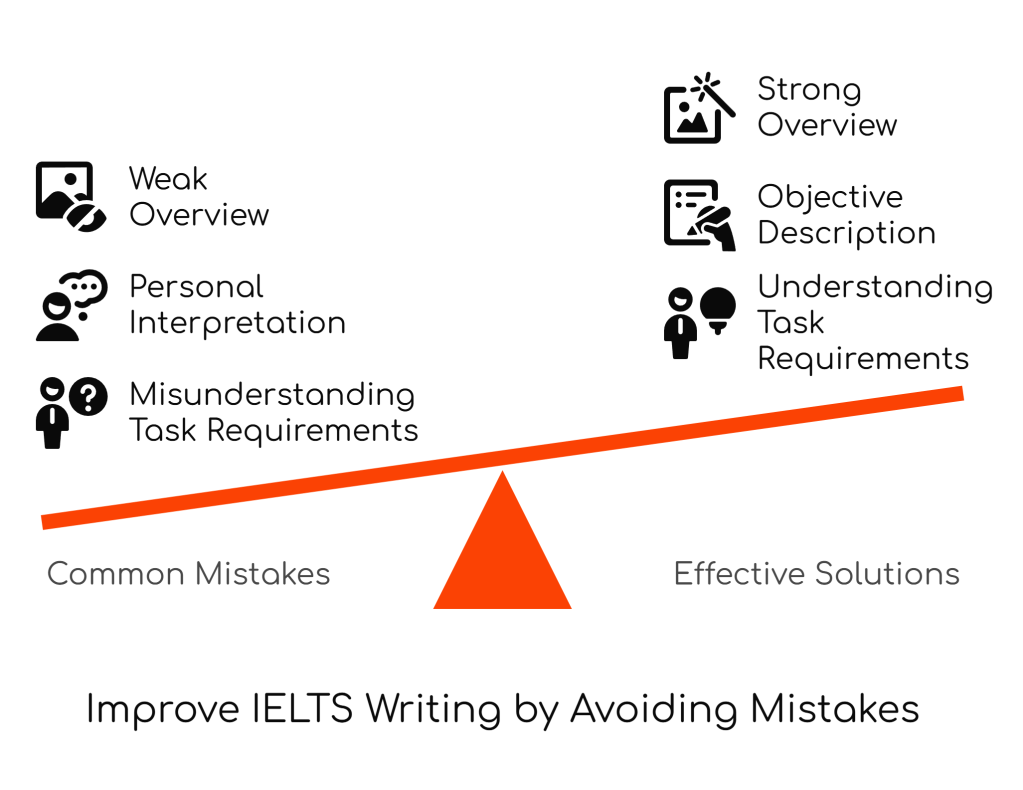
In IELTS Academic Writing Task 1, candidates are required to describe visual data, such as graphs, charts, tables, diagrams, or maps, in at least 150 words. Many candidates lose marks due to avoidable mistakes that hinder their ability to achieve a high score. Below are the most common errors and practical strategies to address them effectively. You can watch this YouTube video explainer by IELTS Guide Phil.
1. Not Understanding the Task Requirements
Mistake:
Candidates often misinterpret the task, leading to irrelevant or overly detailed responses.
Solution:
Carefully read the task prompt and identify the type of visual data presented. Determine whether the task requires a comparison, trend analysis, process description, or description of map changes. Understanding the specific task requirement is crucial for an accurate response.
2. Writing an Opinion or Personal Interpretation
Mistake:
Task 1 is purely descriptive. Expressing opinions or interpretations reduces the score.
Solution:
Stick to objective descriptions. Avoid inserting personal opinions or subjective interpretations.
Example:
Incorrect: “It is clear that more people prefer online shopping.”
Correct: “The data shows that the number of people choosing online shopping increased steadily over the period.”
3. Poor Overview or No Overview
Mistake:
Many candidates skip the overview or provide a weak summary, which significantly affects the Task Achievement score.
Solution:
Always include an overview as the second paragraph after the introduction. Summarize the most significant trends, comparisons, or changes observed in the data.
Example:
“In summary, the data shows a significant increase in online shopping preferences, while the use of physical stores declined.”
4. Describing Every Single Detail
Mistake:
Providing excessive details makes the report lengthy and unfocused.
Solution:
Focus on major trends and significant data points. Group similar data to avoid unnecessary repetition and maintain clarity.
5. Incorrect Data Comparison or Trend Description
Mistake:
Misinterpreting the data or making inaccurate comparisons lowers the score.
Solution:
Use precise comparison language:
- “Compared to…”
- “In contrast…”
- “While X increased, Y remained stable.”
Be specific with data and avoid making assumptions.
6. Lack of Variety in Vocabulary
Mistake:
Repetitive use of basic words like “increase” and “decrease” limits the Lexical Resource score.
Solution:
Use a range of synonyms for describing trends:
- Increase: rise, grow, climb, surge, jump
- Decrease: decline, fall, drop, dip, plunge
- Stability: remain constant, stay the same, stabilize
- Fluctuation: vary, oscillate, go up and down
Example:
Incorrect: “The population increased gradually.”
Correct: “The population showed a gradual rise over the period.”
7. Not Using a Variety of Sentence Structures
Mistake:
Overusing simple sentences lowers the Grammatical Range and Accuracy score.
Solution:
Incorporate a variety of sentence types:
- Simple: “The percentage increased by 10%.”
- Compound: “The percentage increased by 10%, but the overall trend remained stable.”
- Complex: “Although the percentage increased by 10%, the total number of users remained low.”
8. Inconsistent Use of Tenses
Mistake:
Incorrectly switching between past, present, and future tenses confuses the reader.
Solution:
Use the correct tense based on the time period provided:
- Past data: Use past simple (e.g., increased, declined).
- Current trends: Use present simple (e.g., increases, declines).
- Future predictions: Use future simple (e.g., will increase, is expected to decline).
9. Incorrect or Inconsistent Units of Measurement
Mistake:
Candidates sometimes forget to include units of measurement or use them inconsistently.
Solution:
Always mention the unit (percentage, millions, etc.) when describing data and maintain consistency throughout the task.
Example:
“The percentage of students who preferred online learning increased from 40% in 2010 to 70% in 2020.”
10. Ignoring Time Periods or Key Dates
Mistake:
Failing to mention time periods affects the clarity and accuracy of the description.
Solution:
Include relevant dates and time frames where applicable. Use appropriate time phrases such as:
- “Over the period from 2000 to 2020…”
- “Between 2010 and 2015…”
- “In the year 2020…”
11. Overcomplicating Descriptions
Mistake:
Overly complex descriptions often lead to confusion and grammatical errors.
Solution:
Use clear and concise language to describe trends and comparisons. Avoid unnecessary jargon or complicated structures.
12. Inadequate Use of Linking Words
Mistake:
Lack of proper linking words results in a disconnected and poorly organized response.
Solution:
Use appropriate linkers to maintain cohesion:
- To compare: In contrast, while, whereas
- To show change: Subsequently, thereafter, following this
- To add information: Additionally, furthermore, moreover
13. Failing to Group Data Effectively
Mistake:
Describing data individually without grouping makes the response disorganized.
Solution:
Group similar data points to highlight trends or comparisons. Use logical paragraphing to maintain organization.
Example:
- Group by time periods (e.g., first 5 years vs. last 5 years).
- Group by categories (e.g., male vs. female, urban vs. rural).
14. Misinterpreting Maps and Diagrams
Mistake:
Describing only one aspect of a map or providing excessive detail reduces clarity.
Solution:
For maps: Mention major changes (e.g., additions, removals, developments) and use directional language (north, south, east, west).
For process diagrams: Describe stages in sequential order and use passive voice where appropriate.
15. Incorrect Use of Articles and Prepositions
Mistake:
Small grammatical errors, especially with articles and prepositions, affect the Grammatical Accuracy score.
Solution:
Double-check the use of articles before singular and plural nouns. Practice using prepositions correctly in context.
Examples:
- “In 2010,”
- “By 2020,”
- “Between 2000 and 2010”
16. Writing Too Much or Too Little
Mistake:
Writing fewer than 150 words results in a penalty, while exceeding 200 words may lead to losing focus.
Solution:
Aim for 160-180 words to stay within a safe range. Practice writing within the time limit to develop a sense of word count.
17. Not Proofreading for Errors
Mistake:
Many candidates submit their responses without checking for spelling, grammar, or punctuation errors.
Solution:
Spend the last 2-3 minutes proofreading. Look for spelling mistakes, subject-verb agreement errors, and inconsistent tenses.
18. Using Informal or Inappropriate Language
Mistake:
Informal language or contractions (e.g., “it’s,” “won’t”) is inappropriate for an academic task.
Solution:
Use formal and objective language. Avoid contractions and colloquial expressions.
19. Lack of Variation in Describing Percentages or Proportions
Mistake:
Using the same phrases repeatedly to describe percentages or proportions limits lexical variety.
Solution:
Use diverse expressions to describe data:
- A significant proportion (40%)
- Nearly half of the population
- Approximately one-third of respondents
20. Mixing Active and Passive Voice Incorrectly
Mistake:
Inconsistent or incorrect use of passive and active voice confuses the reader.
Solution:
Use passive voice when describing processes or diagrams:
- “The raw materials are transported to the factory.”
Use active voice for trends and comparisons: - “The percentage of users increased steadily.”
Final Tip:
To excel in IELTS Writing Task 1, practice analyzing different types of visuals, focus on clarity and accuracy, and develop a strong understanding of task requirements. Review your work carefully to minimize errors and ensure logical progression of ideas. With consistent effort, you can improve your band score significantly.
#IELTSGuidePhil #IELTSWriting #Task1Tips #AcademicWriting #IELTSPreparation #IELTSMistakes #WritingTask1 #IELTSBand7 #DataDescription #IELTSExam #WritingImprovement
 IELTS Guide Phil
Leave a comment