
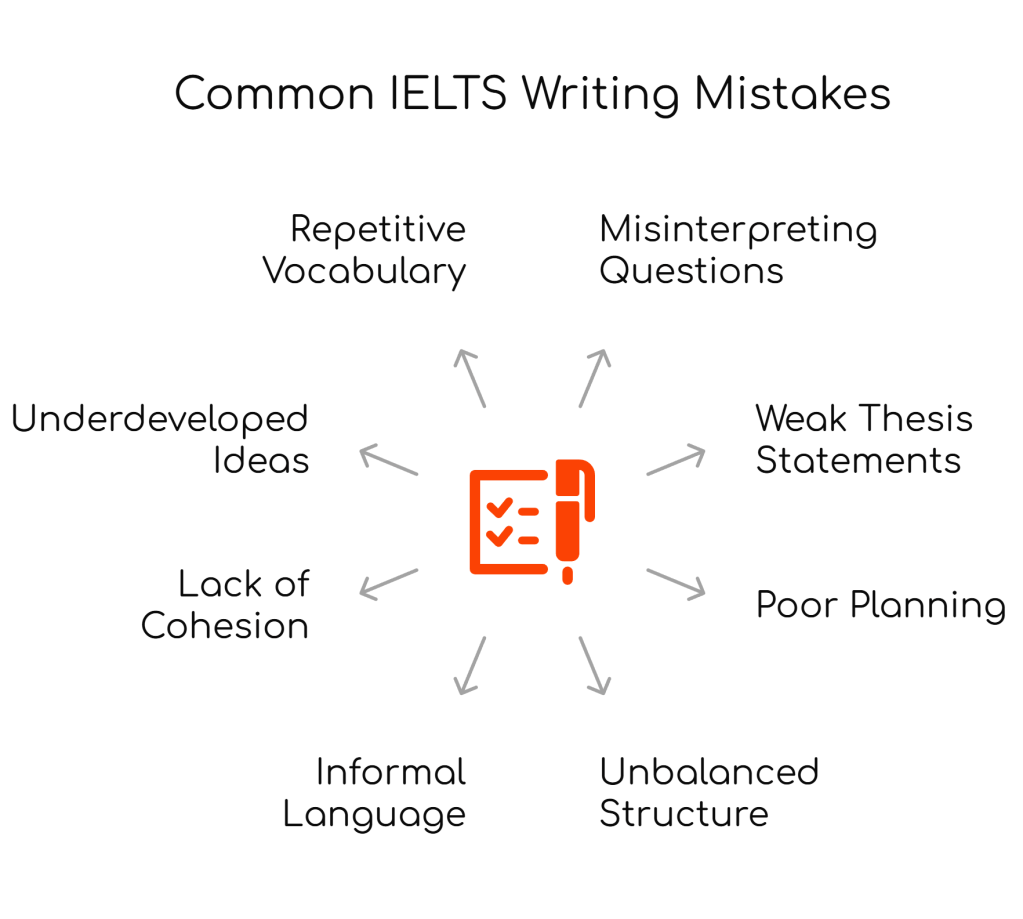
IELTS Writing Task 2 is often considered the most challenging component of the test. It requires candidates to present well-structured ideas, develop logical arguments, and maintain grammatical accuracy—all within a strict 40-minute timeframe. Unfortunately, many candidates lose valuable marks due to avoidable errors. This article explores the most common mistakes in IELTS Writing Task 2 and provides practical strategies to overcome them effectively. You can watch this YouTube video explainer by IELTS Guide Phil.
1. Not Analyzing the Question Properly
Mistake:
Many candidates misunderstand the question and write off-topic responses, which significantly lowers their score.
Solution:
Spend 2-3 minutes carefully analyzing the prompt. Identify the type of essay required and underline key phrases to ensure a clear understanding of the task. Recognize whether the question asks for:
- An opinion (Agree/Disagree)
- A discussion (Discuss both views)
- A problem-solution analysis
- An advantages and disadvantages comparison
- A response to a double question
Example:
Question: “Some people think that the internet has brought people closer together, while others think it has made them more isolated. Discuss both views and give your own opinion.”
✅ Focus: Discuss both perspectives and clearly state your opinion in the conclusion.
2. Writing an Unclear or Weak Thesis Statement
Mistake:
A vague or overly broad thesis statement weakens the overall argument and confuses the reader.
Solution:
Craft a clear thesis statement that directly addresses the question. It should appear at the end of the introduction and outline the main points that will be discussed in the essay.
Example:
- ❌ Poor Thesis: “The internet has both positive and negative effects.”
- ✅ Strong Thesis: “While the internet has improved global communication, it has also contributed to social isolation by reducing face-to-face interactions.”
3. Failing to Plan Before Writing
Mistake:
Skipping the planning phase often results in disorganized ideas and poorly structured arguments.
Solution:
Dedicate 5 minutes to brainstorming and outlining the main points. Create a brief outline with 2-3 key ideas and supporting details to maintain structure and coherence.
4. Unbalanced Essay Structure
Mistake:
Spending too much time on one section often leads to an incomplete essay or a rushed conclusion.
Solution:
Follow a balanced 4-paragraph structure:
- Introduction: Paraphrase the question and state the thesis.
- Body Paragraph 1: Present the first main idea with explanations and examples.
- Body Paragraph 2: Discuss the second main idea with relevant support.
- Conclusion: Summarize the key points and provide a final thought.
Time Management:
- 5 minutes to plan
- 30 minutes to write
- 5 minutes to review
5. Using Informal or Colloquial Language
Mistake:
Informal expressions, slang, and casual language reduce the score for Lexical Resource.
Solution:
Use formal, academic language throughout the essay. Avoid phrases like “a lot of,” “kids,” or “gonna,” and replace them with more formal alternatives such as “a significant number of,” “children,” or “various aspects.”
6. Lack of Cohesion and Coherence
Mistake:
Jumping between ideas without appropriate transitions disrupts the flow of the essay.
Solution:
Use cohesive devices to link ideas smoothly and ensure coherence.
Examples:
- Addition: Moreover, in addition, furthermore
- Contrast: However, on the other hand, although
- Examples: For instance, for example
Each paragraph should begin with a clear topic sentence followed by relevant supporting details.
7. Not Developing Ideas Fully
Mistake:
Candidates often mention ideas without explaining or supporting them with examples.
Solution:
Apply the PEE technique:
- Point: State the main idea.
- Explain: Elaborate with reasons.
- Example: Provide a relevant example.
Example:
- Point: Online education is convenient for students.
- Explain: It allows learners to study from anywhere without commuting.
- Example: For instance, during the pandemic, many universities successfully shifted to online platforms.
8. Repetitive Vocabulary and Sentence Structures
Mistake:
Overusing the same vocabulary and sentence types limits Lexical Resource and Grammatical Range and Accuracy scores.
Solution:
Expand your vocabulary by learning synonyms and paraphrasing common phrases. Additionally, vary sentence structures by incorporating simple, compound, and complex sentences.
Examples:
- Simple Sentence: Technology has changed education.
- Compound Sentence: Technology has changed education, and it has made learning more accessible.
- Complex Sentence: Although technology has changed education, it has also led to some challenges.
9. Overgeneralizing or Making Unsupported Claims
Mistake:
Making broad statements without evidence weakens the argument.
Solution:
Avoid generalizations such as “Everyone agrees that…” or “It is obvious that…” Instead, provide specific examples or data to support claims.
10. Incorrect Use of Complex Sentences
Mistake:
Attempting to use overly complex sentence structures often results in grammatical errors.
Solution:
Use complex sentences naturally by combining ideas logically and ensuring grammatical accuracy.
Example:
- ❌ Incorrect: Although the internet is useful but it can also be dangerous.
- ✅ Correct: Although the internet is useful, it can also be dangerous.
11. Not Addressing All Parts of the Question
Mistake:
Focusing on only one aspect of a multi-part question results in an incomplete response.
Solution:
Carefully read the prompt and address all parts in the essay. Use separate paragraphs if necessary to cover different points.
12. Weak or Incomplete Conclusions
Mistake:
A conclusion that simply repeats ideas leaves a weak impression.
Solution:
Summarize the main points and provide a final thought or implication. Avoid introducing new ideas in the conclusion.
Example:
✅ Good Conclusion: “In conclusion, while the internet has made global communication easier, it has also contributed to social isolation. Therefore, individuals should strive to balance online and offline interactions to maintain meaningful relationships.”
13. Writing Too Much or Too Little
Mistake:
Exceeding the 250-word limit may lead to disorganized writing, while writing fewer than 250 words results in a penalty.
Solution:
Aim for 270-290 words to stay within a safe range. Practice writing essays of the appropriate length to develop a sense of timing.
14. Ignoring Grammar and Punctuation
Mistake:
Frequent grammatical errors, poor punctuation, and lack of subject-verb agreement can significantly lower the score.
Solution:
Review basic grammar rules, including tenses, articles, and subject-verb agreement. Pay attention to punctuation, especially commas and full stops.
15. Not Reviewing Your Essay
Mistake:
Submitting the essay without reviewing for errors can lead to unnecessary deductions.
Solution:
Dedicate the last 3-5 minutes to proofreading. Look for grammar, spelling, and punctuation errors. Ensure that ideas are logically organized and all parts of the question have been addressed.
Final Tip:
To excel in IELTS Writing Task 2, focus on careful planning, thorough idea development, and grammatical accuracy. Practice writing under timed conditions, seek constructive feedback, and refine your technique. With consistent effort and strategy, you can significantly improve your performance and achieve a high band score.
#IELTSGuidePhil #IELTSWriting #IELTSTask2 #IELTSPreparation #IELTSMistakes #IELTSEssayTips #AcademicWriting #IELTSBand7Plus #IELTSExamTips #IELTSPractice #ImproveWritingSkills
 IELTS Guide Phil
Leave a comment