
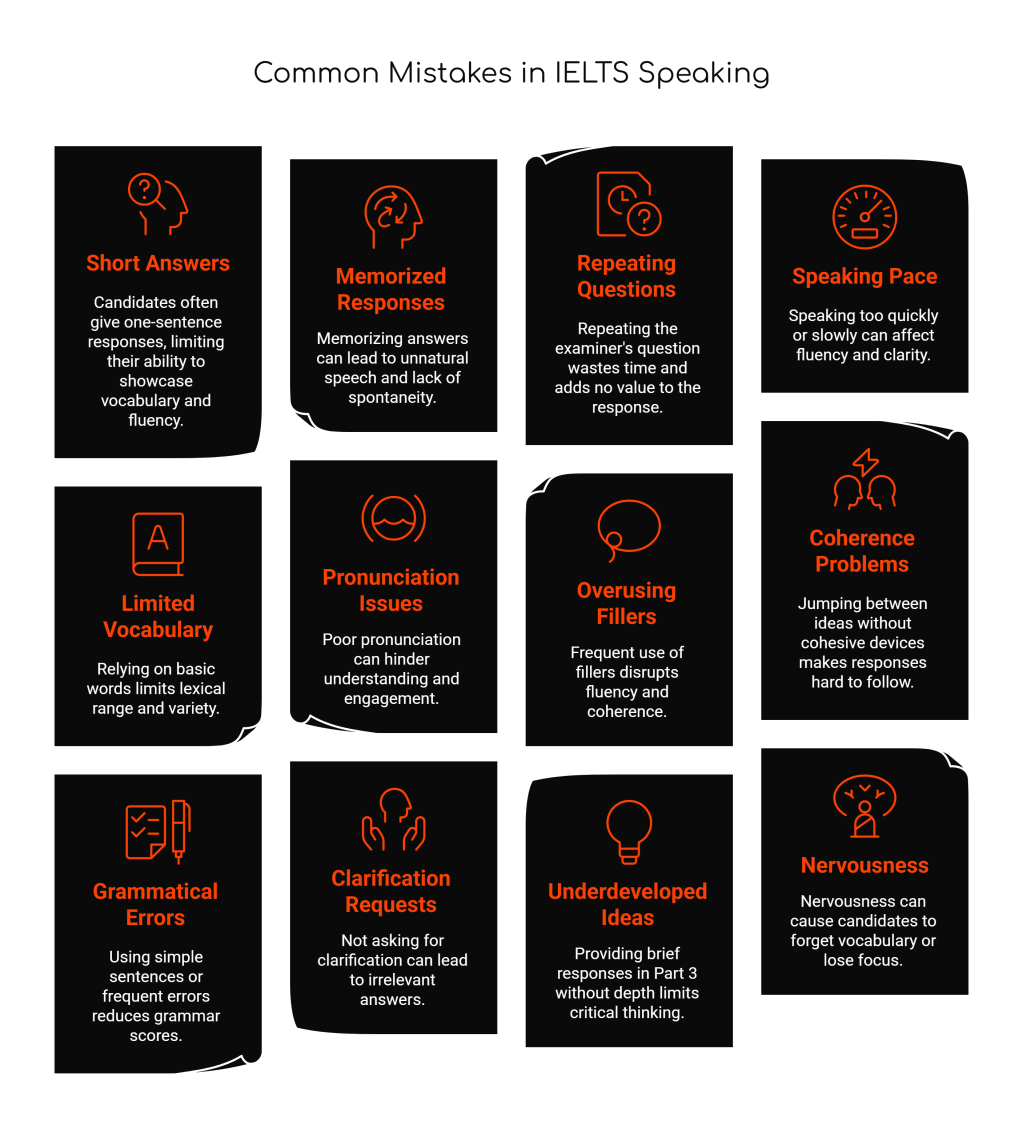
Many IELTS candidates underestimate the Speaking test, believing that fluency alone guarantees a high score. However, examiners assess a range of criteria beyond smooth speech, including lexical resource, grammatical accuracy, pronunciation, and coherence. Understanding and addressing common mistakes can help candidates improve their performance significantly. This article explores the most frequent errors in the IELTS Speaking test and provides effective strategies to correct them. You can watch this YouTube video explainer by IELTS Guide Phil.
1. Providing Short, Underdeveloped Answers
Mistake:
Candidates often give one-sentence responses, particularly in Part 1, which limits opportunities to showcase vocabulary, grammar, and fluency.
Solution:
Extend answers by adding reasons, examples, or personal experiences. Aim for 2–3 sentences minimum to develop ideas effectively.
Example:
- Question: Do you enjoy reading?
- Weak Response: Yes, I do.
- Improved Response: Yes, I enjoy reading because it allows me to escape reality and explore different worlds. Recently, I have been reading a lot of mystery novels, which keeps me engaged for hours.
2. Memorizing Answers
Mistake:
Some candidates memorize answers to common topics, but examiners can easily detect memorized responses, which often sound unnatural and lack spontaneity.
Solution:
Practice discussing a variety of topics in a natural way. Learn flexible phrases that can be adapted to different questions. Focus on mastering useful vocabulary rather than memorizing full responses.
3. Repeating the Question
Mistake:
Repeating the examiner’s question wastes time and adds no value to the response.
Solution:
Paraphrase the question or dive straight into the answer. This demonstrates lexical flexibility and confidence.
Example:
- Question: What do you usually do on weekends?
- Weak Response: What I usually do on weekends is…
- Improved Response: On weekends, I usually spend time with my family or catch up on reading.
4. Speaking Too Quickly or Slowly
Mistake:
Rushing through answers increases the likelihood of mistakes, while speaking too slowly can affect fluency.
Solution:
Find a natural, steady pace. Record practice sessions and assess pacing. Adjust the speed as needed to maintain clarity and coherence.
5. Using Limited Vocabulary
Mistake:
Relying on basic words like “good,” “bad,” “nice,” or “interesting” limits lexical range and variety.
Solution:
Expand vocabulary by learning synonyms and topic-specific words. Practice using a range of descriptive and precise language.
Examples:
- Instead of saying “good,” use “beneficial,” “enjoyable,” or “rewarding.”
- Instead of saying “bad,” opt for “detrimental,” “unpleasant,” or “challenging.”
6. Poor Pronunciation and Intonation
Mistake:
Flat intonation and mispronunciations can make it difficult for the examiner to understand the speaker.
Solution:
Practice pronouncing difficult words and focus on stressing key words to create a more engaging speech pattern. Recording yourself can help identify and correct errors.
7. Overusing Fillers
Mistake:
Frequent use of fillers like “um,” “uh,” “you know,” and “like” disrupts fluency and coherence.
Solution:
Pause briefly to gather your thoughts instead of relying on fillers. Practice thinking in English to reduce hesitation and improve response time.
8. Lack of Coherence and Cohesion
Mistake:
Jumping from one idea to another without using cohesive devices makes it difficult for the examiner to follow the response.
Solution:
Use linking words and cohesive devices to connect ideas logically.
Examples:
- Addition: Moreover, in addition, furthermore
- Contrast: However, on the other hand, although
- Examples: For instance, for example
9. Ignoring Grammatical Range and Accuracy
Mistake:
Using only simple sentences or making frequent grammatical errors reduces the grammar score.
Solution:
Mix simple, compound, and complex sentences. Practice different tenses and sentence structures to demonstrate grammatical range and accuracy.
10. Not Asking for Clarification
Mistake:
When candidates do not understand a question, they often guess and provide irrelevant answers.
Solution:
If unsure, ask for clarification. This shows confidence and ensures that responses are relevant.
Examples:
- “Could you please repeat that?”
- “Do you mean…?”
11. Failing to Fully Develop Ideas in Part 3
Mistake:
In Part 3, candidates often provide brief responses without exploring ideas in depth.
Solution:
Offer a balanced opinion by explaining reasons, giving examples, and considering multiple perspectives. This demonstrates critical thinking and analytical skills.
12. Letting Nerves Take Over
Mistake:
Nervousness can cause candidates to forget vocabulary, lose focus, or speak too quickly.
Solution:
Practice speaking regularly and simulate exam conditions to build confidence. Deep breathing exercises before the test can help maintain composure.
Final Thoughts
Success in the IELTS Speaking test requires consistent practice, a focus on vocabulary and grammar, and the ability to think critically and respond spontaneously. By recognizing and correcting these common mistakes, candidates can improve their speaking skills and achieve a higher band score.
#IELTSGuidePhil #IELTSSpeaking #SpeakingTestTips #IELTSPrep #FluencyAndCoherence #AvoidSpeakingMistakes #BoostYourScore #IELTSVocabulary #SpeakingSkills #ExamSuccess #Band8Preparation
 IELTS Guide Phil
Leave a comment