
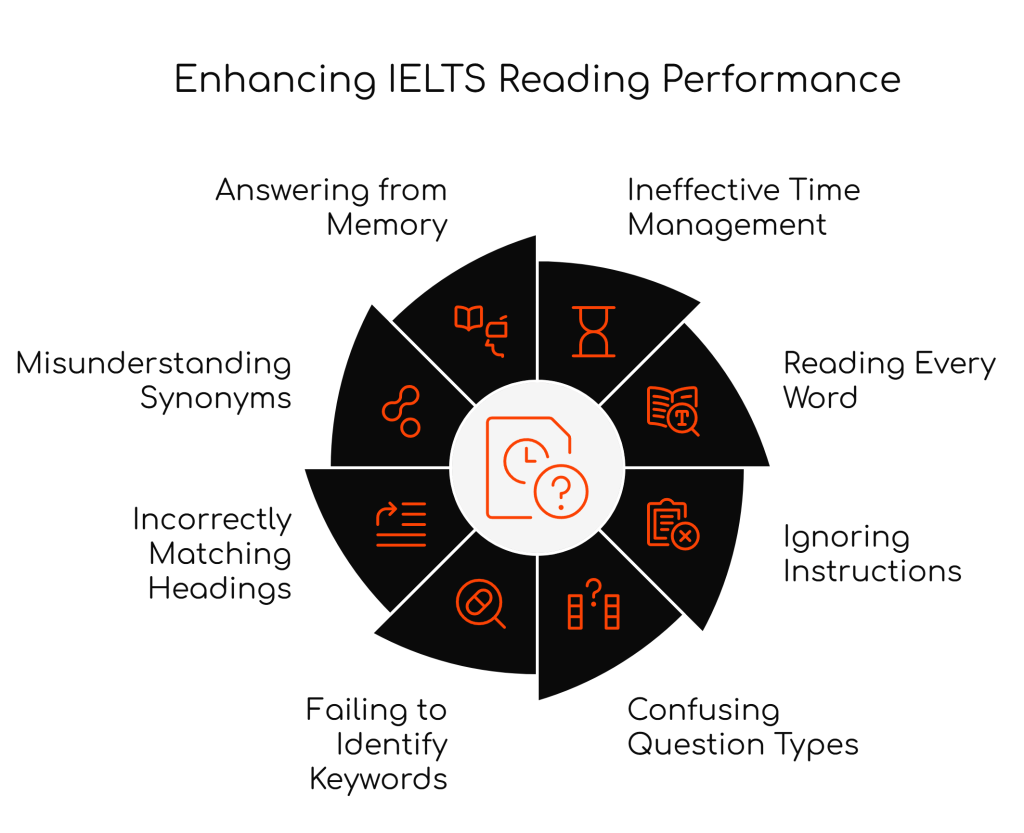
The IELTS Reading test is often challenging due to the time constraints and variety of question types. Many candidates lose valuable marks because of avoidable mistakes. Identifying these errors and applying effective strategies can significantly enhance performance. This article explores the most common mistakes in the IELTS Reading test and provides practical solutions to improve accuracy and efficiency. You can watch this YouTube video explainer by IELTS Guide Phil.
1. Ineffective Time Management
Mistake:
Candidates often spend too much time on a single passage or difficult question, leaving insufficient time for the remaining sections.
Solution:
Allocate approximately 20 minutes per passage. If a question is too difficult, skip it and return later. Regularly practice timed mock tests to improve pacing and develop a sense of time management.
2. Reading Every Word of the Passage
Mistake:
Trying to read and understand the entire passage word-for-word is time-consuming and inefficient.
Solution:
Utilize skimming and scanning techniques. Skim the text to grasp the main ideas, focusing on the first and last sentences of each paragraph. Scan for specific keywords related to the question.
3. Ignoring Instructions
Mistake:
Many candidates overlook specific instructions, which leads to errors, especially in word limit questions.
Solution:
Carefully read and follow instructions. Pay attention to phrases like “NO MORE THAN THREE WORDS” or “CHOOSE TWO LETTERS.” For True/False/Not Given questions, respond exactly as instructed.
4. Confusing ‘True/False/Not Given’ and ‘Yes/No/Not Given’
Mistake:
Candidates often treat these question types as interchangeable, resulting in incorrect answers.
Solution:
Understand the difference:
- True/False/Not Given: Based on factual information in the passage.
- Yes/No/Not Given: Based on the writer’s opinions or views.
If the information is not mentioned, select Not Given.
5. Failing to Identify Keywords
Mistake:
Candidates overlook important keywords or focus on irrelevant words when scanning the text.
Solution:
Underline or highlight keywords in the question and search for synonyms or paraphrased versions in the passage.
6. Incorrectly Matching Headings
Mistake:
Candidates rush through the Matching Headings task and choose the wrong headings.
Solution:
Skim each paragraph to determine the main idea before selecting a heading. Eliminate options that clearly do not fit and remain cautious, as paragraphs may contain overlapping information.
7. Misunderstanding Synonyms and Paraphrases
Mistake:
IELTS often uses synonyms and paraphrased phrases, confusing candidates.
Solution:
Expand your vocabulary by learning synonyms of common words and practice identifying paraphrased information in reading passages.
Example:
- Question: “The company experienced a decline in profits.”
- Passage: “The company’s earnings fell significantly.”
8. Answering from Memory Instead of the Text
Mistake:
Candidates sometimes answer based on prior knowledge rather than information from the text.
Solution:
Always rely on the passage to answer questions, even if the information contradicts what you know.
9. Leaving Answers Blank
Mistake:
Candidates often leave difficult questions unanswered, losing opportunities for potential marks.
Solution:
Never leave a question blank. Make an educated guess if you are unsure, as there is no penalty for wrong answers.
10. Confusion Between Question Types
Mistake:
Mixing up matching information, matching headings, and matching features can lead to errors.
Solution:
Familiarize yourself with all question types and read the instructions carefully. Practice different formats regularly to build confidence.
11. Poor Note-Taking and Annotation
Mistake:
Candidates often fail to mark key information, making it harder to locate answers later.
Solution:
Underline or highlight keywords, names, dates, and figures. Use symbols or short notes to quickly navigate the text.
12. Spelling and Grammar Errors
Mistake:
Incorrect spelling or grammar results in lost marks, even if the content is correct.
Solution:
Double-check spelling, especially for names and technical terms. Pay attention to plural and singular forms, as well as verb tenses.
13. Limited Practice with Different Question Types
Mistake:
Focusing on only a few question types leaves candidates unprepared for unfamiliar formats.
Solution:
Practice all types of questions, including:
- Multiple choice
- Matching headings
- Summary completion
- Sentence completion
- True/False/Not Given
14. Failing to Predict Answers in Gap-Fill Tasks
Mistake:
Candidates often do not predict possible answers before reviewing the passage.
Solution:
Before searching for the answer, predict the type of word required (noun, verb, adjective) and use context clues from the surrounding sentences.
15. Not Reviewing Answers
Mistake:
Rushing through the test leaves no time for reviewing answers, leading to avoidable mistakes.
Solution:
Allocate 2–3 minutes at the end to review answers. Ensure compliance with word limits and verify spelling accuracy.
Final Thoughts
Achieving a high band score in the IELTS Reading test requires practice, strategy, and attention to detail. By recognizing and addressing these common mistakes, candidates can improve their accuracy, manage their time effectively, and increase their chances of securing a higher score.
#IELTSGuidePhil #IELTSReading #IELTSTestPrep #IELTSStudyTips #ReadingStrategies #Band8Preparation #IELTSMistakes #AvoidReadingErrors #IELTSExamTips #BoostYourScore #ReadingComprehension
 IELTS Guide Phil
Leave a comment