
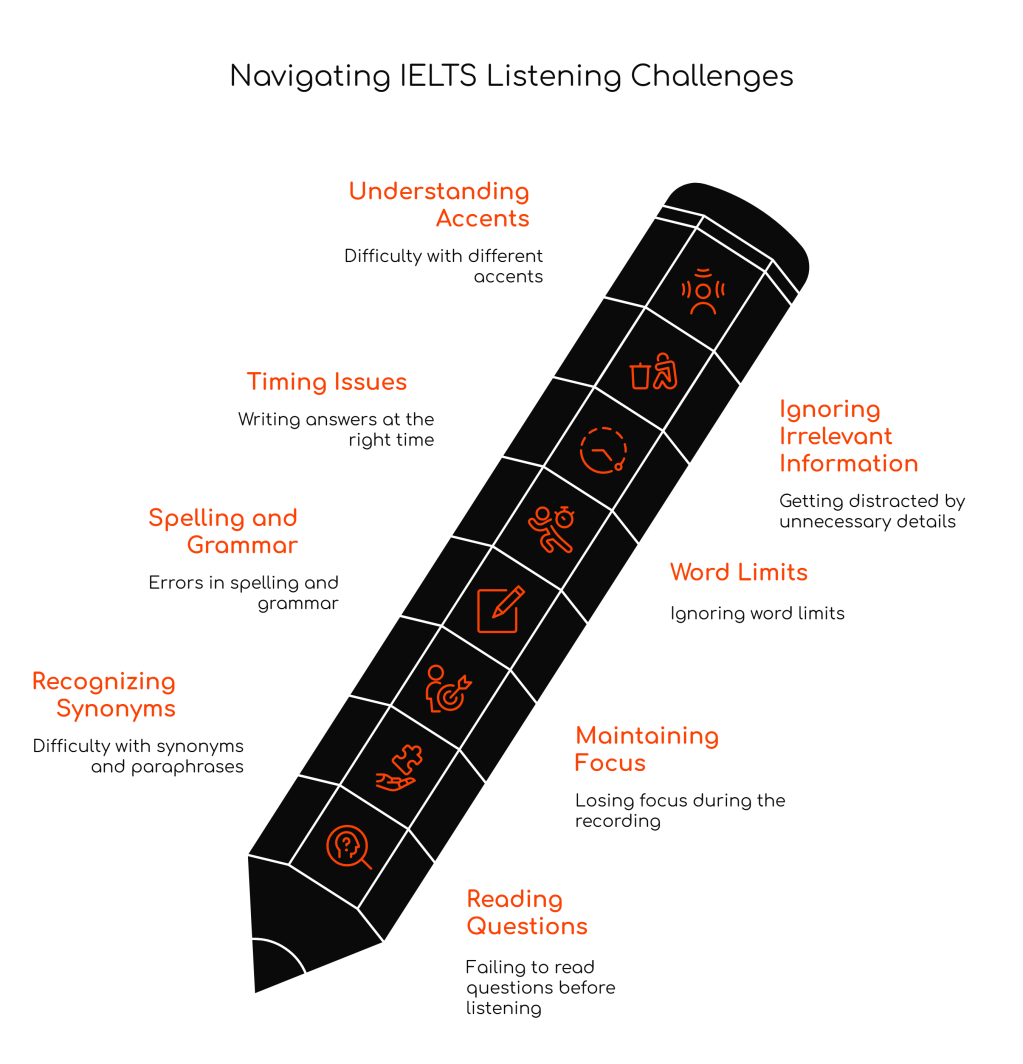
The IELTS Listening test is often perceived as one of the most challenging components of the exam due to its fast-paced nature and the fact that candidates only get one chance to hear the recording. Many test-takers lose valuable marks because of avoidable mistakes. This article explores the most common errors and provides practical strategies to overcome them, enabling candidates to approach the IELTS Listening test with greater confidence and accuracy. You can watch this YouTube video explainer by IELTS Guide Phil.
1. Failure to Read the Questions Before Listening
Mistake:
Candidates often dive straight into the recording without carefully analyzing the questions, making it difficult to follow the conversation or extract relevant information.
Solution:
Use the 30 seconds provided before each section to read the questions carefully. Identify and underline keywords to focus on essential information and predict the type of answer required, such as a name, date, or number. Anticipating potential answers helps you remain attentive to the relevant parts of the recording.
2. Inability to Recognize Synonyms and Paraphrases
Mistake:
The recording rarely uses the exact words from the questions. Instead, synonyms and paraphrased expressions are used, which can confuse candidates who expect a direct match.
Solution:
Develop the habit of identifying synonyms and paraphrases during practice sessions. For instance, if a question asks, “What time does the museum open?” the recording might say, “The museum starts welcoming visitors at 9 AM.” Recognizing variations in phrasing helps maintain accuracy.
3. Losing Focus During the Recording
Mistake:
Staying focused for 30 minutes can be difficult, particularly during lengthy conversations or lectures. Even a momentary lapse in concentration can result in missed answers.
Solution:
Engage actively by taking brief notes while listening to maintain focus. If you miss one question, quickly move on to the next to prevent further losses. Training your mind to remain engaged throughout the recording is essential for success.
4. Spelling and Grammatical Errors
Mistake:
Even when the correct answer is identified, marks are deducted for spelling and grammatical errors.
Solution:
Double-check spelling, especially for names, places, and technical terms. Pay attention to plural and singular forms, and ensure correct usage of articles. Practice writing down numbers and dates accurately to minimize errors.
5. Ignoring Word Limits
Mistake:
Exceeding the specified word limit results in an incorrect answer, even if the content is otherwise correct.
Solution:
Follow the instructions carefully. If the requirement is “NO MORE THAN TWO WORDS,” exceeding this limit will lead to a loss of marks. Practice answering within the given constraints to develop accuracy.
6. Writing Answers Prematurely or Too Late
Mistake:
Candidates sometimes rush to write an answer before hearing all the information, or they hesitate and miss the next question.
Solution:
Wait for confirmation before writing an answer. Trust your instincts when confident, but if unsure, stay calm and continue listening for further clues.
7. Getting Distracted by Irrelevant Information
Mistake:
The recording often includes unnecessary information to mislead candidates. Many fall into this trap and record incorrect answers.
Solution:
Focus on extracting information relevant to the specific question. Ignore extraneous details that do not align with the keywords identified beforehand.
8. Misunderstanding Numbers and Dates
Mistake:
Mishearing numbers, dates, and prices is a frequent source of errors.
Solution:
Familiarize yourself with different formats for numbers and dates, such as “twenty-one” versus “two one” or “the 5th of July” versus “July 5th.” Practicing these variations enhances your listening precision.
9. Poor Time Management During Answer Transfer
Mistake:
Candidates often rush to transfer their answers to the answer sheet, leading to careless errors.
Solution:
Use the 10-minute transfer time efficiently. Review spelling, grammar, and word limits while transferring answers. This final check ensures accuracy and prevents avoidable mistakes.
10. Leaving Questions Unanswered
Mistake:
Some candidates leave difficult questions blank, missing an opportunity to guess and potentially secure a mark.
Solution:
Never leave a question unanswered. Make an educated guess if unsure, as there is no penalty for incorrect answers.
11. Misinterpreting Multiple Choice Questions
Mistake:
Candidates often choose answers based on partial information without considering all available options.
Solution:
Listen carefully for distractors—information designed to mislead—and pay attention to phrases like “but,” “however,” or “although,” which may alter the meaning of a statement.
12. Ignoring Signpost Words
Mistake:
Missing important signpost words can make it difficult to follow the flow of information.
Solution:
Train yourself to listen for signpost words that signal changes or key points. Common examples include:
- Addition: Moreover, furthermore, in addition
- Contrast: However, although, on the other hand
- Examples: For instance, such as, for example
13. Lack of Prediction Skills
Mistake:
Candidates who fail to predict possible answers miss crucial information during the recording.
Solution:
Use clues from the questions to predict whether the answer will be a name, date, number, or place. This predictive approach sharpens your focus during the test.
14. Difficulty Understanding Different Accents
Mistake:
The IELTS Listening test features a variety of accents, including British, Australian, and North American. Candidates unfamiliar with these accents may struggle to understand.
Solution:
Expose yourself to different accents by watching films, listening to podcasts, and practicing with authentic IELTS materials. Pay attention to variations in pronunciation and common vocabulary used in different regions.
15. Falling for Distractors
Mistake:
Distractors are deliberately included to confuse candidates. Many fall for these traps and choose the wrong answer.
Solution:
Listen carefully for corrections or sudden changes in information, indicated by phrases like “Actually, it’s…” or “Oh no, I mean…” Recognizing these cues helps avoid errors.
16. Inadequate Practice with Different Question Types
Mistake:
Candidates who focus solely on one or two question types often struggle when faced with unexpected formats.
Solution:
Practice all types of questions, including multiple choice, form completion, diagram labeling, sentence completion, and matching information. Familiarity with diverse formats enhances overall preparedness.
17. Inconsistent Use of Capital Letters
Mistake:
Inconsistent or incorrect use of capital letters can result in lost marks.
Solution:
To avoid this issue, write all answers in capital letters. This ensures consistency and eliminates the risk of capitalization errors.
Final Thoughts
Success in the IELTS Listening test requires not only good listening skills but also an awareness of potential pitfalls and a proactive approach to avoiding them. By identifying and addressing these common mistakes, candidates can improve their accuracy, enhance their confidence, and maximize their chances of achieving a higher band score. Regular practice, careful attention to detail, and the implementation of these strategies will significantly contribute to improved performance.
#IELTSGuidePhil #IELTSListening #IELTSPreparation #Band8Strategies #IELTSExamTips #ListeningSkills #AvoidIELTSErrors #IELTSSuccess #EnglishListeningPractice #IELTSStudyGuide #ImproveListening
 IELTS Guide Phil
Leave a comment