
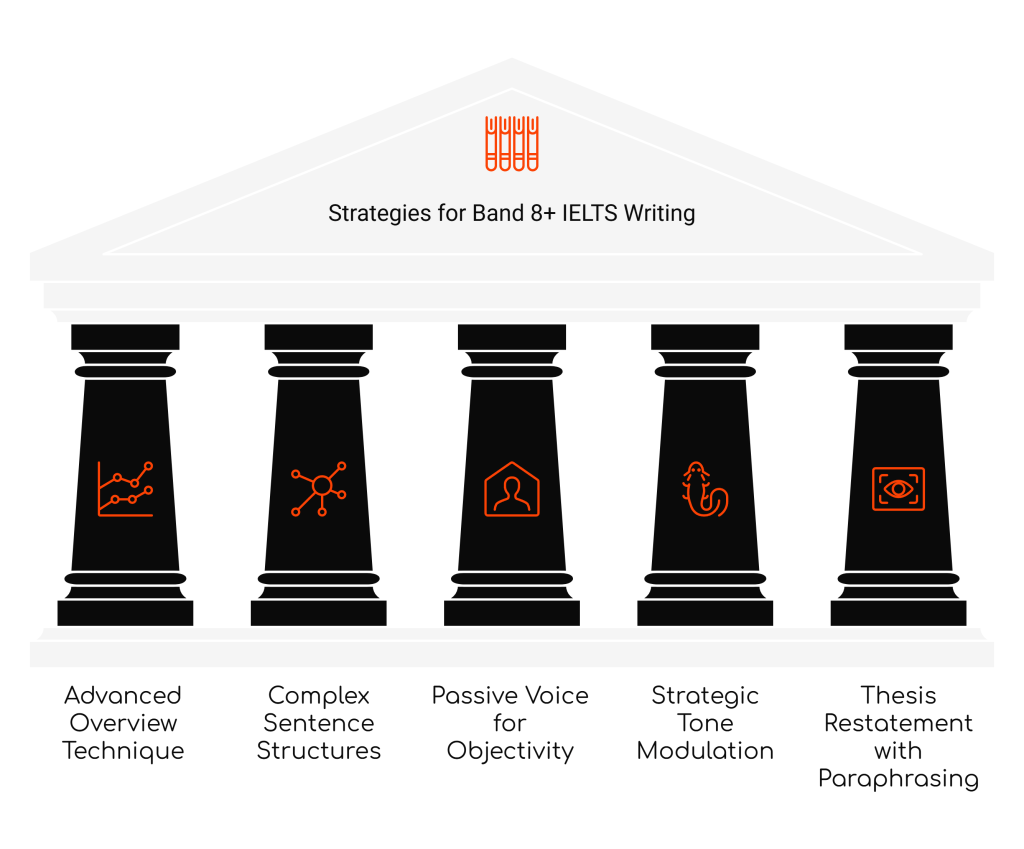
To achieve Band 8 or higher in IELTS Writing Task 1 and Task 2 (both Academic and General Training), candidates must go beyond basic task fulfillment and grammatical accuracy. High-level candidates demonstrate sophisticated structures, precise vocabulary, and advanced techniques to present ideas with clarity and coherence. Below are lesser-known but powerful strategies to maximize your score in both tasks.
IELTS Writing Task 1: Academic and General Training
Academic Task 1 (Reports on Graphs, Charts, Tables, Maps, and Processes)
1. Advanced Overview/Key Trends Technique
A Band 8+ overview is concise, insightful, and highlights trends effectively. Avoid listing details—focus on big-picture changes or comparisons.
Examples:
- The most striking feature is the sharp increase in online sales, while in-store purchases experienced a steady decline over the period.
- Overall, the northern area witnessed a transformation from rural farmland to a modern residential hub.
Pro Tip:
Use nominalization to enhance formal tone:
- There was a steady growth in exports, instead of exports grew steadily.
2. Complex Sentence Structures for Descriptions
High-level candidates use a variety of complex sentence types, including:
- Relative Clauses:
The number of students, which had been increasing steadily, peaked in 2019. - Participle Clauses:
Rising dramatically after 2015, the figures nearly doubled in five years. - Double Comparatives for Dynamic Data:
The higher the population grew, the greater the demand for housing became.
Why It Matters:
Complex structures demonstrate grammatical range and make descriptions more dynamic and engaging.
3. Use of Passive Voice for Objectivity
In formal reports, passive voice adds a neutral and objective tone.
Examples:
- The data were collected over a 10-year period.
- A significant increase was observed in the number of international students.
Why It Matters:
Passive voice adds formality and shifts focus to the process or results, aligning with academic tone.
4. Trend Descriptions Using Adverbial Phrases
Go beyond “increase” and “decrease” by using advanced phrases.
Examples:
- Following a period of stability, sales surged dramatically.
- After fluctuating slightly, the figures plateaued in the final quarter.
- A steady upward trajectory was maintained throughout the decade.
Why It Matters:
Variety in trend descriptions demonstrates lexical flexibility and improves coherence.
General Training Task 1 (Letters: Formal, Semi-formal, Informal)
5. Strategic Tone Modulation for Letter Types
High-level candidates adjust tone seamlessly between formal, semi-formal, and informal letters.
Examples:
- Formal Letters:
I am writing to express my dissatisfaction with…
I would appreciate it if you could address this matter promptly. - Semi-Formal Letters:
I am writing to inform you that…
Could you kindly let me know when it would be convenient? - Informal Letters:
Hey! It’s been ages since we last caught up!
I just wanted to let you know about my recent trip.
Why It Matters:
Consistent and appropriate tone enhances Task Achievement and demonstrates control over formality.
6. Idiomatic Language for Informal Letters
For informal letters, appropriate use of idiomatic expressions makes your writing more natural.
Examples:
- I was over the moon when I heard your news.
- Let’s catch up soon—I’ve got so much to tell you!
Why It Matters:
Natural use of idiomatic language adds authenticity and boosts lexical range.
IELTS Writing Task 2: Academic and General Training (Essays)
7. Thesis Restatement with Paraphrasing in Conclusion
To achieve Band 8+, avoid repeating your introduction verbatim in the conclusion. Instead, rephrase the thesis and summarize key ideas.
Example:
- Introduction: While some argue that traditional classrooms are becoming obsolete, others believe that face-to-face learning offers irreplaceable benefits.
- Conclusion: In conclusion, although online platforms have revolutionized education, the irreplaceable advantages of physical classroom settings cannot be overlooked.
Why It Matters:
Paraphrasing in the conclusion shows lexical variety and reinforces the argument without redundancy.
8. Balanced Use of Hedging for Academic Caution
In formal essays, hedging shows a cautious approach to claims, which is highly valued in IELTS.
Examples:
- It is likely that technological advancements will continue to reshape industries.
- There appears to be a growing consensus that climate change poses a significant threat.
Why It Matters:
Hedging improves the academic tone and demonstrates a nuanced perspective, which is critical for high scores.
9. Effective Use of Conditional Sentences for Hypotheticals
Conditionals allow you to discuss hypothetical scenarios and their outcomes, adding depth to your argument.
Examples:
- If governments had prioritized education, literacy rates would have improved.
- Should stricter regulations be enforced, environmental degradation could be minimized.
Why It Matters:
Using conditionals appropriately adds complexity and sophistication to your arguments.
10. Lexical Chains for Cohesion and Synonym Variety
High-scoring essays avoid repetition by using lexical chains to create cohesion.
Examples:
- Technology → digital innovations → advancements in communication → online platforms
- Education → academic pursuits → knowledge acquisition → intellectual growth
Why It Matters:
Lexical chains enhance coherence by creating logical connections between related ideas.
11. Advanced Cohesive Devices Beyond ‘Firstly’ and ‘However’
Candidates aiming for Band 8+ use a range of cohesive devices to link ideas smoothly.
Examples:
- Cause and Effect:
As a consequence of this development…
Owing to the increase in demand… - Adding Information:
What is more, this approach fosters creativity.
In addition to this, policies should focus on inclusivity. - Contrasting Ideas:
By contrast, rural areas face fewer transportation challenges.
Nevertheless, the benefits outweigh the drawbacks.
Why It Matters:
Using a wide range of cohesive devices ensures smoother progression of ideas, boosting coherence and cohesion scores.
12. Nominalization to Increase Formality
Nominalization turns verbs or adjectives into nouns, creating a more formal and objective tone.
Examples:
- Investigate → Investigation
- Develop → Development
- Aware → Awareness
Why It Matters:
Nominalization enhances the academic style required for high-band essays.
Pro Tips for Task 1 and Task 2 Success
- Task 1 Academic:
Use passive voice and participle clauses to describe processes and trends.
Incorporate double comparatives to highlight data relationships. - Task 1 General Training:
Adjust tone appropriately to suit the letter type.
Use natural idiomatic language in informal letters. - Task 2 (Both Academic and General Training):
Include conditionals to discuss hypothetical outcomes.
Paraphrase the thesis effectively in the conclusion.
Use hedging to present balanced perspectives.
Final Thoughts
To achieve Band 8+ in IELTS Writing, candidates need to showcase control over advanced grammar, precise vocabulary, and formal writing techniques. By applying these lesser-known strategies, you can create well-structured, cohesive, and sophisticated responses that impress the examiner.
#IELTSGuidePhil #IELTSWriting #Band8IELTS #IELTSTask1 #IELTSTask2 #AdvancedIELTS #IELTSPreparation #HighBandWriting #IELTSGrammar #IELTSTips
 IELTS Guide Phil
Leave a comment