
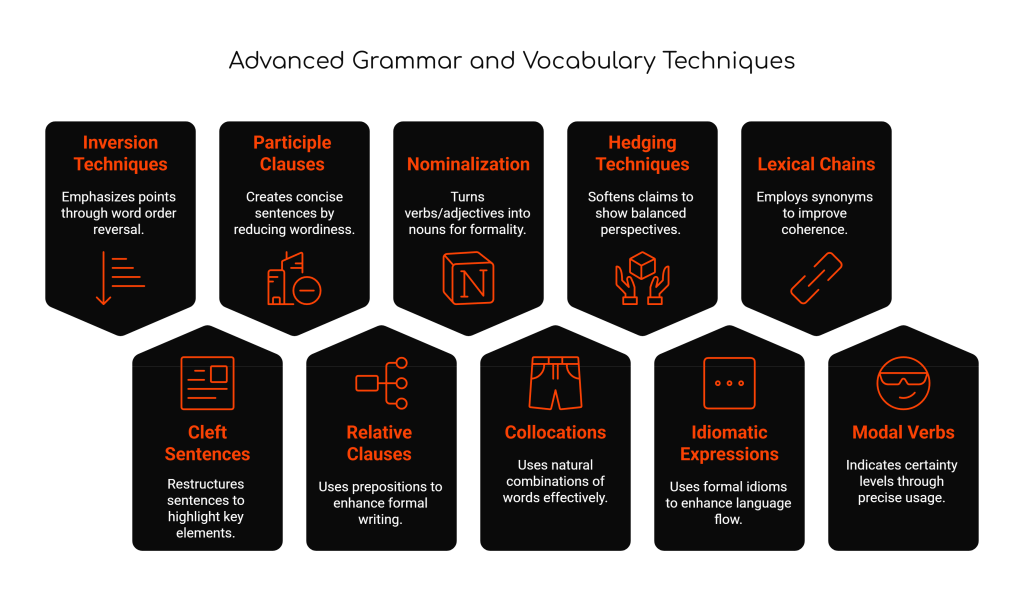
Achieving Band 8 or higher in the IELTS exam requires more than just a solid understanding of basic grammar and vocabulary. High-level candidates distinguish themselves by demonstrating control over complex structures, precise word choices, and natural expressions. This article explores ten lesser-known but highly effective grammar and vocabulary techniques that can elevate your IELTS performance.
Advanced Grammar Skills for Band 8+
1. Inversion for Emphasis and Formality
Inversion involves reversing the usual word order to emphasize a point, often used in formal writing or speaking. This technique enhances the sophistication of your responses, which is a hallmark of high-band candidates.
Key Structures:
- Negative Adverbials:
- Rarely have I seen such a breathtaking view.
- Not only did she complete the project, but she also delivered it ahead of schedule.
- Conditionals without ‘if’:
- Had I known, I would have acted differently.
- Were they to arrive earlier, they would catch the presentation.
Why it matters:
Inverted structures indicate a high level of grammatical control and are particularly effective in formal contexts, such as Writing Task 2 and Speaking Part 3.
2. Cleft Sentences for Emphasis
Cleft sentences emphasize a specific element of a sentence by restructuring its form. This technique can enhance coherence and draw attention to key points.
Key Structures:
- It-Cleft:
- It was John who suggested the idea.
- It is hard work that leads to success.
- What-Cleft:
- What matters most is consistency.
- What I need is more time to prepare.
Why it matters:
Cleft sentences highlight important information and add variety to sentence structures, making them an excellent tool for constructing persuasive arguments.
3. Participle Clauses for Conciseness
Participle clauses allow for the combination of ideas in a concise and sophisticated manner, reducing redundancy and enhancing fluency.
Key Structures:
- Present Participle:
- Walking through the park, I noticed the vibrant flowers.
- Past Participle:
- Left unattended, the plant began to wither.
- Perfect Participle:
- Having completed the assignment, she took a break.
Why it matters:
Participle clauses reflect a high level of grammatical sophistication, enabling candidates to express ideas succinctly and effectively.
4. Relative Clauses with Prepositions at the Beginning
Using prepositions at the start of relative clauses adds formality and precision to writing, making this structure particularly useful in academic contexts.
Key Structures:
- Formal Usage:
- The topic about which we were discussing is controversial.
- Informal Usage:
- The person who/that I spoke to was very helpful.
Why it matters:
This advanced structure reflects a polished writing style, ideal for formal contexts such as Writing Task 2 and Speaking Part 3.
5. Nominalization to Increase Formality
Nominalization transforms verbs and adjectives into nouns, enhancing the formal and academic tone required for higher bands in IELTS.
Key Structures:
- Verb → Noun:
- Investigate → Investigation
- Develop → Development
- Adjective → Noun:
- Aware → Awareness
- Efficient → Efficiency
Example:
- Instead of: The government should investigate the issue.
- Say: An investigation into the issue is required.
Why it matters:
Nominalization improves academic tone and precision, aligning well with the expectations of IELTS Writing Task 2.
Advanced Vocabulary Skills for Band 8+
6. Collocations and Strong Verb-Noun Combinations
Mastery of collocations and strong verb-noun combinations enhances lexical resource and demonstrates a deep understanding of natural language.
Key Examples:
- Common Collocations:
- Make a decision (not do a decision)
- Bear in mind (more formal than keep in mind)
- Undertake research (instead of do research)
- Stronger Verbs:
- Alleviate (problems)
- Enhance (performance)
- Mitigate (risks)
Why it matters:
Using precise collocations improves lexical variety and strengthens the overall coherence of your responses.
7. Hedging for Academic Caution
Hedging is a crucial technique for expressing ideas with caution and balance, which is essential for maintaining an objective and academic tone.
Key Examples:
- It is possible that…
- There appears to be…
- Some evidence suggests that…
Why it matters:
Hedging devices demonstrate a nuanced, balanced approach, which is highly valued in IELTS Writing Task 2 and Speaking Part 3.
8. Idiomatic Expressions with a Formal Twist
Idiomatic expressions, when used correctly and appropriately, add sophistication to your responses. However, in formal settings, it is important to use idioms that align with an academic tone.
Key Examples:
- A double-edged sword (something with both benefits and drawbacks)
- Go the extra mile (make additional effort)
- Bide one’s time (wait patiently for the right moment)
Why it matters:
Well-placed idiomatic expressions can add natural variety to your responses, but overusing informal phrases can harm your score. It is advisable to stick to formal idioms in Writing Task 2.
9. Lexical Chains for Coherence
Lexical chains involve using synonyms and related terms to avoid repetition and enhance coherence in writing and speaking.
Example:
- Education → learning → academic pursuits → knowledge acquisition
Why it matters:
Building lexical chains improves coherence and lexical variety, which positively impacts both the Lexical Resource and Coherence & Cohesion criteria.
10. Precise Modal Verbs for Degrees of Certainty
Accurate use of modal verbs indicates a strong command of grammatical nuances and allows candidates to express different levels of certainty.
Key Examples:
- High Certainty:
- It must be true.
- Medium Certainty:
- It might be possible.
- Low Certainty:
- It could happen under certain circumstances.
Why it matters:
Using modal verbs with precision enhances grammatical range and demonstrates a nuanced understanding of probability and certainty.
Practical Applications for IELTS Success
Writing Task 1
- Incorporate nominalization to describe trends formally.
- Use inversion to emphasize comparisons and key observations.
Writing Task 2
- Employ cleft sentences and participle clauses to structure arguments concisely.
- Apply hedging to present balanced viewpoints effectively.
Speaking Part 3
- Use idiomatic expressions and collocations naturally.
- Demonstrate control over inversion and conditionals to showcase advanced grammar.
Final Thoughts
To achieve Band 8 or higher in IELTS, it is not enough to avoid grammatical errors. High-scoring candidates showcase complexity, accuracy, and variety in their grammar and vocabulary. By incorporating these advanced techniques into your preparation, you will enhance the sophistication of your language and significantly improve your chances of standing out in the IELTS exam.
#IELTSGuidePhil IELTSBand8Plus #AdvancedIELTSTips #IELTSGrammarSkills #IELTSVocabularyMastery #IELTSSpeakingTips #IELTSWritingTask2 #GrammarForIELTS #VocabularyForIELTS #IELTSSuccess
 IELTS Guide Phil
Leave a comment