
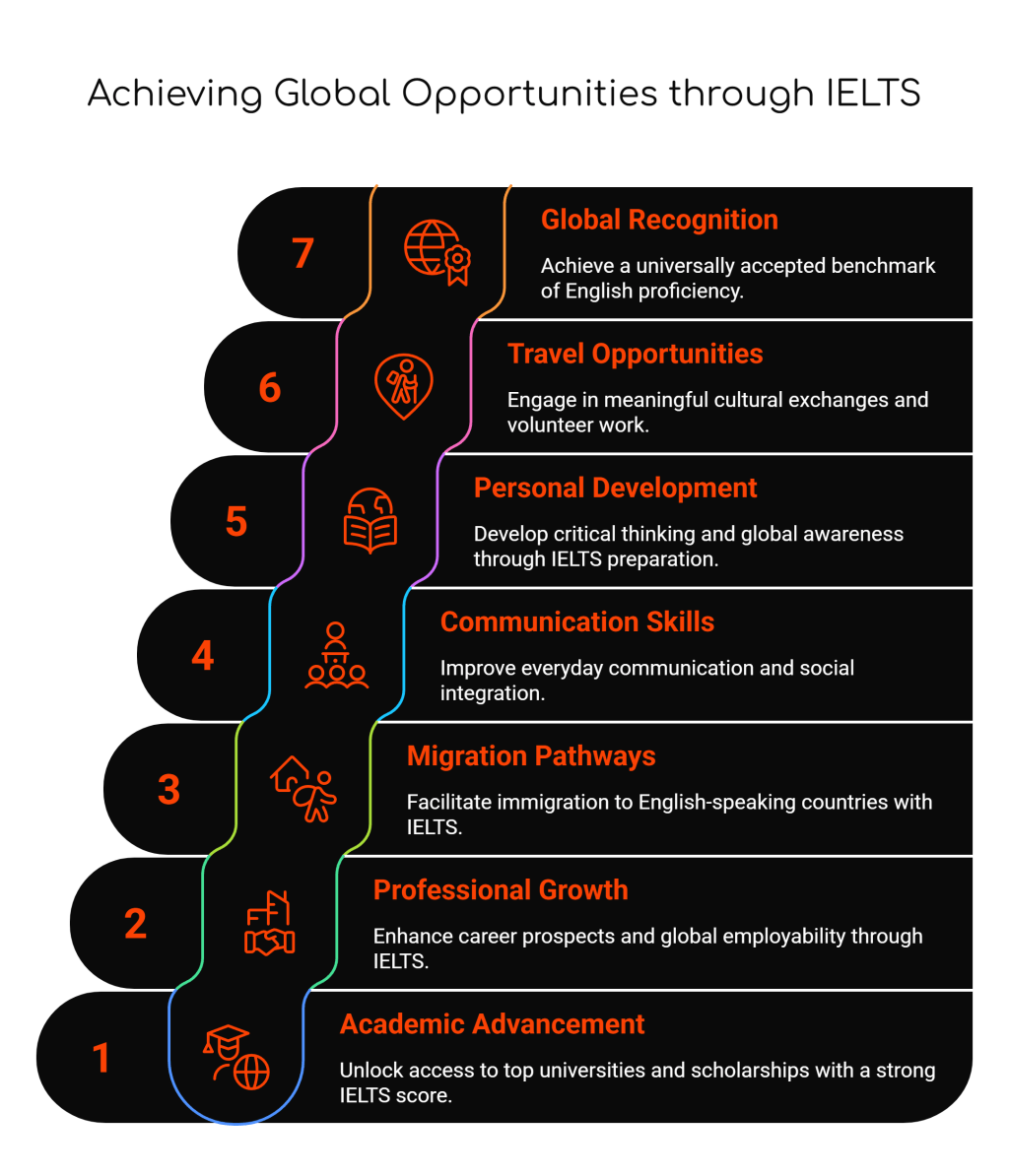
The International English Language Testing System (IELTS) is one of the most widely recognized English proficiency exams globally. Whether you are pursuing higher education, seeking career advancement, or planning to migrate to an English-speaking country, a high IELTS score can significantly enhance your prospects. With more than 12,000 organizations in over 140 countries recognizing IELTS as a valid measure of English proficiency, it is a gateway to numerous opportunities. Here’s a closer look at why IELTS is important and the key opportunities it unlocks.
1. Academic Advancement: Study at Top Universities Worldwide
IELTS Academic is a prerequisite for admission to many universities and higher education institutions in countries such as the United Kingdom, Australia, Canada, New Zealand, and the United States. A strong IELTS score demonstrates that you possess the necessary language skills to succeed in an academic environment.
- Access to Prestigious Institutions:
Leading universities, such as the University of Oxford (UK), Harvard University (USA), and the University of Melbourne (Australia), require IELTS scores as part of their admission process. For instance, the University of Toronto in Canada generally requires an overall band score of 6.5 with no band lower than 6.0 for undergraduate programs. - Scholarship Eligibility:
Many universities offer scholarships and financial aid to international students, often requiring a high IELTS score. For example, the Chevening Scholarship (UK) and the Australia Awards Scholarship require strong IELTS results to qualify. - Foundation for Academic Success:
Students with a solid command of English are better prepared to handle academic challenges, such as writing research papers, participating in group discussions, and comprehending complex texts. For instance, a postgraduate student pursuing an MBA in Australia will need strong writing and analytical skills to draft business reports and case studies effectively.
2. Professional Growth: Expand Your Career Horizons
For professionals seeking to work in an English-speaking environment or pursue international career opportunities, IELTS General Training is often a requirement. Many regulatory bodies and employers worldwide use IELTS scores to assess English proficiency, ensuring that employees can communicate effectively in the workplace.
- Professional Registration and Licensing:
Professions such as medicine, nursing, engineering, and law often require IELTS for professional registration. For example, the Nursing and Midwifery Council (NMC) in the UK and the Medical Council of Canada (MCC) require a minimum IELTS score to ensure that healthcare professionals can effectively communicate with patients and colleagues. - Global Employability:
A high IELTS score enhances employability in multinational companies, particularly in sectors such as IT, finance, and customer service. For instance, Microsoft, Google, and Deloitte often prefer candidates who can demonstrate strong English proficiency for roles that require collaboration across global teams. - Career Progression and Promotions:
Professionals looking to advance their careers within international organizations often need to demonstrate English proficiency to qualify for promotions. For example, an employee seeking a managerial role in a global corporation based in Canada may need to provide evidence of English language skills through IELTS to secure the position.
3. Migration Pathways: Move to an English-Speaking Country
IELTS plays a crucial role in the immigration process for individuals planning to migrate to countries such as Canada, Australia, New Zealand, and the United Kingdom. Immigration authorities use IELTS scores to assess an applicant’s language skills and ability to integrate into the local community.
- Permanent Residency and Citizenship:
Countries such as Canada and Australia use point-based immigration systems where higher IELTS scores contribute to a candidate’s overall points. For instance, Canada’s Express Entry System awards additional points to applicants who achieve a Canadian Language Benchmark (CLB) level 9 or above in IELTS. - Skill-Based Migration Programs:
Skilled migration programs, such as Australia’s Skilled Independent Visa (Subclass 189) and New Zealand’s Skilled Migrant Category, require a minimum IELTS score for eligibility. Candidates with higher scores often have a competitive edge during the selection process. - Family Sponsorship and Partner Visas:
In cases where family members or partners apply for sponsorship or partner visas, they may also be required to demonstrate their English proficiency through IELTS. For example, partners applying for a Spouse Visa (Subclass 309/100) in Australia need to meet minimum language requirements.
4. Enhanced Communication Skills: Thrive in Everyday Life
Proficiency in English is essential for effective communication, especially when living, working, or studying in an English-speaking country. IELTS equips candidates with the language skills needed to thrive in various real-life situations.
- Social Integration:
Being able to communicate fluently helps newcomers build relationships, engage with their communities, and participate in cultural and social activities. For example, immigrants to Canada who achieve a high IELTS score often find it easier to integrate into their local communities and participate in civic life. - Confidence in Communication:
A strong IELTS score reflects your ability to listen, speak, read, and write effectively, allowing you to confidently handle situations such as opening a bank account, seeking medical assistance, or attending parent-teacher meetings. For instance, a new resident in Australia may need to communicate effectively with healthcare providers or school administrators.
5. Improved Personal and Professional Development
Preparing for IELTS involves more than just learning the English language. The rigorous preparation process helps candidates develop essential skills that contribute to long-term personal and professional growth.
- Critical Thinking and Analytical Skills:
The Reading and Writing sections, in particular, promote critical thinking and analytical skills. Candidates learn to identify key information, analyze complex texts, and articulate coherent arguments, skills that are valuable in both academic and professional settings. - Increased Global Awareness:
Engaging with diverse topics in IELTS materials exposes candidates to global issues and cultural perspectives, fostering a broader understanding of the world. For example, reading texts on environmental issues, technological advancements, or social trends helps candidates develop a global outlook.
6. Opportunities for International Travel and Volunteer Work
A high IELTS score can facilitate opportunities beyond traditional career and academic paths. Many international organizations and volunteer programs require proof of English proficiency to ensure that participants can effectively contribute to their initiatives.
- Volunteer Programs:
Organizations such as the United Nations (UN), World Health Organization (WHO), and other global NGOs often require English proficiency to participate in international volunteer programs. Volunteers working on humanitarian projects in countries such as Kenya or Nepal need to communicate effectively with local communities and project teams. - Travel and Cultural Exchange:
Proficiency in English allows for more meaningful interactions and cultural exchanges during international travel. Travelers who can communicate fluently are better equipped to navigate new environments, understand local customs, and engage with diverse cultures.
7. IELTS as a Benchmark for English Proficiency
IELTS is not only a test but also a globally recognized benchmark for measuring English proficiency. The IELTS band score system provides an accurate assessment of a candidate’s ability across four key language skills: Listening, Reading, Writing, and Speaking.
- Standardized and Fair Assessment:
IELTS is renowned for its fairness and accuracy in evaluating language skills. The standardized format ensures that candidates are assessed consistently, regardless of their background or nationality. - Recognition by Global Institutions:
IELTS is accepted by more than 11,000 institutions worldwide, including universities, employers, immigration authorities, and professional bodies. This widespread recognition makes IELTS a trusted measure of English proficiency for individuals seeking global opportunities.
Final Thoughts: Your Pathway to Global Success
The importance of IELTS cannot be overstated. Whether you are pursuing higher education, seeking career growth, or planning to migrate, a strong IELTS score opens the door to numerous opportunities. Beyond academic and professional benefits, IELTS preparation fosters critical skills and confidence that contribute to long-term success in an increasingly globalized world.
Investing in IELTS preparation is an investment in your future. By understanding the test format, practicing regularly, and developing a strong foundation in English, you can achieve your desired score and confidently pursue your academic, professional, and personal goals.
#IELTSGuidePhil #IELTS #IELTSAcademic #IELTSGeneralTraining #IELTSPrep #StudyAbroad #WorkAbroad #LiveAbroad #IELTSTips #TestSuccess #HigherEducation
 IELTS Guide Phil
Leave a comment