
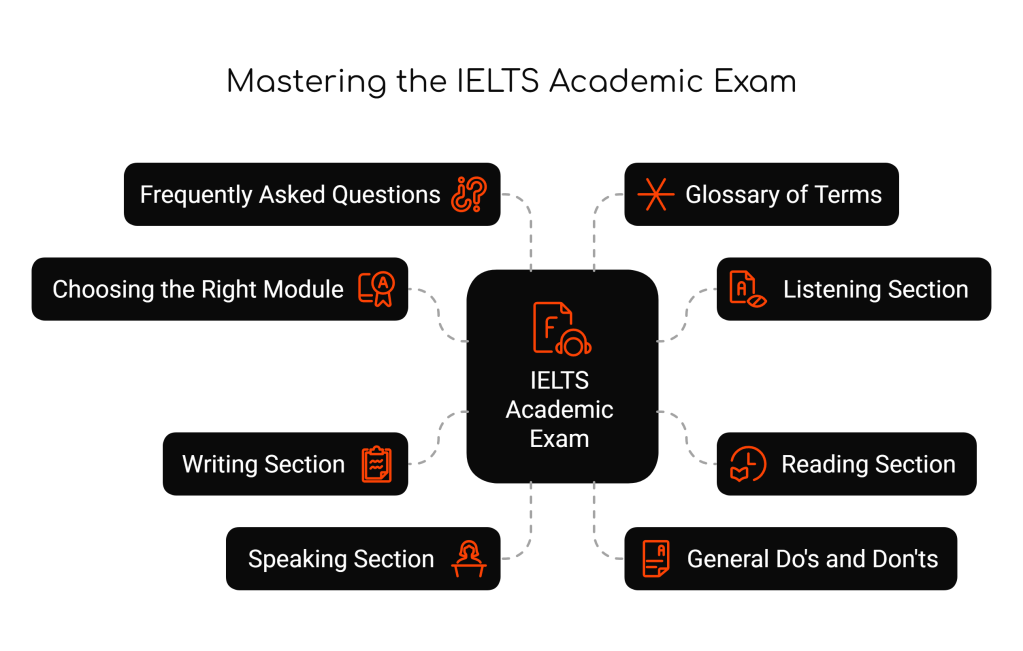
The IELTS Academic exam is a critical step for individuals aspiring to pursue undergraduate or postgraduate education or seeking professional registration in an English-speaking environment. Achieving a high score requires a thorough understanding of the test format, familiarity with effective strategies, and consistent practice. This guide provides an in-depth overview of the IELTS Academic exam, offering essential tips and strategies to help candidates succeed.
Choosing the Right Module: Academic vs. General Training
Before registering for the IELTS exam, it is essential to confirm which module is required by the institution or employer. IELTS offers two distinct modules:
- Academic Module: Designed for candidates pursuing higher education or professional registration.
- General Training Module: Intended for those seeking migration or study below the degree level.
Failing to select the correct module may result in the invalidation of test results, so candidates should double-check the requirements of the institution or organization to which they are applying.
Listening Section: Key Strategies for Success
The Listening section consists of four recordings, each played only once. It requires strong concentration and careful attention to detail. To maximize performance, candidates should:
- Preview Questions: Quickly review the questions before the recording begins to anticipate the type of information required.
- Write Answers While Listening: Jot down answers as the recording progresses to avoid missing crucial information. Candidates taking the paper-based test will have 10 minutes at the end to transfer answers to the answer sheet.
- Adhere to Word Limits: If instructions specify “NO MORE THAN THREE WORDS,” exceeding the limit will result in a loss of marks.
- Familiarize Themselves with Different Accents: The IELTS Listening section includes accents from British, American, Australian, and other English-speaking regions, so candidates should practice with a variety of sources.
Reading Section: Mastering Time Management
The Reading section presents three passages with 40 questions to be completed within 60 minutes. Efficient time management is crucial for success. Key strategies include:
- Allocate Time Wisely: Aim to spend no more than 20 minutes per passage.
- Skim and Scan: Skimming allows candidates to grasp the main idea, while scanning helps locate specific details quickly.
- Follow Instructions Carefully: Pay close attention to word limits and question requirements.
- Skip and Return: If a question seems difficult, move on and return to it later if time permits.
- Maintain Accuracy: Spelling and grammatical errors can result in lost marks, so candidates should carefully review their answers.
Writing Section: Understanding Task 1 and Task 2
The Writing section consists of two tasks:
- Task 1: Candidates are required to describe, summarize, or explain data presented in a graph, chart, diagram, or process. An overview should be provided without speculation or personal opinion.
- Task 2: This task requires a formal essay-style response addressing a given prompt. Candidates should present a clear structure, develop ideas with supporting arguments, and provide relevant examples.
Task 2 carries twice as much weight as Task 1, so candidates should allocate approximately 40 minutes to Task 2 and 20 minutes to Task 1.
Key Recommendations:
- Plan Before Writing: Spend a few minutes organizing ideas before beginning the response.
- Check for Errors: Review spelling, grammar, and coherence to enhance clarity.
- Avoid Common Pitfalls: Refrain from copying phrases from the question or using bullet points, as these practices can lower the score.
Speaking Section: Building Confidence and Fluency
The Speaking section assesses oral communication skills and consists of three parts:
- Introduction and Interview: The examiner asks general questions about the candidate’s background.
- Cue Card Task: The candidate delivers a 1-2 minute monologue on a given topic, followed by a brief follow-up question.
- Discussion: The examiner engages the candidate in a deeper discussion related to the cue card topic.
To perform well in the Speaking section, candidates should:
- Provide Detailed Answers: Extend responses by adding relevant information and examples.
- Practice Speaking for 2 Minutes: Develop the ability to speak fluently for the duration of the Cue Card task.
- Avoid Memorizing Responses: Natural and spontaneous answers are more effective.
- Seek Clarification if Needed: If a question is unclear, it is acceptable to ask the examiner to repeat or clarify it.
IELTS Do’s and Don’ts: Essential Guidelines
To optimize performance in the IELTS Academic exam, candidates should adhere to the following best practices:
Do:
- Read instructions carefully.
- Manage time effectively across all sections.
- Answer every question, as there is no penalty for incorrect responses.
- Check spelling and grammar to avoid unnecessary errors.
Don’t:
- Panic if a question is missed—move on and return later if possible.
- Waste time on a single difficult question.
- Memorize answers—examiners are trained to identify rehearsed responses.
- Neglect to review work before submission.
IELTS Q&A: Frequently Asked Questions
1. How long is my IELTS score valid?
IELTS scores are valid for two years from the date of the test.
2. Can I retake only one section of the IELTS?
Yes, the IELTS One Skill Retake allows candidates to retake a single section instead of the entire test. However, this option is available only in certain locations.
3. What is the minimum score required for universities?
Minimum score requirements vary by institution, but most universities require an overall band score of 6.5 or higher.
4. Can I use a pen during the IELTS test?
Candidates must use a pencil for the Listening and Reading sections. For the Writing section, either a pen or pencil is acceptable.
5. Will my accent affect my Speaking score?
No. Examiners are trained to assess a wide range of accents, provided the candidate speaks clearly and fluently.
6. What happens if I do not finish the Writing section?
Partial responses may result in a lower score, but submitting incomplete answers is preferable to leaving questions blank.
7. How can I improve my IELTS score?
Consistent practice, taking timed mock tests, and focusing on grammar, vocabulary, and fluency are effective ways to enhance IELTS performance.
Glossary of IELTS Terms
- Band Score: A numerical score ranging from 0 to 9 that reflects English proficiency.
- Cue Card: A prompt used in Speaking Part 2 requiring a 2-minute monologue.
- Skimming: Quickly reading a passage to get a general understanding.
- Scanning: Searching for specific details without reading the entire text.
- Word Limit: The maximum or minimum number of words required in Writing and Reading answers.
- Task Response: A Writing criterion that evaluates how well the candidate addresses the task.
- Fluency: The ability to speak smoothly and naturally during the Speaking section.
- One Skill Retake: An option that allows candidates to retake a single section instead of the full IELTS exam.
Final Thoughts: Preparing for Success
Achieving a high score on the IELTS Academic exam requires careful preparation, a clear understanding of the test format, and the application of effective test-taking strategies. By practicing regularly, managing time effectively, and addressing the specific requirements of each section, candidates can significantly improve their chances of success.
For further guidance and expert insights on IELTS preparation, stay informed with the latest tips and resources from reliable sources. With dedication and a structured approach, candidates can confidently move one step closer to their academic and professional goals.
#IELTSGuidePhil #IELTS #IELTSAcademic #IELTSPrep #StudyAbroad #WorkAbroad #IELTSTips #TestSuccess #HigherEducation
 IELTS Guide Phil
Leave a comment