
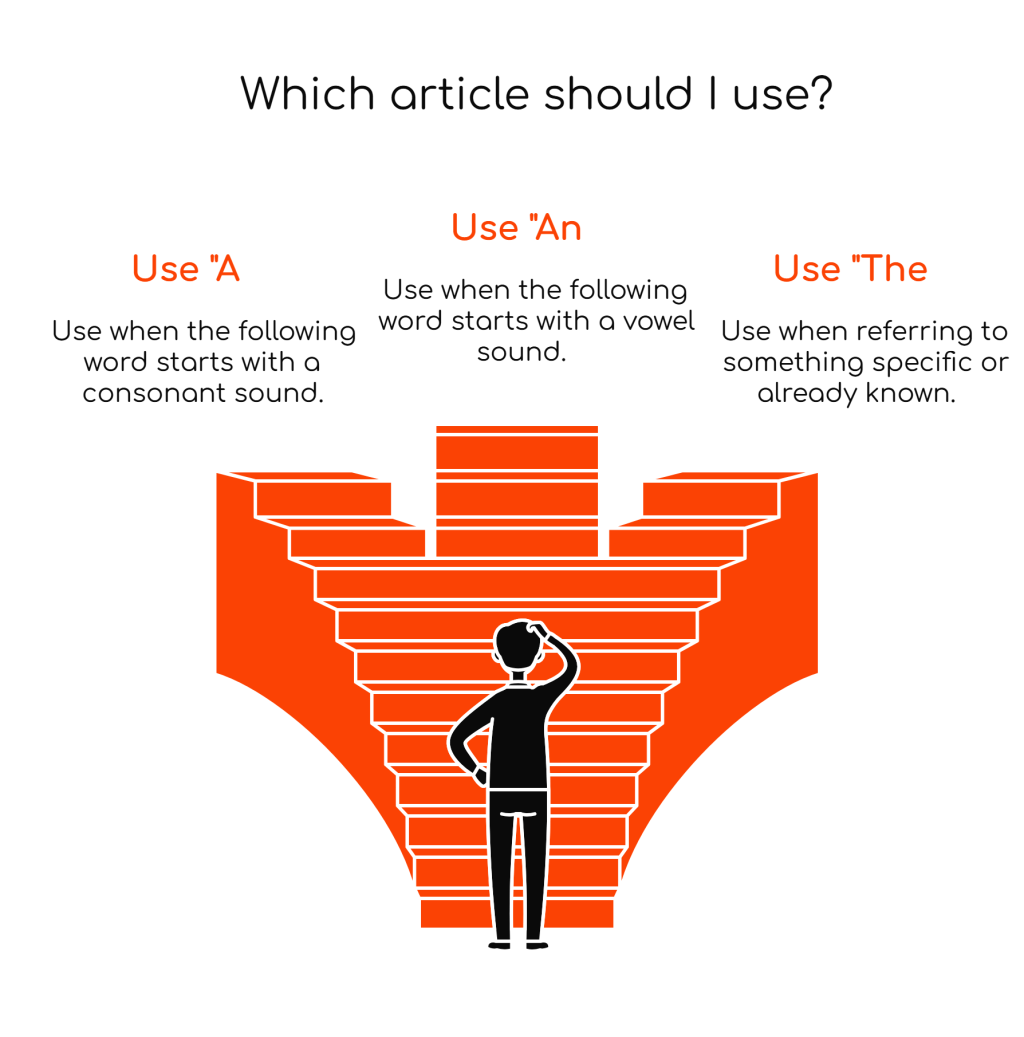
Articles in English are small yet essential words that significantly impact meaning and clarity. Many English learners struggle with using “a,” “an,” and “the” correctly, but mastering their usage can greatly enhance fluency and accuracy. This comprehensive guide explores the rules, exceptions, common mistakes, and best strategies for learning articles effectively.
Understanding the Importance of Articles
Articles define whether a noun is specific or general. They are categorized into two types:
- Definite Article: “The” (used for specific nouns)
- Indefinite Articles: “A” and “An” (used for general or non-specific nouns)
For example: I saw a cat (referring to any cat). The cat was black (referring to a specific cat previously mentioned).
Usage of “A” and “An” (Indefinite Articles)
Indefinite articles are used when referring to non-specific or unknown nouns.
When to Use “A”
Use “a” before words that begin with a consonant sound:
- a book
- a dog
- a university (The word “university” begins with a “yoo” sound, which is a consonant sound.)
- a European country (Similarly, “European” starts with a “yoo” sound, not a vowel sound.)
When to Use “An”
Use “an” before words that begin with a vowel sound:
- an apple
- an hour (The “h” is silent, making the word begin with a vowel sound.)
- an interesting story
- an honest person (The “h” is silent in “honest,” making it start with a vowel sound.)
Usage of “The” (Definite Article)
The definite article “the” is used when referring to something specific or already known to the listener or reader.
Situations Where “The” Is Used
- When referring to something previously mentioned:
- I saw a dog. The dog was barking loudly.
- When there is only one of something:
- The sun is shining today.
- She is the president of the club.
- Before superlatives and ordinal numbers:
- She is the best student in the class.
- He finished in the first place.
- With unique places and institutions:
- The Eiffel Tower is in France.
- She is studying at the University of Oxford.
- With geographical locations:
- The Pacific Ocean
- The Himalayas
- The Sahara Desert
- The United States
- The Moon
- With musical instruments:
- He plays the piano beautifully.
- With families and nationalities:
- The Smiths are coming over for dinner.
- The French are known for their cuisine.
Common Mistakes and Corrections
Incorrect: I saw an university.
Correct: I saw a university. (“University” starts with a “yoo” sound, which is a consonant sound.)
Incorrect: She is best student in the class.
Correct: She is the best student in the class. (Superlatives always require “the”.)
Incorrect: I went to the school yesterday.
Correct: I went to school yesterday. (No article is needed when referring to institutions in a general sense, but “the school” is correct if referring to a specific one.)
Incorrect: I love the nature.
Correct: I love nature. (Abstract nouns such as “nature” typically do not require articles.)
Incorrect: We stayed at a Hilton Hotel.
Correct: We stayed at the Hilton Hotel. (Specific hotel chains take “the”.)
Frequently Asked Questions
Can “A” and “An” Be Used with Plural Nouns?
No, “a” and “an” are only used with singular countable nouns. For plurals, use “some” or no article at all.
Example: I bought some apples. (Not “an apples”)
Do I Always Use “The” Before Country Names?
No. “The” is used only with:
- Countries that have plural names (e.g., the Netherlands, the Philippines)
- Countries that include “Republic” or “Kingdom” (e.g., the United Kingdom, the Czech Republic)
Can “The” Be Omitted in Some Cases?
Yes. “The” is not used before:
- General concepts (Love is important.)
- Proper names (Paris is beautiful.)
- Institutions (I go to church on Sundays.)
Strategies for Mastering Articles
1. Listen to Native Speakers
Pay close attention to how articles are used in conversations, podcasts, and media to develop an intuitive understanding.
2. Read Extensively
Articles are easier to grasp when seen in context. Read books, newspapers, and academic articles to observe their correct usage.
3. Memorize Common Expressions
Certain phrases always take specific articles, such as “in the morning” and “by car” (which does not require an article).
4. Learn Exceptions
Some words do not follow typical rules. For example, “an honor” uses “an” because the “h” is silent.
5. Practice Regularly
Engage in exercises and quizzes to test your knowledge and reinforce learning.
6. Write and Speak Consistently
Applying articles in writing and speaking helps solidify understanding and make usage more natural.
Conclusion
Mastering articles in English is essential for achieving accuracy and fluency. While the rules may seem complex, consistent practice and exposure to the language will help learners use “a,” “an,” and “the” correctly. By following the guidelines outlined in this article, learners can significantly enhance their communication skills and confidence in English.
#IELTS #IELTSGuidePhil #IELTSWriting #GrammaticalRange #GrammarTips #IELTSSpeaking #WritingSkills #IELTSPreparation #StudyEnglish
 IELTS Guide Phil
Leave a comment